Tampilkan postingan dengan label Jill Lepore. Tampilkan semua postingan

Selasa, 11 Januari 2011

Wood on Lepore on presentism or, why Gordon Wood thinks Jill Lepore is an academic snob

The history blogosphere has been abuzz the last couple of weeks over Gordon Wood's takedown of Jill Lepore in his NYRB treatment of her book, The Whites of Their Eyes. Since I've already expressed my admiration for Lepore's book, I read the review with a certain amount of consternation that grew to bafflement and finally culminated in a small amount of outrage and incredulity. Gordon Wood is, of course, one of our preeminent historians of the Founding period, and Lepore is one of the most interesting (and widely read) historians of the past decade through her sharp and funny essays in the New Yorker. The conflict between them is suggestive not so much of a debate over the past, but of our attitude toward the past and of the purposes of history.

Let's start with Wood. I, like almost everyone, admire Wood's first book, The Creation of the American Republic, and consider his second book, The Radicalism of the American Revolution, a remarkable work in spite of its Whig inclinations. It is, alas, those Whig inclinations that set him against Lepore. For Wood, the Revolution was the archetypal moment that placed the United States on a trajectory toward greatness. It put forth the radical idea of the equality of all men (and women, Wood would have us believe), an idea that "tore through American society and culture with awesome power." You might remember that The Radicalism of the American Revolution received a Pulitzer prize, but praise from academic quarters was not universal. In a 1994 William and Mary Quarterly roundtable on the work, all the participants--Joyce Appleby, Michael Zuckermann, Barbara Clark Smith--expressed some degree of dissatisfaction with Wood's conceptualization and argument. But no one quite got to the major problems with the book--a book, remember, that I admire--like Barbara Clark Smith in her essay, "The Adequate Revolution." Smith argues that Wood's narrative highlights "a single thread, namely the inevitable if sometimes slow expansion of liberty under the American state." As a result, his account is oddly ahistorical, leaving out many of "the society's central and most pressing issues." Focusing especially on women, Smith notes that Wood seeks to credit the Revolution with the achievement of women's rights (even though the Nineteenth Amendment was passed nearly one hundred and fifty years later). This sends her into a fit of incredulity. "The Revolution was not some transhistorical agent that could go marching through the ages to bestow economic, social, or political rights on waiting womankind," Smith objects.

Enter Lepore. The Whites of their Eyes is, as much of anything, a meditation of the uses of history and an objection to the uses to which the Tea Party movement has put the American past. Lepore objects to their "antihistory" that conflates the past with the present and ultimately leads to "historical fundamentalism." This, I think, is the ultimate source of conflict between Lepore and Wood. Lepore spends most of the book offering various stories of the late eighteenth century that undermine a triumphant view of the period--the ways in which slaves, women, the insane, and the poor struggled in a frankly illiberal era--in order to show the strangeness of the past and the limitations that that strangeness imposes when trying to put the past to work in a nationalist celebration or a political movement. But Wood is, in fact, engaged in the nationalist celebration as a central component of his intellectual project. He believes that the United States is in some sense unique in providing a model of liberty for the world, and he looks to the founding moment, much as the Tea Partiers do, in a way that Smith calls "transhistorical."

His review bears out this tension. Wood begins by claiming that "Americans seem to have a special need for these authentic historical figures [such as Washington or Jefferson] in the here and now." But instead of taking this need seriously, Wood complains that Lepore, "an expert at mocking," does what academic historians do by "making fun of the Tea party." In her criticism of the movement's historical malapropisms and strained political gestures, Wood suggests that the book's implicit question is: "Don't these people realize just how silly they are?" This academic elitism further suggests to Wood a misunderstanding of history for "ordinary Americans" that someone like Lepore just can't seem to get.

This is where his review gets really weird. He never quite admits that the Tea Party's history is bad, or that their stance toward it is wrong-headed. Instead, Wood shifts into a discussion of memory, as opposed to history, and the emotional requirement of memory for, again, "ordinary Americans." As opposed to critical history, Wood asserts that ordinary Americans need a variety of mythical interpretations by which "humans have sought to sanctify their societies, buttress their institutions, and invest their lives and their nations with a sense of destiny." At one point Wood suggests that "Lepore is correct in believing that historians have a professional obligation to dispel myths and legends," but then he spends the next eight paragraphs trying to show the emotional thinness of critical history, which seems to suggest that professional obligations run contrary to human need--a somewhat bizarre stance for an intellectual and an educator. Since I've just published a book that seeks to dispel a myth (The Myth of Religious Freedom) I read this section of the review with great interest, but the more I think about it, the less it makes sense. It seems to be nothing so much as an intellectual defense of anti-intellectualism. He seems, against all protestations to the contrary, to be faulting the historian Jill Lepore for being (wait for it) . . . a historian!

At bottom, his conclusion seems to be that you must not be critical if you write a history that culminates in or intersects with the present. You must be sensitive to the human need to use history to cloth our lives with destiny. You must remain subservient to nationalist imperatives or risk being an academic snob. You must, in other words, be Gordon S. Wood.

Wood on Lepore on presentism or, why Gordon Wood thinks Jill Lepore is an academic snob

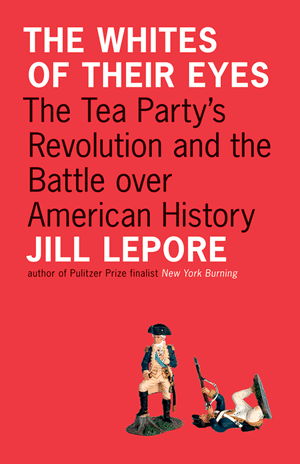
The history blogosphere has been abuzz the last couple of weeks over Gordon Wood's takedown of Jill Lepore in his NYRB treatment of her book, The Whites of Their Eyes. Since I've already expressed my admiration for Lepore's book, I read the review with a certain amount of consternation that grew to bafflement and finally culminated in a small amount of outrage and incredulity. Gordon Wood is, of course, one of our preeminent historians of the Founding period, and Lepore is one of the most interesting (and widely read) historians of the past decade through her sharp and funny essays in the New Yorker. The conflict between them is suggestive not so much of a debate over the past, but of our attitude toward the past and of the purposes of history.

Let's start with Wood. I, like almost everyone, admire Wood's first book, The Creation of the American Republic, and consider his second book, The Radicalism of the American Revolution, a remarkable work in spite of its Whig inclinations. It is, alas, those Whig inclinations that set him against Lepore. For Wood, the Revolution was the archetypal moment that placed the United States on a trajectory toward greatness. It put forth the radical idea of the equality of all men (and women, Wood would have us believe), an idea that "tore through American society and culture with awesome power." You might remember that The Radicalism of the American Revolution received a Pulitzer prize, but praise from academic quarters was not universal. In a 1994 William and Mary Quarterly roundtable on the work, all the participants--Joyce Appleby, Michael Zuckermann, Barbara Clark Smith--expressed some degree of dissatisfaction with Wood's conceptualization and argument. But no one quite got to the major problems with the book--a book, remember, that I admire--like Barbara Clark Smith in her essay, "The Adequate Revolution." Smith argues that Wood's narrative highlights "a single thread, namely the inevitable if sometimes slow expansion of liberty under the American state." As a result, his account is oddly ahistorical, leaving out many of "the society's central and most pressing issues." Focusing especially on women, Smith notes that Wood seeks to credit the Revolution with the achievement of women's rights (even though the Nineteenth Amendment was passed nearly one hundred and fifty years later). This sends her into a fit of incredulity. "The Revolution was not some transhistorical agent that could go marching through the ages to bestow economic, social, or political rights on waiting womankind," Smith objects.

Enter Lepore. The Whites of their Eyes is, as much of anything, a meditation of the uses of history and an objection to the uses to which the Tea Party movement has put the American past. Lepore objects to their "antihistory" that conflates the past with the present and ultimately leads to "historical fundamentalism." This, I think, is the ultimate source of conflict between Lepore and Wood. Lepore spends most of the book offering various stories of the late eighteenth century that undermine a triumphant view of the period--the ways in which slaves, women, the insane, and the poor struggled in a frankly illiberal era--in order to show the strangeness of the past and the limitations that that strangeness imposes when trying to put the past to work in a nationalist celebration or a political movement. But Wood is, in fact, engaged in the nationalist celebration as a central component of his intellectual project. He believes that the United States is in some sense unique in providing a model of liberty for the world, and he looks to the founding moment, much as the Tea Partiers do, in a way that Smith calls "transhistorical."

His review bears out this tension. Wood begins by claiming that "Americans seem to have a special need for these authentic historical figures [such as Washington or Jefferson] in the here and now." But instead of taking this need seriously, Wood complains that Lepore, "an expert at mocking," does what academic historians do by "making fun of the Tea party." In her criticism of the movement's historical malapropisms and strained political gestures, Wood suggests that the book's implicit question is: "Don't these people realize just how silly they are?" This academic elitism further suggests to Wood a misunderstanding of history for "ordinary Americans" that someone like Lepore just can't seem to get.

This is where his review gets really weird. He never quite admits that the Tea Party's history is bad, or that their stance toward it is wrong-headed. Instead, Wood shifts into a discussion of memory, as opposed to history, and the emotional requirement of memory for, again, "ordinary Americans." As opposed to critical history, Wood asserts that ordinary Americans need a variety of mythical interpretations by which "humans have sought to sanctify their societies, buttress their institutions, and invest their lives and their nations with a sense of destiny." At one point Wood suggests that "Lepore is correct in believing that historians have a professional obligation to dispel myths and legends," but then he spends the next eight paragraphs trying to show the emotional thinness of critical history, which seems to suggest that professional obligations run contrary to human need--a somewhat bizarre stance for an intellectual and an educator. Since I've just published a book that seeks to dispel a myth (The Myth of Religious Freedom) I read this section of the review with great interest, but the more I think about it, the less it makes sense. It seems to be nothing so much as an intellectual defense of anti-intellectualism. He seems, against all protestations to the contrary, to be faulting the historian Jill Lepore for being (wait for it) . . . a historian!

At bottom, his conclusion seems to be that you must not be critical if you write a history that culminates in or intersects with the present. You must be sensitive to the human need to use history to cloth our lives with destiny. You must remain subservient to nationalist imperatives or risk being an academic snob. You must, in other words, be Gordon S. Wood.

Selasa, 16 November 2010

Jill Lepore on Presentism

David Sehat

Jill Lepore's new book, The Whites of Their Eyes: The Tea Party's Revolution and the Battle Over History (Princeton: Princeton UP, 2010), has been garnering much-deserved attention for the past few months. Building on an article in the New Yorker, Lepore seeks to show how fanatical and antihistorical are much of the Tea Party and its many boosters (Glenn Beck, etc.) in their pronouncements about history and their reverence for the Founding Fathers. By juxtaposing pieces of reportage at Tea Party events with stories about the Founders and others in the Founding generation such as Phyllis Wheatley and Jane Mecom, Lepore shows multiple ways in which the eighteenth century fails by our contemporary standards of decency and justice. Yet she also simultaneously manages to humanize the founding generation. It's quite a trick, one that I wish I could figure out so that I could emulate. Her perspective is clear--she does not agree with Tea Partiers about much of anything--but even when she calls the Tea Partiers devotees of "historical fundamentalism" she seems reasonable and humane, like she is interested in having a conversation rather than simply passing judgment.

If anything, she seems to blame not so much the Tea Party as historians. Or maybe blame isn't the right word. Lepore argues that the Tea Party's version of history (or, rather, antihistory) began in the 1970s with the Bicentennial Celebration. Angry at the social protests and dislocations from the late 60s and early 70s, historical fundamentalists reacted angrily to what they as as the besmirching of national character perpetuated by leftists. But Lepore actually places a fair amount of responsibility--a better word than blame--on historians for the sorry state of affairs. She writes:

That reactionary history has simmered for decades and went, for the most part, unchallenged, because 1970 marked the end of an era in the writing of American history: [Richard] Hofstadter would turn out to have been one of the last university professors of American history to reach readers outside the academy with sweeping interpretations both of the past and of his own time. For much of its history, the American historical profession has defined itself by its dedication to the proposition that looking to the past to explain the present--and especially to solve present-day problems--falls outside the realm of serious historical inquiry. That stuff is for amateurs, toadies, and cranks. Historians decry the fallacy of "presentism": to see the past as nothing more than a prologue to the present introduces evidentiary and analytical distortions and risks reducing humanistic inquiry into shabby self-justification. Hofstadter recognized the perils of presentism, but he believed that historians with something to say about the relationship between the past and present had an obligation to say it, as carefully as possible, by writing with method, perspective, skepticism, and an authority that derived not only from their discipline but also from their distance from the corridors of power.

I read Lepore's book as an attempt to diagnose the present by looking to the past, providing a model for historically informed analysis of the present and calling on others to do the same. But I also wonder if Lepore isn't calling for something that is already happening. Off the top of my head, I can think of several recent books by junior scholars that engage the public and have significant relevance for understanding the present: Bethany Moreton's To Serve God and Walmart (2009), Stephen P. Miller's Billy Graham and Rise of the Republican South (2008), Daniel K. Williams's God's Own Party: The Making of the Christian Right (2010), Jennifer Burns's Goddess of the Market: Ayn Rand and the American Right (2009), and (not a junior scholar) James Kloppenberg's Reading Obama: Dreams, Hopes, and the American Political Tradition (2010). My own book (ahem), The Myth of American Religious Freedom (2011), also quite explicitly seeks to explain the present by appealing to the past. I'm sure there are others. All of this suggests to me that the narrowly professional model of historical writing might not be as dominant as it was in the past, with many historians seeking to reach a broader public in order to frame public discussions from a proper historical perspective.

But I also wonder if it matters. Put another way, Lepore seems to suggest that if historians had not abandoned the public sphere to write technical and professional monographs that the Tea Party's history might have been stopped. She writes, "Historians mocked the Bicentennial as schlock and its protests as contrived but didn't offer an answer, a story, to a country that needed one. That left plenty of room for a lot of other people to get into the history business." But let's say we all starting writing the kinds of history that Hofstader wrote. And let's say that the we did it with even a fraction of his stylistic grace and critical acumen. Given the bully pulpit of Fox News and the fantasy history of Glenn Beck, which after all, tells people what they want to hear, would it actually change anything? After seeing Glenn Beck's following, his multimillion dollar platform on multiple media outlets, and his ability to twist history any way he wishes, I ask myself: how can I compete with that? How can anyone compete with that?

Jill Lepore on Presentism

David Sehat

Jill Lepore's new book, The Whites of Their Eyes: The Tea Party's Revolution and the Battle Over History (Princeton: Princeton UP, 2010), has been garnering much-deserved attention for the past few months. Building on an article in the New Yorker, Lepore seeks to show how fanatical and antihistorical are much of the Tea Party and its many boosters (Glenn Beck, etc.) in their pronouncements about history and their reverence for the Founding Fathers. By juxtaposing pieces of reportage at Tea Party events with stories about the Founders and others in the Founding generation such as Phyllis Wheatley and Jane Mecom, Lepore shows multiple ways in which the eighteenth century fails by our contemporary standards of decency and justice. Yet she also simultaneously manages to humanize the founding generation. It's quite a trick, one that I wish I could figure out so that I could emulate. Her perspective is clear--she does not agree with Tea Partiers about much of anything--but even when she calls the Tea Partiers devotees of "historical fundamentalism" she seems reasonable and humane, like she is interested in having a conversation rather than simply passing judgment.

If anything, she seems to blame not so much the Tea Party as historians. Or maybe blame isn't the right word. Lepore argues that the Tea Party's version of history (or, rather, antihistory) began in the 1970s with the Bicentennial Celebration. Angry at the social protests and dislocations from the late 60s and early 70s, historical fundamentalists reacted angrily to what they as as the besmirching of national character perpetuated by leftists. But Lepore actually places a fair amount of responsibility--a better word than blame--on historians for the sorry state of affairs. She writes:

That reactionary history has simmered for decades and went, for the most part, unchallenged, because 1970 marked the end of an era in the writing of American history: [Richard] Hofstadter would turn out to have been one of the last university professors of American history to reach readers outside the academy with sweeping interpretations both of the past and of his own time. For much of its history, the American historical profession has defined itself by its dedication to the proposition that looking to the past to explain the present--and especially to solve present-day problems--falls outside the realm of serious historical inquiry. That stuff is for amateurs, toadies, and cranks. Historians decry the fallacy of "presentism": to see the past as nothing more than a prologue to the present introduces evidentiary and analytical distortions and risks reducing humanistic inquiry into shabby self-justification. Hofstadter recognized the perils of presentism, but he believed that historians with something to say about the relationship between the past and present had an obligation to say it, as carefully as possible, by writing with method, perspective, skepticism, and an authority that derived not only from their discipline but also from their distance from the corridors of power.

I read Lepore's book as an attempt to diagnose the present by looking to the past, providing a model for historically informed analysis of the present and calling on others to do the same. But I also wonder if Lepore isn't calling for something that is already happening. Off the top of my head, I can think of several recent books by junior scholars that engage the public and have significant relevance for understanding the present: Bethany Moreton's To Serve God and Walmart (2009), Stephen P. Miller's Billy Graham and Rise of the Republican South (2008), Daniel K. Williams's God's Own Party: The Making of the Christian Right (2010), Jennifer Burns's Goddess of the Market: Ayn Rand and the American Right (2009), and (not a junior scholar) James Kloppenberg's Reading Obama: Dreams, Hopes, and the American Political Tradition (2010). My own book (ahem), The Myth of American Religious Freedom (2011), also quite explicitly seeks to explain the present by appealing to the past. I'm sure there are others. All of this suggests to me that the narrowly professional model of historical writing might not be as dominant as it was in the past, with many historians seeking to reach a broader public in order to frame public discussions from a proper historical perspective.

But I also wonder if it matters. Put another way, Lepore seems to suggest that if historians had not abandoned the public sphere to write technical and professional monographs that the Tea Party's history might have been stopped. She writes, "Historians mocked the Bicentennial as schlock and its protests as contrived but didn't offer an answer, a story, to a country that needed one. That left plenty of room for a lot of other people to get into the history business." But let's say we all starting writing the kinds of history that Hofstader wrote. And let's say that the we did it with even a fraction of his stylistic grace and critical acumen. Given the bully pulpit of Fox News and the fantasy history of Glenn Beck, which after all, tells people what they want to hear, would it actually change anything? After seeing Glenn Beck's following, his multimillion dollar platform on multiple media outlets, and his ability to twist history any way he wishes, I ask myself: how can I compete with that? How can anyone compete with that?