Tampilkan postingan dengan label presentism. Tampilkan semua postingan

Selasa, 28 Agustus 2012

Kevin Mattson on his own behalf


(Guest post.)
1.
Returning to the debate…

Andrew Hartman’s a smart guy.  He wrote a thoughtful critique of my work (here and here).  But his timing, at least for me, was poor.  He posted just as I was leaving for a two and a half month sojourn into the wilds of Oregon and Washington on the Pacific Crest Trail with my wife, kid, and dog (for those who want a bit more, see these photos).  Now back, I appreciate the opportunity to reengage the debate that Hartman sparked.
 
Though I agree with much of what Andrew said in his pieces, it’s probably no surprise that I also disagree.  I’ll be roundabout in engaging his arguments, starting in one place and circling out to others and then coming back to the debate he most wanted to prompt.

Hartman fails to mention something crucial in the Old Right constellation (let’s say the early 1950s to demarcate the time-frame here) when he contrasts it to the neoconservatism of the 1960s: The centrality of McCarthyism and the heated rhetoric used against Adlai Stevenson and liberalism during the 1952 election.  I deal with this in greater detail in my book, Just Plain Dick: Richard Nixon’s Checkers Speech and the “Rocking, Socking” Election of 1952, and so allow me to elaborate to begin our debate.


The conservative mind has always been hell-bent on tracking down a betrayal among elites (that’s why a “populist turn” was not that difficult to make early-on).  During the 1950s, the target became “eggheads” – Harvard-centered liberals (think Arthur Schlesinger, Jr. or John Kenneth Galbraith) giving advice to the king egghead of them all, Adlai Stevenson.  Nixon accused Stevenson of holding a “Ph.D. from Dean Acheson’s Cowardly College of Communist Containment,” an alliteration that pummeled Stevenson as a traitor to his country.  America needed to elect a “real man,” another term Nixon used.  Adlai Stevenson, Nixon said numerous times, lacked “backbone.”  Joseph McCarthy (the gruff ally of Richard Nixon in 1952 and a man who had campaigned for him earlier during his 1950 Senate-run) talked about physically assaulting the “debonair” Democrat (no “ic” added there) candidate for President.  McCarthy, like Nixon, loved a good fight – a tough fight.  Liberals had silver spoons in their mouths and were sissies.  They were indecisive and wimpy.  Both Nixon and McCarthy conflated a real communist sympathizer, Alger Hiss, with an anti-communist and fairly conservative-leaning liberal, Adlai Stevenson.  That was a part of their intellectual-political toolkit and worldview. And it became a central feature of so much conservative political thought during the postwar years.

Enough about political campaigns.  Consider, in light of where we’re having this debate, two intellectuals.  First and foremost Whittaker Chambers, whose book Witnesscame out in 1952 (Nixon did what he could to promote his ally’s book).  Witnessderided “the most articulate section of mankind” (codeword: educated) for betraying the country by ceasing to “believe in God” and giving into communist dreams of remaking the world.  Alger Hiss was the icon here.  The book set the tone of so much conservative work from that point onwards – apocalyptic, melodramatic, and grandiose.  Central in it was something Chambers overheard from a friend of Henry Luce’s: “In the United States, the working class are Democrats.  The middle class are Republicans.  The upper class are Communists.”  

The second intellectual, and this starts getting us to the point that Andrew wanted to engage the most, is Irving Kristol.  Writing about “liberals” in 1952 (seemingly he still was one – though it depended on what the term meant), Kristol contrasted them to Joseph McCarthy.  In one of the most quoted lines from the essay (used in the documentary, Arguing the World, and Neil Jumonville’s The New York Intellectuals Reader), Kristol worried: “There is one thing that the American people know about Senator McCarthy: he, like them, is unequivocally anti-Communist.  About the spokesmen for American liberalism, they feel they know no such thing.  And with some justification.”  The person he cites to make his case is Henry Steele Commager, professor of history at Columbia University and one of many eggheads who would later go on to protest Eisenhower’s run for the presidency.

Kristol’s point, I think, was that the style mattered – that it was McCarthy’s gruffness that attracted many to his side.  Liberals lacked the spirit of the fight, because they also worried about something called “civil liberties.”  McCarthy’s assured style mattered in the common perception of him as a fighter against liberal pansies who had too many self-tormented doubts.  Kristol wasn’t endorsing McCarthy here, but he was putting an idea on the table that neoconservatives would come back to later after the sixties: That liberal elites (the term “new class” wasn’t used at this point – the huge explosion in higher education was still emerging as a major social factor) betrayed their country and lacked legitimacy in the eyes of the American public.

2.
Style versus substance and good versus bad presentism…

Andrew suggests I pick up on style too much rather than substance.  I realize I’m not in great standing if I defend style over substance.  Nonetheless, my undergraduate students have taught me that style and substance are inseparable every time they complain that I’ve graded their essays on writing (usually my “awkward prose” comments litter their margins) rather than their ideas or arguments.  Over and over, I have to explain that how you communicate your ideas – your tone, clarity, verve or lackthereof – is wedded to substance.  “If you can’t state your case, you don’t have a case,” I have said to many a perturbed younger writer.  There’s of course a fancy tradition of linguistic philosophy I could cite here, but why bother?  What I suggested in Rebels All! is that the style of contemporary conservatives – apocalyptic, fabulist in orientation, insular, aggressive – tells us a great deal about the substance of their ideas.  Hard right writers create hard right prose and communicate the nature of their ideas in doing so.  Andrew wants to separate out these two areas too quickly (and I should point out that one of the commenters on Andrew’s piece pointed this out better than I can).

This style argument is also tied to my defense of the liberal tradition in American ideas.  I must take aim at Hartman’s conflation of my interpretation of postwar liberalism with that of Peter Beinart (author of The Good Fight).  Indeed, I reviewed Beinart’s book in the Boston Review.  I spent a great deal of time showing that Beinart’s book was sloppy and full of historical analogies that didn’t work.  I am by all means a presentist, but I also see the inherent dangers of writing presentist history.  It’s rather easy to conflate the 9/11 period with the early years of the Cold War and to do so in a bad, sloppy, and rushed way.  Personally, I was shocked by Peter Beinart’s shock in the opening pages of The Good Fight where he confessed that he overvalued America’s legitimacy abroad and underestimated George W. Bush’s incompetence.  This coming from someone who had read Reinhold Niebuhr?!  Good presentism would have raised more doubts about our prospects of exporting democracy.  It would make us appreciate an insight of postwar liberalism: That irony and humility are necessary guards against self-assured expansion of American power.  That style, the way you hold your ideas and worldview, often guide the way you do things in the world.

So, yes, I’m a presentist less concerned with historiography and academic debates than I am in understanding the world I occupy.  On that, Andrew is certainly right.  I have just assigned George Orwell’s essays on writing for an upcoming graduate student course.  I am reminded in rereading Orwell that his motivation in writing – political and engaged – was always mine.  I cut my teeth and came into a great deal of my knowledge not from academe but from activism.  I learned to write for political publications and punk rock fanzines.  I also am suspicious that “new” ideas in historiography are as important as they often appear.  When I entered graduate school, there was still a great deal of interest in the prospect of labor and social history saving the historical profession as well as growing interest in Western Marxist theory to orient historical explorations (I was at the hotbed for that project during graduate school – the University of Rochester).  Remember how feminist historians touted the virtues of deconstruction as a method for rewriting history – a la Joan Scott (for more on this point, I point readers here)?  What happened to all of that, I’m left wondering today.  Historiography is largely a dustbin of trendy ideas that get put on for a number of years and then discarded.  The only thing we have left today, as far as I can tell, is a bricolage of ideas and orientations, none of which promise to orient our intellectual work with assuredness.  Perhaps such a statement consigns me to being on no graduate reading lists, as Andrew suggests.

3.
Politics

A simpler and cleaner point.  I sense Andrew and I disagree on politics.  He appears much more of a leftist; I’m a liberal.  Some of his criticisms seem less about the substance of my own argument and getting things wrong and more with my own political conclusions.  As I recall, he didn’t care for my critique of Howard Zinn and other far lefties that I made a number of years ago.  It’s not about the popularization but about the conclusions you draw and where they point you politically.  Andrew goes much further in a left direction than I do.  This is not the place for me to elaborate on all of the ins and outs of the differences between liberals and leftists.

4.

The debate about neocons that Andrew wanted to have…

Finally, the chief point that Andrew wanted most to debate, and this brings me back to my opening.  Andrew doesn’t like that I conflate the neoconservative critique (1960s onwards) with the Old Right intellectual hatred of liberal elites (1950s).  There are rarely direct lines in history (unlike Corey Robin, I don’t see straight lines, for instance, from Burke to Palin), but I’m pretty sure about thisdirect line.  I admit to a suspicion when anyone claims they are a “new” or “neo” anything.  I think that’s probably a historian’s natural inclination.  No doubt, the neoconservatives Andrew has in mind claimed the altar of uniqueness.  They felt uncomfortable being associated with WASP or Catholic curmudgeons, like Whittaker Chambers or William F. Buckley.  They were Jews educated in an urban milieu.  They believed in “social science” rather than purely moralistic arguments.  They had been mugged by the sixties.  They had “new” ideas to add to the debate.

True, true, true.  The “new class” conception had its own roots.  An entire book could be written about the idea (hell, an entire edited book was published about the idea).  Indeed, the conception of a new class had much deeper roots than the sixties.  Andrew knows that many of its roots went farther back to Thorstein Veblen’s idea of “engineers” clashing with capitalist owners, to the Trostkyist critique of Stalin’s supposed “betrayal” of the Soviet revolution, to Lionel Trilling’s conception of modernism’s “adversary” tendencies.  Daniel Bell – the sociologist who helped neoconservative arguments along the way until he balked at Kristol’s ideological hardening and recognized his own liberal beliefs – knew about all of these different roots and called the concept of a “new class” a “muddled” concept.  He was right.

My point is that the “new class” idea mimicked and helped reproduce, much more than the neoconservatives might have thought, that older idea of educated elites selling out the country to communism.  Who was Alger Hiss and who was Dean Acheson and who was Adlai Stevenson?  Well, they were all men who attended good schools because their families could afford them and yet who betrayed the ballast of western civilization.  The terms “egghead” and “new class” share more than we might at first think if we think about how the terms operate in political debate.  Most important of all, hardening a critique of a “new class” helped someone like a Kristol create a more populist tone to his work – a tone that he had once rejected during the mid-1960s and early 1970s (for more on this, see my essay about Kristol here).  Neoconservatives might have thought of themselves as social scientists in the pages of the Public Interest, but that would never have satisfied Kristol.  He wanted a movement, based around certain moral and political ideas, to take back the country from the liberal new class.  And who could blame him, if such ideas were always supposed to be about more than just academic ponderings?  Social scientific arguments weren’t enough.  He returned to the language of the Old Conservative right – one that was charged and moralistic – in order to fuel a political agenda.  I would suggest that the idea of a new class helped him get to this point.

So too Norman Podhoretz in the realm of foreign policy.  He would return to the spirit of Joseph McCarthy by the late 1970s, suggesting that a liberal elite (effeminate, perhaps even homosexual, and certainly cautious) had lost the Vietnam War.  That echoed the war at home that worried Irving Kristol once the Cold War had ended. In 1993, Kristol wrote, "My cold war has increased in intensity, as sector after sector of American life has been ruthlessly corrupted by the liberal ethos. It is an ethos that aims simultaneously at political and social collectivism on the one hand, and moral anarchy on the other."  The language of war was the language of politics, of course.  Social science wouldn’t win a war.  But a class warfare argument just might.  And so the neoconservatives were right back to the language of Nixon (the 1952 Nixon, I would argue, as much as the 1972 Nixon who Kristol supported) and McCarthy as they vocalized a politics they thought could win the nation back from the perils of liberalism.  The 1960s and the culture wars mattered here for sure.  But my point is that the lineage was there to build upon already.  

Kamis, 09 Agustus 2012

James Livingston's Comedy of History

[Today I offer you a guest post from long-time USIH blog and conference participant, William "Bill" Fine. Enjoy! - TL]

In reviewing Jim Livingston’s recent USIH articles and a few posts in his Politics and Letters blog* I’m persuaded that he speaks out of a deeply personal desire to advance a view of history that supports present and future hopes---in spite of his assertion that the priority must be on “going back” to recover historical contexts. [“Museum”]

Livingston might be seen to contradict himself in declaring that the past both exists and does not exist, or that history can be a guide and yet be open to whatever meanings we might project onto it. For him, knowledge of reality is mediated by language and other cultural forms, it’s “what we can act upon,” so “the past as such [is] indistinguishable from what we have said about it.” At the same time, he makes numerous truth-claims. For example, he’s annoyed that Paul Murphy allegedly didn’t practice sufficient “estrangement” from the ‘20s context, on the assumption that it’s a foreign world. But the warrant for that truism isn’t obvious. It’s not that Murphy draws lessons from the past, it’s that he misunderstands its relation to our “different” historical moment, and so draws the wrong lessons. Maybe we can’t understand ‘20s intellectuals without “going back,” but we have to understand them before we can assume the need to do so. [“Museum”]

Both Livingston and his interlocutors soften contradictions into paradoxes that seem to capture the multi-dimensional character of historical practice. Two of Livingston’s best are: “You can’t ‘go back’ to the past without the conviction that it’s always already different from the present, but when you feel you’re just catching up with something from the past, that difference is erased”; and “the past is both real and artificial. Like God, it’s consequential because we created it. The past is what we make of it…but we make it from these raw materials, and meanwhile they make us.” [“Museum”]


Ray Haberski generously finds in the latter a way “around” the either/or of determinism versus freedom, while Dan Wickberg opines that inconsistency is a matter of perception, and at least our modern critical tools protect us from the temptations of totalism. [“Museum”] Along similar lines, William Cronon, in “Loving History,” in Perspectives on History, sees “two fundamentally competing orientations for approaching history”---summarized as "how did things get to be this way?" and “the past is a foreign country.” But he concludes that, if history is to retain its attraction for professionals and others, “we need them both.” What Livingston said of the Rutgers conference on W.A. Williams into might apply here: “there was too much consensus, too little conflict.”

We could shift from logic to rhetoric, to see where and how Livingston deploys points that otherwise might be thought irreconcilable. Sometimes, in criticizing another historian, such as Paul Murphy, or advancing his own positions, he implies a fairly certain knowledge, saying that some views “deny reality,” while others accord with “the world as it actually exists.” There is no particular reason not to take him at his word, as others do in responding to his truth-claims. But at other junctures, to defend against the charge he isn’t a proper historian, he adopts a different rhetoric, asserting at one point that there’s no “practical difference between history, the past as such, and historiography, our interpretations of the past, because all we actually know about the past is contained in those interpretations.” [“Williams”]

The past has a number of discrete though related meanings in his work. Sometimes it’s the almost infinitely plastic material we shape in acts of knowing, as if the very idea of representation implies a closed reality. At other times the past possesses “legibility,” a metaphor he uses repeatedly. The term implies something pre-constituted as text-like, decipherable by historical actors and historians. So, for ‘20s intellectuals, the divide between traditional and modern “became legible…as fundamental change in the meanings of work, labor, and necessity.” [“Museum”] In his article on W.A. Williams, “historical circumstances” themselves are described as directly legible, as are both the “original intent” of the Open Door and the immanence of our “ethical principles” in that setting.

On the other hand, the past is presented as virtually created and cumulatively enriched through narrativizing. In his blog, discussing Edward St. Aubyn’s “Patrick Melrose” novels dealing with the trauma of a main character raped by his father, Livingston criticizes those who say it’s a denial of real suffering to read such events as only “fantasy,” since in themselves they are “meaningless.” [“Pol and Letters” - 5.2.12]. Some might insist instead that human events are by definition meaningful, though it’s not clear how much difference it makes -- to the traumatized, for instance---whether stories recount things that actually occurred. Still, if events lack their own legibility, in what sense can they be “falsified” by narratives, except by contrast to some other unnamed device? In any case, here narratives produced over time by different actors accumulate richer meanings, redeeming traumatic pasts, rendering events “significant…as moments in a meaningful sequence,” a story that can be retold. [“Politics and Letters” - 5.18.12]

Livingston’s freewheeling constructionism implies an ontological and epistemological pluralism that stands over against what he calls “metaphysical” accounts that presume an objective, realist history, a “Totalism” or “Absolute”; monolithic, deterministic, and typically declensionist. As he puts it at one point, “the truth of historical reality is always plural. The rhetorics are the reality.” [“Museum”] Perhaps he tends to universalize the interpretive chaos of our historical moment; either way, that wouldn’t prove we don’t live in a block universe after all.

Sometimes he goes further, insisting that good history confirms an emancipatory potential immanent in the historical process, and that history tends toward the good---or will if we think and act properly. For example, in his article on Williams, Livingston writes approvingly that:

“Williams assumed that a post-imperialist future was legible in the original intent of what he called the “imperialism of idealism” and in the real differences over diplomatic means and ends…. Without that assumption,…his critique…stops making sense because its fulfillment would then require the evasion of the world as it actually exists [which] would not allow for history as a way of learning. If the ethical principles of a post-imperialist future do not reside in the historical circumstances…then our only honorable recourse is to repudiate and escape those circumstances….”

Later, in the same essay, he generalizes what’s at stake:

“When people start wishing that things were better and assuring you that they won’t be, largely because nothing has ever changed except for the worse, you know that you’re in the presence of Kantian radicals who lack, or despise, historical consciousness---you’re in the presence of metaphysicians who know the past cannot be a guide to the present because it is the repository of myths, lies, deceptions, and their attendant moral atrocities.”

Livingston is fond of drawing a contrast between Kant and Hegel [though he seems to mention the former by name more than the latter], which he understands in part as the contrast between a morality that stands apart from and tries to impose itself on the world, and one that sees morality to “reside in and flow from historical circumstances,” as he wrote in his “Response to Cotkin.” [JHI 69, 1, April 2008] This may be taken as a descriptive sociological point---and Livingston among others have shown how “the social self” developed out of the interaction of Hegelian idealism and pragmatism, along with feminism. But to me this is quite different than using it to build a philosophy of history.

In “Socialism Without Socialists” [“Politics and Letters” - 7.25.12] Livingston challenges the pessimists of the left, using the terms of Kant vs Hegel to frame a stark choice: one embraces the present, recognizes that the left is everywhere, and “sees the ethical principles of socialism residing in and flowing from historical circumstances…not as ideas imposed from elsewhere,” partly because cultural has replaced political change. The other, from a fixed point of moralistic purity, gives up on a hopeless world, taking refuge in a saving remnant with no one to save, “leading us away from the world as it is.”

Whatever case might be made for Livingston’s argument that the left has been victorious, here he gives full-out expression to a historical teleology almost beyond intention or agency, a progressive conductorless orchestration that “recognize[s] what we ought to be doing in what we’re already doing.” [cf. his quotation of an early, still very Hegelian Dewey in the Williams article] Unless we accept these ideas, we’re denying reality and destroying all hope and possibility; the study of the past must affirm what present circumstances demand.

At the outset I speculated that Livingston is motivated by “deeply personal desire,” which of course goes far beyond what I could know, much less demonstrate, and it’s not terribly relevant anyway in assessing his work. I’m not sure how much is accountable as an act of will in depressing times, and how much flows from a secure confidence in his comic-religious, metaphysical vision. Because he so often frames his arguments in terms of the either/or of hope vs. despair, my guess is that there’s a good bit of trying in his believing. His efforts to show empirically that left-liberalism has “won” notwithstanding, my guess is that most people will see it as a framework brought to history---a leap of sorts---rather than supported by it. Indeed, if he is as much of a Hegelian as I think, it’s not easy to see how it ever could be, partly because we’re not done yet.

Anyway, seeing what comedy sometimes makes of irony, I miss a sense of the obdurate, of difficult trade-offs, the complexities of unintended consequences, the limitations of narrative----and a sense of the past as/in the present, the world to which we accommodate ourselves. I’m inclined to read his comic teleology as more a reflex of its historical moment than a way beyond.

 ---------------------------
 * I draw on the following sources and indicate them following quotations:

 USIH

- “Near Dark at the Museum,” 7/12/12; and
- “William Appleman Williams: Fifty Years After His Book on the Tragedy of American Diplomacy,” 7/19/12.

Politics and Letters

a. “The Weight of the Past,” Part 1 (4/22/12), Part 2 (5/2/12), and Part 3 (5/18/12);

b.  “Socialism Without Socialists, or, What’s the Matter With Leftists?” 7/25/12.

Selasa, 16 November 2010

Jill Lepore on Presentism

David Sehat

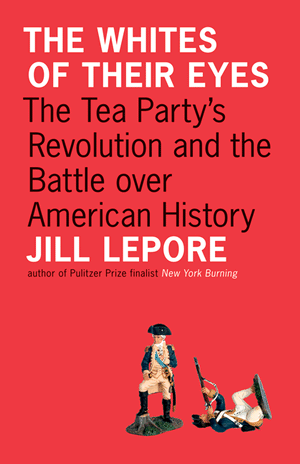
Jill Lepore's new book, The Whites of Their Eyes: The Tea Party's Revolution and the Battle Over History (Princeton: Princeton UP, 2010), has been garnering much-deserved attention for the past few months. Building on an article in the New Yorker, Lepore seeks to show how fanatical and antihistorical are much of the Tea Party and its many boosters (Glenn Beck, etc.) in their pronouncements about history and their reverence for the Founding Fathers. By juxtaposing pieces of reportage at Tea Party events with stories about the Founders and others in the Founding generation such as Phyllis Wheatley and Jane Mecom, Lepore shows multiple ways in which the eighteenth century fails by our contemporary standards of decency and justice. Yet she also simultaneously manages to humanize the founding generation. It's quite a trick, one that I wish I could figure out so that I could emulate. Her perspective is clear--she does not agree with Tea Partiers about much of anything--but even when she calls the Tea Partiers devotees of "historical fundamentalism" she seems reasonable and humane, like she is interested in having a conversation rather than simply passing judgment.

If anything, she seems to blame not so much the Tea Party as historians. Or maybe blame isn't the right word. Lepore argues that the Tea Party's version of history (or, rather, antihistory) began in the 1970s with the Bicentennial Celebration. Angry at the social protests and dislocations from the late 60s and early 70s, historical fundamentalists reacted angrily to what they as as the besmirching of national character perpetuated by leftists. But Lepore actually places a fair amount of responsibility--a better word than blame--on historians for the sorry state of affairs. She writes:

That reactionary history has simmered for decades and went, for the most part, unchallenged, because 1970 marked the end of an era in the writing of American history: [Richard] Hofstadter would turn out to have been one of the last university professors of American history to reach readers outside the academy with sweeping interpretations both of the past and of his own time. For much of its history, the American historical profession has defined itself by its dedication to the proposition that looking to the past to explain the present--and especially to solve present-day problems--falls outside the realm of serious historical inquiry. That stuff is for amateurs, toadies, and cranks. Historians decry the fallacy of "presentism": to see the past as nothing more than a prologue to the present introduces evidentiary and analytical distortions and risks reducing humanistic inquiry into shabby self-justification. Hofstadter recognized the perils of presentism, but he believed that historians with something to say about the relationship between the past and present had an obligation to say it, as carefully as possible, by writing with method, perspective, skepticism, and an authority that derived not only from their discipline but also from their distance from the corridors of power.

I read Lepore's book as an attempt to diagnose the present by looking to the past, providing a model for historically informed analysis of the present and calling on others to do the same. But I also wonder if Lepore isn't calling for something that is already happening. Off the top of my head, I can think of several recent books by junior scholars that engage the public and have significant relevance for understanding the present: Bethany Moreton's To Serve God and Walmart (2009), Stephen P. Miller's Billy Graham and Rise of the Republican South (2008), Daniel K. Williams's God's Own Party: The Making of the Christian Right (2010), Jennifer Burns's Goddess of the Market: Ayn Rand and the American Right (2009), and (not a junior scholar) James Kloppenberg's Reading Obama: Dreams, Hopes, and the American Political Tradition (2010). My own book (ahem), The Myth of American Religious Freedom (2011), also quite explicitly seeks to explain the present by appealing to the past. I'm sure there are others. All of this suggests to me that the narrowly professional model of historical writing might not be as dominant as it was in the past, with many historians seeking to reach a broader public in order to frame public discussions from a proper historical perspective.

But I also wonder if it matters. Put another way, Lepore seems to suggest that if historians had not abandoned the public sphere to write technical and professional monographs that the Tea Party's history might have been stopped. She writes, "Historians mocked the Bicentennial as schlock and its protests as contrived but didn't offer an answer, a story, to a country that needed one. That left plenty of room for a lot of other people to get into the history business." But let's say we all starting writing the kinds of history that Hofstader wrote. And let's say that the we did it with even a fraction of his stylistic grace and critical acumen. Given the bully pulpit of Fox News and the fantasy history of Glenn Beck, which after all, tells people what they want to hear, would it actually change anything? After seeing Glenn Beck's following, his multimillion dollar platform on multiple media outlets, and his ability to twist history any way he wishes, I ask myself: how can I compete with that? How can anyone compete with that?

Jill Lepore on Presentism

David Sehat

Jill Lepore's new book, The Whites of Their Eyes: The Tea Party's Revolution and the Battle Over History (Princeton: Princeton UP, 2010), has been garnering much-deserved attention for the past few months. Building on an article in the New Yorker, Lepore seeks to show how fanatical and antihistorical are much of the Tea Party and its many boosters (Glenn Beck, etc.) in their pronouncements about history and their reverence for the Founding Fathers. By juxtaposing pieces of reportage at Tea Party events with stories about the Founders and others in the Founding generation such as Phyllis Wheatley and Jane Mecom, Lepore shows multiple ways in which the eighteenth century fails by our contemporary standards of decency and justice. Yet she also simultaneously manages to humanize the founding generation. It's quite a trick, one that I wish I could figure out so that I could emulate. Her perspective is clear--she does not agree with Tea Partiers about much of anything--but even when she calls the Tea Partiers devotees of "historical fundamentalism" she seems reasonable and humane, like she is interested in having a conversation rather than simply passing judgment.

If anything, she seems to blame not so much the Tea Party as historians. Or maybe blame isn't the right word. Lepore argues that the Tea Party's version of history (or, rather, antihistory) began in the 1970s with the Bicentennial Celebration. Angry at the social protests and dislocations from the late 60s and early 70s, historical fundamentalists reacted angrily to what they as as the besmirching of national character perpetuated by leftists. But Lepore actually places a fair amount of responsibility--a better word than blame--on historians for the sorry state of affairs. She writes:

That reactionary history has simmered for decades and went, for the most part, unchallenged, because 1970 marked the end of an era in the writing of American history: [Richard] Hofstadter would turn out to have been one of the last university professors of American history to reach readers outside the academy with sweeping interpretations both of the past and of his own time. For much of its history, the American historical profession has defined itself by its dedication to the proposition that looking to the past to explain the present--and especially to solve present-day problems--falls outside the realm of serious historical inquiry. That stuff is for amateurs, toadies, and cranks. Historians decry the fallacy of "presentism": to see the past as nothing more than a prologue to the present introduces evidentiary and analytical distortions and risks reducing humanistic inquiry into shabby self-justification. Hofstadter recognized the perils of presentism, but he believed that historians with something to say about the relationship between the past and present had an obligation to say it, as carefully as possible, by writing with method, perspective, skepticism, and an authority that derived not only from their discipline but also from their distance from the corridors of power.

I read Lepore's book as an attempt to diagnose the present by looking to the past, providing a model for historically informed analysis of the present and calling on others to do the same. But I also wonder if Lepore isn't calling for something that is already happening. Off the top of my head, I can think of several recent books by junior scholars that engage the public and have significant relevance for understanding the present: Bethany Moreton's To Serve God and Walmart (2009), Stephen P. Miller's Billy Graham and Rise of the Republican South (2008), Daniel K. Williams's God's Own Party: The Making of the Christian Right (2010), Jennifer Burns's Goddess of the Market: Ayn Rand and the American Right (2009), and (not a junior scholar) James Kloppenberg's Reading Obama: Dreams, Hopes, and the American Political Tradition (2010). My own book (ahem), The Myth of American Religious Freedom (2011), also quite explicitly seeks to explain the present by appealing to the past. I'm sure there are others. All of this suggests to me that the narrowly professional model of historical writing might not be as dominant as it was in the past, with many historians seeking to reach a broader public in order to frame public discussions from a proper historical perspective.

But I also wonder if it matters. Put another way, Lepore seems to suggest that if historians had not abandoned the public sphere to write technical and professional monographs that the Tea Party's history might have been stopped. She writes, "Historians mocked the Bicentennial as schlock and its protests as contrived but didn't offer an answer, a story, to a country that needed one. That left plenty of room for a lot of other people to get into the history business." But let's say we all starting writing the kinds of history that Hofstader wrote. And let's say that the we did it with even a fraction of his stylistic grace and critical acumen. Given the bully pulpit of Fox News and the fantasy history of Glenn Beck, which after all, tells people what they want to hear, would it actually change anything? After seeing Glenn Beck's following, his multimillion dollar platform on multiple media outlets, and his ability to twist history any way he wishes, I ask myself: how can I compete with that? How can anyone compete with that?

Rabu, 07 Juli 2010

History in the Intertubes

Having engaged in some long-form commenting below, here's a little short-form blogging on three topics of interest to this blog and its readers:

1) David Lowenthal, author of the terrific The Past is a Foreign Country, thinks we are become more presentist, which is not a good thing. I'm not sure if the "we" Lowenthal has in mind is Americans or people in the twenty-first century (it's certainly not historians). I'm also honestly not sure whether or not I agree with Lowenthal's diagnosis of rising presentism (though I'd agree that presentism is generally not a good thing). What d'ya think?

2) Based on a forthcoming U.S. Department of Education study, the Chronicle of Higher Education declares tenure dead. HNN asks readers to comment on what should be done now that it is. Predictably (given HNN comment threads) the first response consists of someone dancing on tenure's grave. Is tenure dead or merely dying? Either way, what is to be done? And, finally, why does HNN have such godawful comment threads?

3) Following a lot of recent lobbying from various quarters, Ulysses S. Grant is slowly climbing the presidential ratings charts. Currently he's ascended from bottom tier to middle of the pack. Where does he belong? And which, if any, of the changing views of Grant is most presentist? [h/t to Scott Lemieux at Lawyers, Guns and Money, who expresses justified disgust at the fact that sixty years ago historians thought that Grant was a worse president than Andrew Johnson.]

History in the Intertubes

Having engaged in some long-form commenting below, here's a little short-form blogging on three topics of interest to this blog and its readers:

1) David Lowenthal, author of the terrific The Past is a Foreign Country, thinks we are become more presentist, which is not a good thing. I'm not sure if the "we" Lowenthal has in mind is Americans or people in the twenty-first century (it's certainly not historians). I'm also honestly not sure whether or not I agree with Lowenthal's diagnosis of rising presentism (though I'd agree that presentism is generally not a good thing). What d'ya think?

2) Based on a forthcoming U.S. Department of Education study, the Chronicle of Higher Education declares tenure dead. HNN asks readers to comment on what should be done now that it is. Predictably (given HNN comment threads) the first response consists of someone dancing on tenure's grave. Is tenure dead or merely dying? Either way, what is to be done? And, finally, why does HNN have such godawful comment threads?

3) Following a lot of recent lobbying from various quarters, Ulysses S. Grant is slowly climbing the presidential ratings charts. Currently he's ascended from bottom tier to middle of the pack. Where does he belong? And which, if any, of the changing views of Grant is most presentist? [h/t to Scott Lemieux at Lawyers, Guns and Money, who expresses justified disgust at the fact that sixty years ago historians thought that Grant was a worse president than Andrew Johnson.]