Kamis, 19 April 2012

Fun CFP For Film & History 2012 (The Conference): Chicks With Brains


The 2012 Film & History Conference (September 26-30, 2012) is focused on the theme of "Film and Myth." The conference is related to the journal, Film & History.

I found the following "area"/panel(?) call to be quite interesting:

---------------------------------------------------------
Area: Chicks with Brains: Representing Women’s Intellect in Film

Since the Second Wave Feminist Movement during the 1970s, Hollywood has slowly begun to give prominent and leading roles to women. However, the intellectual representations of women are out of line with reality, in many cases failing to reflect the successes and struggles that women have faced in a resistant social and political environment. This area considers the portrayals of traditional myths about “chicks with brains” across film history, as well as new myths and/or myth-busters that may have arisen since the Second Wave.

In what ways does Hollywood control expectations about the brains of women by foiling their intellect with their own bodies? Beautiful and naïve Elle Woods becomes a successful lawyer based on her knowledge of haircare products in Legally Blond; Natalie Portman is an astrophysicist whose sarcastic charm wins over Thor, heir to the God’s Realm of Asgard in superhero blockbuster Thor; and Easy A reminds us that smart teens—even ones as stunningly gorgeous as Emma Stone—aren’t accepted in the brutal high school hierarchies of popularity. How are smart women cast as threats to the social order, as in Julia Roberts' portrayal of 1950s Wellesley College co-ed Katherine Ann Watson in Mona Lisa Smile? What do we make of cinematic strategies that cast women as the counter-intellectual to men of superior intellect, such as Bella Swan in the Twilight saga, and Cameron Diaz in Bad Teacher, or don't allow them to display any characteristics of the intellectual at all?

This area seeks to critique the myths of women’s intellect in film across multiple genres and historic time periods, and across cultures and national borders (films do not need to have been produced in the U.S.). Papers might consider film history as well as cultural, social, or political history when formulating their analysis, in order to examine the twin complexities of subjugation by the film industry as well as the broader oppression of women in society.

Questions for consideration may include, but are not limited to:

· In what ways are women in film imprisoned by their intelligence?
· In what way are women ostracized for it?
· Are their cases in which women in film are set free, or live better, as a result of intellectual growth?
· How do female roles in film reinforce standards of beauty, submissiveness, and silence, over intellect, problem solving, or leadership?
· In what ways are smart women infantilized, or commodified, by their intelligence in film (i.e.: chicks, babes, and honeys who are, despite their appearance or place in society, intelligent)?
· How does an actress’s personal standards of intellect in her real life affect the way she is given roles, or seen on screen?
· Are there successes (i.e. females in film who are intelligent without also being objectified or villified)?

Please e-mail 250-500 word abstracts to the Area Chair: Laura Mattoon D’Amore, ldamore-at-rwu.edu.

---------------------------------------------------------

My academic situation is a bit uncertain for the summer and fall. Otherwise I'd find a way to either present or attend. I hope Laura D'Amore gets plenty of applications for her panel. Perhaps I can coax her or one of her forthcoming panel participants to share some of their findings at USIH? - TL

Rabu, 18 April 2012

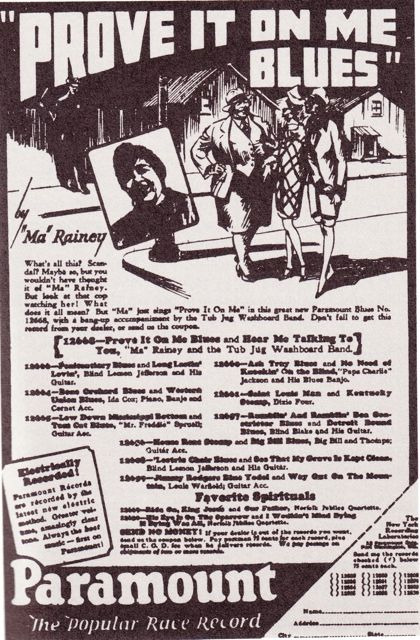
"Prove it on Me" New Negro women

I read something very exciting this week, the introduction of Erin Chapman's 2012 Prove It On Me: New Negroes, Sex, and Popular Culture in the 1920s. She argues many of the things I was searching to find here and here. I took four pages of notes on the introduction, and would love to share the quotes I so ardently took down, but in fairness to her and you, I'll just share a couple. But I urge you to go read her work if you are interested in the politics of respectability, the way popular culture influences society, the New Negro era, or the limits imposed on feminism.


"Prove it on me" is a quote from a Ma Rainey song, which flirts with the audience and dares them to prove she's done anything wrong. She "knows she is not completely free, but she acts independently anyway. ... In the face of social and moral condemnation, this New Negro woman determined to shape her own identity and fate." (3) But while she and other New Negro women insisted "on her right to enjoy, as sociologist E. Franklin Frazier lamented, the era's 'larger freedom of women,'" at the same time, "the question remained whether women, especially African American women, really had any more social, political, or economic power than they had had before." The spectacle of freedom, rather than its reality "overshadowed the ongoing political suppression and exclusion of most black women's voices. Instead of representing liberation, the prevalence of such spectacle indicated society's use of black women's bodies, images, and subjectivities to 'prove' --establish, test, assert, flout--the countless quandaries in gender roles, sexuality, and morality presented by the modern era and its new race politics." (4)

Chapman captures the tension I mentioned in my first post on the politics of respectability, though she frames in terms of the New Negro debate over the meaning of art. Perhaps that was my mistake in the first post--not recognizing the transition between the politics of respectability and New Negro Modernism. After reading Chapman's introduction, I can see how much the women I study straddle that line, sometimes evoking the one and sometimes evoking the other.
"Although modern African Americans determined to shape their own destinies, both in personal and political terms, and to take leading roles in the newly configured discursive debate over black humanity and worth, there was little agreement about the best means of accomplishing these aspirations. Thus, New Negroes were divided into two major camps. There were those who sought to modernize and professionalize established ideologies of racial advancement, solidarity, and uplift through a New Negro progressivism.... Others.. questioned, if not the very idea of racial solidarity itself, then at least the obligation of racial allegiance and respectability, and instead touted a radical individualism and independence from all but the most personal allegiances to 'art' or 'self' or some other self-generated ideal." (10)
Chapman moves from the sex-race marketplace to the intrarace dialogue about the proper role of women and sexual morality. She argues that while "class-biased" uplift ideology of the National Association of Colored Women dominated what she calls the Reconstruction generation, a masculine-impulse dominated the New Negro era (12). The New Negroes "accentuated the manhood rights of the black male worker as a tenet of racial advancement" (11). Their politics led to an emphasis on what Chapman defines as "race motherhood," which was not the heir of Reconstruction era feminism, "but a discourse confining black women's subjectivity, identity, and activity to others' support and use." (13)

Chapman's thesis represents a direct challenge to me: "As the great migration and converging economic and technological changes precipitated the formation of the sex-race marketplace that would shape the course of twentieth-century race politics and racialized popular culture, so too did the modern racial discourse motivate the development of an intra-racial discourse of race motherhood. Together, they rendered black women largely invisible, their subjectivity flat and inhuman, for the greater part of that century." (14)

 My work is all about New Negro women who updated uplift ideology for a modern world. I argue these women were not invisible in their Harlem society nor outside of it, to YWCA women, Pan-African leaders, the League of Nations and others. Chapman very explicitly says that her work is not about the women themselves or their "quotidian experiences," but rather about the "social forces shaping" "the meanings dominant society, New Negro politics, and black women themselves made and attempted to make out of black women's subjectivities." (15)

Despite our different pursuits and methodologies, Chapman's work is going to be very helpful to me as I attempt to understand the lived experience and inhabited ideas of four black New Negro women who traveled internationally because she defines the social forces constraining these women and against which they struggled. Can't wait to read the rest of the book!

Selasa, 17 April 2012

The 2012 S-USIH Conference Forum


As most readers of this blog probably know, the deadline for submitting proposals to the 2012 Society for U.S. Intellectual History Conference is fast approaching. Proposals are due on June 1. Unlike in previous years, we will not be accepting individual paper proposals, so it's vital that you have a complete panel before submitting it to the organizers.

I've put together a 2012 S-USIH Conference Forum, which is designed to help those of you seeking to put together panels who need to locate additional presenters or chairs / commentators.

Before posting anything in this forum, please be sure to read the Call for Papers, which specifies what the committee is looking for in submissions.

Then post a topic in the appropriate sub-forum.

If you have a paper you're interested in presenting, but don't have a particular panel in mind, please post a new topic in the INDIVIDUAL PAPERS SEEKING PANELS sub-forum.  Please use the title of your paper as the title of your topic.

If you know the topic of your session, but need some more papers / presenters for it, please post a new topic in the PANEL PROPOSALS sub-thread.  Please use the title of your session as the title of your topic.

If you have a complete panel assembled, but lack a chair / commentator, please post a new topic in the PANELS SEEKING CHAIRS / COMMENTATORS sub-forum. Please use the title of your session as the title of your topic.

Finally, if you are planning to be at the conference but are not otherwise on the program, you can offer your services as a chair / commentator in the AVAILABLE TO CHAIR / COMMENT sub-forum. Please use your name and affiliation as the title of your topic.

Wherever you post, the more information you provide about what you already know about your paper / session and what you're looking for in collaborators, the better your chance of success in finding good scholarly matches.

PLEASE NOTE: Posting to the forum does not in itself constitute submitting a proposal to the Conference Committee. Please be sure, once you have assembled a panel, to submit it to the organizers as specified in the Call for Papers.

There will be a link to the forum on the top of the blog through the first week of June.

UPDATE (June 11, 2012):  I've removed the forum as the deadline for putting panels together has passed.

Jefferson, Paine, and the Question of Generations

For your reading pleasure today, a guest post from Tom Cutterham, a graduate student at St Hugh's College and the Rothermere American Institute, Oxford (UK). Cutterham works on social, political, and economic thought in the so-called critical period of the 1780s. He is also a senior editor at the Oxonian Review, and tweets as @tomc759.

In September 1789 Thomas Jefferson wrote to James Madison from Paris that “the question Whether one generation of men has a right to bind another, seems never to have been started either on this or our side of the water.” In making his own answer, Jefferson famously declared that “the earth belongs in usufruct to the living,” that “by the law of nature, one generation is to another as one independant nation to another,” and furthermore that “no society can make a perpetual constitution, or even a perpetual law... Every constitution then, and every law, naturally expires at the end of 19 years. If it be enforced longer, it is an act of force, and not of right.”

Jefferson's concern was with the principle of popular and legislative sovereignty, for that principle seemed to potentially come down on both sides of the issue. If the people were sovereign they could make any laws and contract any debts they liked, without impediment, including those that had effect after the lifetimes of the lawmakers. If there was no sovereignty above the popular representatives, then there was nothing to restrict them. On the other hand, this freedom ought to apply just as well to future sets of representatives. Otherwise, as Jefferson said, the world “belongs to the dead, and not to the living.”

But Jefferson was wrong to say that the question had “never... been started either on this or our side of the water.” More than three years earlier, in 1786, Thomas Paine had addressed this very question in his pamphlet, Dissertations on Government, the Affairs of the Bank, and Paper-Money. The issue that raised the question for Paine was the middle one, the affair of the bank. The Pennsylvania legislature had repealed a charter it had previously granted to Robert Morris’ Bank of North America. Did it have the power to do so? Paine argued that it did not.

“The election of new Assemblies folowing each other makes no difference in the nature of the thing. The State is still the same State. - The public is still the same body. These do not annually expire though the time of an Assembly does. These are not new-created every year, nor can they be displaced from their original standing; but are a perpetual permanent body, always in being and stil the same.” Hence, contracts entered into by the state, i.e. by the public, could not be broken by later representatives. And the charter was not so much a law as a contract.

Paine prefigured Jefferson's entire train of thought, but from almost the opposite direction. He asked his readers to imagine how it would be “if we adopt the vague inconsistent idea that every new Assembly has a full and complete authority over every Act done by the State in a former Assembly... It will lead us,” he wrote, “into a wilderness of endless confusion and unsurmountable difficulties... Every new election would be a new revolution, or it would suppose the public of the former year dead and a new public risen in its place.”

Yet that last clause opens new space for Jefferson's attack. The Virginian's position really does rest on the former public being now dead - at least a majority of it - and a new one arisen in its place. In his pamphlet, Paine leaves the issue at this point, and moves on to a history of the bank charter itself. But a few pages later he picks up the thread:

“As we are not to live forever ourselves, and other generations are to follow us, we have neither the power nor the right to govern them, or to say how they shall govern themselves. It is the summit of human vanity, and shews a covetousness of power beyond the grave, to be dictating to the world to come.”

His prescription? That it “be made an article in the Constitution, that all laws and Acts should cease of themselves in thirty ears, and have no legal force beyond that time.” So from the position of an anti-Jeffersonian defender of stability, Paine has become, in the space of five pages in his pamphlet, the precursor of one of Jefferson's most famous - and famously original - thoughts.

That a man like Jefferson had an incomplete knowledge of his own milieu (to be fair, he was in France at the time), should give intellectual historians some pause when they consider their own methodological anxieties of influence. As for the question at hand, the last word in this particular exchange went, aptly, to James Madison. “My first thoughts though coinciding with many of yours,” he wrote to Jefferson, “lead me to view the doctrine as not in all respects compatible with the course of human affairs.”

The present veneration of the founders and their constitution is unlikely to disappear within a generation, be it one of nineteen or of thirty years. But like Tom Paine and Thomas Jefferson, thinkers and writers of the twenty-first century still struggle with the problem of generations, which may now be more pertinent than ever. If anything, the persistence of the founders reminds us that the question is still open: does the earth belong to the living, or the dead?

Senin, 16 April 2012

And the Winners Are....

Today is Pulitzer Prize announcement day. The big news will no doubt be the decision not to award a prize in fiction for the first time since 1977.

But of greater interest to this blog are three of the awards that were given.

The Pulitzer Prize in Biography went to John Lewis Gaddis's George F. Kennan: An American Life.


The Pulitzer Prize in History went to the late Manning Marable's Malcolm X: A Life of Reinvention, which, in an unusual move, was originally nominated for the biography prize and moved over to History by the Pulitzer Board.

And the winner for General Nonfiction was Stephen Greenblatt's The Swerve: How the World Became Modern. Though Greenblatt is of course a literary scholar, this book, on the impact of the 15th-century re-discovery of Lucretius's De rerum natura, is the most intellectual history-oriented of the bunch.

I'm sorry to say that I haven't read any of these three books yet. Each is of some interest to me, though all are rather far removed from anything I'm working on at the moment.

Consider this an open thread to discuss the Pulitzer winners...and any even worthier books from the last year that you feel might have been overlooked.


Sabtu, 14 April 2012

In the Lists: Reading for Exams

Though the time of trial is still a year away, I have begun to prepare in earnest for my (in)glorious combat in the lists:  the ordeal of qualifying exams.

At this point, my preparations involve hammering out the reading lists for my fields:  American intellectual and cultural history (soup to nuts), American literature (Early Republic to the day before yesterday), and Transatlantic history in the long 19th century (1776-1924).

At my institution, the process begins manageably enough:  I provide the profs supervising my fields with a preliminary list of texts I think I need to read, and then we make additions and changes from there.  One value of having us students come up with the first list ourselves is that it gives our profs a benchmark for assessing our initial understanding (or lack thereof) of our fields.  Do we have a sense of the basic boundaries, the major landmarks, or are we wandering lost in a trackless epistemic wasteland?  That would be problematic.

Fortunately, those who have traveled this ground before me have left some trail markers to guide me and other grad students along the way.  Indeed, some of the most helpful navigation aids for putting together a preliminary list are embedded in others' posts and comments on this very blog.

For those of you putting together exam lists (or syllabi), I want to call your attention to several past posts on USIH that have featured discussions of "must-read" texts in U.S. intellectual history, U.S. history in general, the "long 19th century," and so forth:

Secondary sources in U.S. intellectual history

A Canon of U.S. Intellectual History

A Reading List for the Long Nineteenth Century

The U.S. History Canon

A truly canonical U.S. history list

Perhaps putting these links together in one blog post will be helpful to those who come after me on this pilgrim pathway.  But as you can see from the posts and their dates, I'm certainly not the one blazing this trail.  Thanks to Mike O'Connor and David Sehat for taking up these questions, and thanks to the other commenters on their posts for participating in the discussion and adding their suggestions.  Most helpful.

I am sure to end up with a reading list for U.S. intellectual history that is somewhat different from the (combined) suggestions of these posts.  But this isn't a bad place to start.

------------
Addendum, June 3, 2012 1:10 AM:

I have since finalized my reading list for U.S. Intellectual and Cultural history; I have posted it here.

Jumat, 13 April 2012

In Quest of Intellectual Community

In this fascinating essay, Eric Miller, author of the excellent intellectual biography, Hope in a Scattering Time: A Life of Christopher Lasch, reflects on his experience at the 2011 U.S. Intellectual History Conference. Miller's perspective is, I think, pretty different from many attendees, which makes this essay that much more interesting. A small sample:

It was most basically a tradition at play, serious play. Even liberal modernity requires earthy sites of institutionalized ritual (think panel+respondent+Q&A, or wine and cheese receptions, or "business meetings"), although the underground suite of grey classrooms we huddled within at the Graduate Center of the City University of New York could hardly be described as "earthy"—dull windowless rooms lit in florescent white and cluttered with wires, screens, and plastic chairs.

The upshot, though, like most of the rest of us, Miller enjoyed himself, thinking that, just perhaps, he found an intellectual community that suits him. For those of you who wish to see if our intellectual community is the right one for you, submit a proposal for this year's conference.