On behalf of all the writers and readers of the U.S. Intellectual History blog, as well as the members and friends of the Society for U.S. Intellectual History, we wish to congratulate Daniel T. Rodgers, who was recently named as one of three winners of the 2012 Bancroft Prize.
We knew that Age of Fracture was an Important Book. Andrew Hartman made that call for the USIH blog on January 4, 2011. He wrote, "A new book by Daniel Rodgers, The Age of Fracture, which I predict will be the most talked about work of intellectual history since Louis Menand’s Metaphysical Club, implies that Marx’s thesis is a pretty good explanation for our postmodern condition."
Well...
What Daniel Rodgers's book implies became a subject of repeated inquiry and rigorous debate here on the blog and in the intellectual history blogosphere generally. Andrew launched the discussion of Age of Fracture with a response to Lisa Szefel's review of Rodgers's book (History News Network), and followed his invocation of Szefel's critique with some reflections of his own ("The Culture Wars: Notes Towards a Working Definition"). Fellow blog authors Ben Alpers ("Pulling a Thread: How Should Intellectual Historians Deal with Erroneous, Foolish, or Vicious Thought?" ), Tim Lacy ("Who's In? The Hierarchy of Intellectuals"), Ray Haberski ("What Fractured?"), David Sehat ("Intellectual History and the Age of Fracture, Part I") and Mike O'Connor ("more on 'Age of Fracture'") picked up the discussion and carried it forward, backward, and sideways, with the enthusiastic participation of commenters known and unknown.*
Indeed, in a marvelous bit of mimesis, Daniel Rodgers and his brilliant book spread across the USIH cosmos (on this blog and well beyond it) like the very contagion of metaphors he so brilliantly, thickly and deftly described.
A highlight of the fourth annual USIH conference (the first to be held under the auspices of the newly organized S-USIH) was an entire session devoted to discussing Rodgers's Age of Fracture. Ben Alpers chaired the roundtable; Andrew Hartman, James Livingston, Lisa Szefel, and Mary Dudziak offered careful, critical reviews of the work. Daniel Rodgers responded thoughtfully to these thoughtful interlocutors, and answered questions from the audience -- though, as is only fitting for such a thought-provoking book, his cryptic, coy replies may have raised more questions than they answered.
Beyond question, though, is the breathtaking brilliance of Age of Fracture. Daniel Rodgers managed to frame the epistemic frame of an age in such a way that others are able to glimpse its contours, even as we stand within it. That is no small feat, and this is no small book.
We are all delighted that Daniel Rodgers has been honored for this remarkable work.
------------
*I have provided links to just a few of more than a score of posts on this blog labeled with the keywords "Age of Fracture" or "Daniel Rodgers." There are many more posts where Rodgers, his book, and his ideas are the subject of discussion in the text and the comments.
Tampilkan postingan dengan label 2011 USIH Conference. Tampilkan semua postingan
Tampilkan postingan dengan label 2011 USIH Conference. Tampilkan semua postingan
Sabtu, 17 Maret 2012

Selasa, 27 Desember 2011
Ribuffo, "President James A. Garfield Had a Great Personality" (Personality and the Self Panel, Part III)
Dear Readers: As a special holiday season treat, I give you one of the more interesting panels from our recent conference--"Personality and the Self in Twentieth-Century American Social Thought."' See the first paper by Dave Varel here. The second paper by Dave Steigerwald is here. Below are the comments by Leo Ribuffo.
PRESIDENT JAMES A. GARFIELD HAD A GREAT PERSONALITY
Leo P. Ribuffo, The George Washington University

In the generous spirit of S-USIH, this is less a comment in the AHA/OAH “gotcha” sense than some reflections on two interesting articles. My first reflection is that both of these essays deal with what might be called the self-absorbed era in the conceptualization of the self—and all deal primarily with middle class people or above in a rich world power during a relatively short span of time, the past 120 yrs or so. Accordingly, choosing a conception of the self was to an increasing degree voluntary, especially after the culturally normative “American Way of Life” of the Great Depression yielded to the looser notion of “life styles” in the 1960s and 1970s. This is the era, as David Varel stresses (following Warren Susman's classic essay), when, amid visions of affluence, an ascetic emphasis on “character” yielded to a “culture of personality” befitting a “culture of consumption.”
Without totally discounting the now standard notion that the search for the self in some sense escalated during the modern era, whenever that began, let me suggest that it had a longer lineage, was not confined to rich “Western” countries, and often involved what William James called forced options. Consider the following hypothetical situations:
A speaker in 331 B. C. E. Persia. “Believe it or not, guys, Darius III just lost to Alexander the Great. We’ve got to decide how Hellenized we’re going to become.”
Fast forward to the Indian subcontinent in the seventh century C. E. “Hey, guys, there’s this new religion going around called Islam. It doesn’t have a caste system. Sounds pretty good to me.”
Fast forward again to the sixteenth century—to a place our history department colleagues call early modern Europe. “Hey buddy, does the wine in church turn into Christ’s blood or is it just a symbol? Decide fast; we’re piling the kindling around the stake.”
And across the ocean in Peru: “Look, guys, I know the Spanish conquerors have really powerful weapons and are trying to win our hearts and minds with paintings of the Apostles as Indians, but don’t we owe it to our Inca ancestors to join Tupac Amaru’s revolt?”
Even for the prosperous United States. (by world standards) choices about self were in play for more than a century before the era of self-absorption began in the late nineteenth century. We can see this behavior in many “keywords.” In addition to the ubiquitous “character,” we have for instance: republican virtue, honor, patriot, true woman, born again Christian, and manliness (preferably self-made). At the same time there were negative selves that should be avoided or (in the Darwinian worst cases) could not be avoided—undeserving poor, rebel, feeble minded, racial mongrel, and gook.
As Susman acknowledged, such notions did not disappear even as the “culture of personality” came to dominate the Zeitgeist. For instance, self-made manliness survived from Henry Clay through Booker T. Washington to Malcolm X and the Nixon White House, honor persisted from the Hamilton-Burr duel to Paul Goodman’s Growing Up Absurd, gook echoed from the Philippine War to the Vietnam War, and derision of the undeserving poor affected politics from Theodore Roosevelt's Square Deal to Bill Clinton’s signing of welfare reform, so-called, in 1996.
Nor should we forget the enormous legacy of Romanticism with its cult of the hero, which popularized the self-absorbed search for the self long before this disposition became professionalized. Despite the countless gospel of success guides published by Russell Conwell, Edward Bok, Garfield, et al, what red blooded American boy would choose to clerk in that startup company Carnegie Steel instead of riding with General George Custer? At least until June 25, 1876.
And if we want a more complicated symbol (or modal personality if you prefer), although James Garfield wrote one of the classic tracts about achieving success through character, he did have a great personality even before there was a whole “culture of personality,” a fact confirmed by his phrenologist, by his rapid political rise, and by the three women madly in love with him during his early twenties.
David Steigerwald takes us from the early days of the professionalized search for the self to the 1970s. Steigerwald begins by bringing us back to the first heyday of guides to success, variously defined, in this world and the next, and nicely places this search in the context of a longer debate about free will and determinism.
Thus we return to the question that vexed scholars three decades ago in the heyday of the academic study of the gospel of success--such scholars as Susman, Donald Meyer, John Cawelti, Irwin Wylie, Richard Huber, and Lawrence Chenoweth --Is William James responsible for Norman Vincent Peale? This question is a lot of fun, along with its kin: Is Marx responsible for Stalin, is Rousseau responsible for Timothy Leary, and what would Jesus do? Steigerwald gets it right in this instance, writing that James with his “famous open-mindedness” would have found some merit in Charles Reich’s The Greening of America.
Yet Steigerwald leads us astray when he dismisses the medical side of nineteenth century positive thinking as “self-evidently unscientific.” These theories were considered science by many Americans just as much as eugenicist warnings against racial mongrelization and the homeopathic medicine preferred by President Garfield. So too, later on, with Abraham Maslow cultivating his peak experiences and Wilhelm Reich absorbing the intergalactic libido in his orgone box.
The issue of “agency” also needs a closer look (“deconstruction” if a trendier word makes readers feel smarter). As currently bandied about, agency means two related but separate questions. First, can “the people” in some sense think for themselves or are they just easily manipulated dimwits, a notion already on the rise in American social science before there was a Frankfurt School even in Frankfurt, as Edward Purcell showed in his brilliant book The Crisis of Democratic Theory. As Purcell also showed, this question influenced the interwar debate between behaviorists and humanists in the social sciences.
Second, even if “the people” can think for themselves, do they have enough power--agency--to change the Zeitgeist let alone the social order? In the broad sweep of things, my sense is that people do think for themselves when they are moved to think, but that they tend to limit their thoughts and feelings to what seems possible. Hence most educated women went along with the feminine mystique in the 1950s, there is no socialism in the United States, and only a minority of Incas joined Tupac Amaru’s revolt.
Steigerwald sees two great eras of agency affirmation, and both seem to coincide with periods of major social change and political flux. The odd exception is the 1930s, and here Steigerwald’s Google search may have led him astray. Guides to success flourished during the Great Depression, none more so than Dale Carnegie’s How to Win Friends and Influence People. If there was a drop off in references to free will, perhaps this was because a critical mass of “the people” temporarily had both the will and the freedom to change things significantly (by American standards).
Varel takes us forward to Henry Murray, a self-described William Jamesian and one of the creators of “humanistic psychology”--as Murray called the field as early as 1930--along with Gordon Allport, Carl Rogers, John Dollard, and Abraham Maslow.
While agreeing that we need more than an “internalist” examination of Murray’s ideas, I am skeptical of Varel’s main choice of social-intellectual context. From Richard Hofstadter through Christopher Lasch to Jackson Lears, historians have noted the importance of personal crises about the meaning of life for modern thinkers, crises summed up in the key word “weightlessness.”
Murray doesn’t fit very well. As a youth he stuttered, felt rejected by his mother, and suffered from sexual repression but he is a long way from being a Jamesian “sick soul” and a modal personality for an age of “weightlessness.” Until his early twenties, Murray’s main crisis seems to have been guilt about his role in a rebellion against his Harvard crew coach that may have resulted in a loss to Yale. As we used to say in working class New Jersey before I encountered the psychiatric mode of denigration, the young Murray was a rich spoiled jerk.
In his early thirties Murray did suffer what he called a “profound affectional crisis” that involved immersion in Romantic literature, enthusiasm for Carl Jung, and lust for Christiana Morgan. Except perhaps for the Jungian infatuation, John Stuart Mill and Harriet Taylor would have understood ninety years earlier.
This affectional crisis did influence Murray’s work, including his senior authorship of Explorations in Personality, but so too did a broad assortment of ideas. Although Varel can only sketch the early years, we do need to appreciate what a juicy life Murray lived. By his early forties his circle included Alfred North Whitehead, Lewis Mumford, Conrad Aiken, Eugene O’Neill, Archibald MacLeish, Joseph Schumpeter, and Paul Robeson.
Varel neatly summarizes Explorations in Personality but we should appreciate, too, what an incredible mish mash the book is, a combination of empiricism, insight, jargon, empathy, and elite insularity. For instance, Murray in effect regrets that his Catholic subjects, adhering to their church's "rationalized fantasy system," are "blissfully" less neurotic than their Protestant and Jewish counterparts. Certainly Murray's work had the potential to nudge psychology in various directions. The TAT became a tool for sorting out corporate executives, as William Whyte satirized in The Organization Man. Murray personally influenced Talcott Parsons as well as Kenneth Keniston and Erik Erikson.
If we are looking for sweeping contexts, we might say that both Explorations in Personality and Murray himself in the late 1930s illustrate tenacious American optimism. According to Murray at that time, Freud’s Civilization and Its Discontents exuded “black despair.”
Since Murray lived well into his nineties, he can be used as a symbol or modal personality for many intellectual trends. After the United States entered World War II he discovered evil, informed the world of its existence in his writings, and administered TATs for the Office of Strategic Services--“great fun.” Murray testified for the defense at the second Alger Hiss trial, diagnosed Whittaker Chambers as a “psychopathic personality” on the basis of his writings, and took pride in coming off better on the witness stand than Cornell psychiatrist Carl Binger. Joining in the post-World War II disenchantment with “the people” this rich spoiled jerk complained that soldiers, students, and his own research assistants were becoming uppity. Ever adaptable in self-absorption, however, Murray enjoyed an acid trip with Timothy Leary.
As we move into the 1960s and 1970s, Steigerwald sees the denouement of the descent from Jamesian giants to Maslovian pygmies. Although guides to success variously defined still proliferate in all sorts of media, the late 1970s marked the end of a phase in the discussion of the self. It had been a triumphant phase marked by psychological interpretations in venues as significant as George Kennan’s Cold War tract “The Sources of Soviet Conduct,” the United States Supreme Court decision in Brown v Board of Education, and Justice Harry Blackmun's majority opinion in Roe v Wade.
Maslow, Reich, and others criticized by Steigerwald, a good Laschian, have never been my cup of chamomile tea, and I have been trying all of my professional life to bury the phrase “paranoid style in American politics.” But as a Susmanite I have always had a soft spot for the gentler positive thinkers. Many people would be better off listening to Maslow than listening to Prozac. And with the resurgence of “economic man,” construed with a stunted conception of rationality that would surprise Adam Smith, I am softening further. Come the revolution, perhaps we could sentence the authors of Freakonomics and the policy wonks at the American Enterprise Institute to a few weeks in a hot tub with Charlie Reich.
PRESIDENT JAMES A. GARFIELD HAD A GREAT PERSONALITY
Leo P. Ribuffo, The George Washington University

In the generous spirit of S-USIH, this is less a comment in the AHA/OAH “gotcha” sense than some reflections on two interesting articles. My first reflection is that both of these essays deal with what might be called the self-absorbed era in the conceptualization of the self—and all deal primarily with middle class people or above in a rich world power during a relatively short span of time, the past 120 yrs or so. Accordingly, choosing a conception of the self was to an increasing degree voluntary, especially after the culturally normative “American Way of Life” of the Great Depression yielded to the looser notion of “life styles” in the 1960s and 1970s. This is the era, as David Varel stresses (following Warren Susman's classic essay), when, amid visions of affluence, an ascetic emphasis on “character” yielded to a “culture of personality” befitting a “culture of consumption.”
Without totally discounting the now standard notion that the search for the self in some sense escalated during the modern era, whenever that began, let me suggest that it had a longer lineage, was not confined to rich “Western” countries, and often involved what William James called forced options. Consider the following hypothetical situations:
A speaker in 331 B. C. E. Persia. “Believe it or not, guys, Darius III just lost to Alexander the Great. We’ve got to decide how Hellenized we’re going to become.”
Fast forward to the Indian subcontinent in the seventh century C. E. “Hey, guys, there’s this new religion going around called Islam. It doesn’t have a caste system. Sounds pretty good to me.”
Fast forward again to the sixteenth century—to a place our history department colleagues call early modern Europe. “Hey buddy, does the wine in church turn into Christ’s blood or is it just a symbol? Decide fast; we’re piling the kindling around the stake.”
And across the ocean in Peru: “Look, guys, I know the Spanish conquerors have really powerful weapons and are trying to win our hearts and minds with paintings of the Apostles as Indians, but don’t we owe it to our Inca ancestors to join Tupac Amaru’s revolt?”
Even for the prosperous United States. (by world standards) choices about self were in play for more than a century before the era of self-absorption began in the late nineteenth century. We can see this behavior in many “keywords.” In addition to the ubiquitous “character,” we have for instance: republican virtue, honor, patriot, true woman, born again Christian, and manliness (preferably self-made). At the same time there were negative selves that should be avoided or (in the Darwinian worst cases) could not be avoided—undeserving poor, rebel, feeble minded, racial mongrel, and gook.
As Susman acknowledged, such notions did not disappear even as the “culture of personality” came to dominate the Zeitgeist. For instance, self-made manliness survived from Henry Clay through Booker T. Washington to Malcolm X and the Nixon White House, honor persisted from the Hamilton-Burr duel to Paul Goodman’s Growing Up Absurd, gook echoed from the Philippine War to the Vietnam War, and derision of the undeserving poor affected politics from Theodore Roosevelt's Square Deal to Bill Clinton’s signing of welfare reform, so-called, in 1996.
Nor should we forget the enormous legacy of Romanticism with its cult of the hero, which popularized the self-absorbed search for the self long before this disposition became professionalized. Despite the countless gospel of success guides published by Russell Conwell, Edward Bok, Garfield, et al, what red blooded American boy would choose to clerk in that startup company Carnegie Steel instead of riding with General George Custer? At least until June 25, 1876.
And if we want a more complicated symbol (or modal personality if you prefer), although James Garfield wrote one of the classic tracts about achieving success through character, he did have a great personality even before there was a whole “culture of personality,” a fact confirmed by his phrenologist, by his rapid political rise, and by the three women madly in love with him during his early twenties.
David Steigerwald takes us from the early days of the professionalized search for the self to the 1970s. Steigerwald begins by bringing us back to the first heyday of guides to success, variously defined, in this world and the next, and nicely places this search in the context of a longer debate about free will and determinism.
Thus we return to the question that vexed scholars three decades ago in the heyday of the academic study of the gospel of success--such scholars as Susman, Donald Meyer, John Cawelti, Irwin Wylie, Richard Huber, and Lawrence Chenoweth --Is William James responsible for Norman Vincent Peale? This question is a lot of fun, along with its kin: Is Marx responsible for Stalin, is Rousseau responsible for Timothy Leary, and what would Jesus do? Steigerwald gets it right in this instance, writing that James with his “famous open-mindedness” would have found some merit in Charles Reich’s The Greening of America.
Yet Steigerwald leads us astray when he dismisses the medical side of nineteenth century positive thinking as “self-evidently unscientific.” These theories were considered science by many Americans just as much as eugenicist warnings against racial mongrelization and the homeopathic medicine preferred by President Garfield. So too, later on, with Abraham Maslow cultivating his peak experiences and Wilhelm Reich absorbing the intergalactic libido in his orgone box.
The issue of “agency” also needs a closer look (“deconstruction” if a trendier word makes readers feel smarter). As currently bandied about, agency means two related but separate questions. First, can “the people” in some sense think for themselves or are they just easily manipulated dimwits, a notion already on the rise in American social science before there was a Frankfurt School even in Frankfurt, as Edward Purcell showed in his brilliant book The Crisis of Democratic Theory. As Purcell also showed, this question influenced the interwar debate between behaviorists and humanists in the social sciences.
Second, even if “the people” can think for themselves, do they have enough power--agency--to change the Zeitgeist let alone the social order? In the broad sweep of things, my sense is that people do think for themselves when they are moved to think, but that they tend to limit their thoughts and feelings to what seems possible. Hence most educated women went along with the feminine mystique in the 1950s, there is no socialism in the United States, and only a minority of Incas joined Tupac Amaru’s revolt.
Steigerwald sees two great eras of agency affirmation, and both seem to coincide with periods of major social change and political flux. The odd exception is the 1930s, and here Steigerwald’s Google search may have led him astray. Guides to success flourished during the Great Depression, none more so than Dale Carnegie’s How to Win Friends and Influence People. If there was a drop off in references to free will, perhaps this was because a critical mass of “the people” temporarily had both the will and the freedom to change things significantly (by American standards).
Varel takes us forward to Henry Murray, a self-described William Jamesian and one of the creators of “humanistic psychology”--as Murray called the field as early as 1930--along with Gordon Allport, Carl Rogers, John Dollard, and Abraham Maslow.
While agreeing that we need more than an “internalist” examination of Murray’s ideas, I am skeptical of Varel’s main choice of social-intellectual context. From Richard Hofstadter through Christopher Lasch to Jackson Lears, historians have noted the importance of personal crises about the meaning of life for modern thinkers, crises summed up in the key word “weightlessness.”
Murray doesn’t fit very well. As a youth he stuttered, felt rejected by his mother, and suffered from sexual repression but he is a long way from being a Jamesian “sick soul” and a modal personality for an age of “weightlessness.” Until his early twenties, Murray’s main crisis seems to have been guilt about his role in a rebellion against his Harvard crew coach that may have resulted in a loss to Yale. As we used to say in working class New Jersey before I encountered the psychiatric mode of denigration, the young Murray was a rich spoiled jerk.
In his early thirties Murray did suffer what he called a “profound affectional crisis” that involved immersion in Romantic literature, enthusiasm for Carl Jung, and lust for Christiana Morgan. Except perhaps for the Jungian infatuation, John Stuart Mill and Harriet Taylor would have understood ninety years earlier.
This affectional crisis did influence Murray’s work, including his senior authorship of Explorations in Personality, but so too did a broad assortment of ideas. Although Varel can only sketch the early years, we do need to appreciate what a juicy life Murray lived. By his early forties his circle included Alfred North Whitehead, Lewis Mumford, Conrad Aiken, Eugene O’Neill, Archibald MacLeish, Joseph Schumpeter, and Paul Robeson.
Varel neatly summarizes Explorations in Personality but we should appreciate, too, what an incredible mish mash the book is, a combination of empiricism, insight, jargon, empathy, and elite insularity. For instance, Murray in effect regrets that his Catholic subjects, adhering to their church's "rationalized fantasy system," are "blissfully" less neurotic than their Protestant and Jewish counterparts. Certainly Murray's work had the potential to nudge psychology in various directions. The TAT became a tool for sorting out corporate executives, as William Whyte satirized in The Organization Man. Murray personally influenced Talcott Parsons as well as Kenneth Keniston and Erik Erikson.
If we are looking for sweeping contexts, we might say that both Explorations in Personality and Murray himself in the late 1930s illustrate tenacious American optimism. According to Murray at that time, Freud’s Civilization and Its Discontents exuded “black despair.”
Since Murray lived well into his nineties, he can be used as a symbol or modal personality for many intellectual trends. After the United States entered World War II he discovered evil, informed the world of its existence in his writings, and administered TATs for the Office of Strategic Services--“great fun.” Murray testified for the defense at the second Alger Hiss trial, diagnosed Whittaker Chambers as a “psychopathic personality” on the basis of his writings, and took pride in coming off better on the witness stand than Cornell psychiatrist Carl Binger. Joining in the post-World War II disenchantment with “the people” this rich spoiled jerk complained that soldiers, students, and his own research assistants were becoming uppity. Ever adaptable in self-absorption, however, Murray enjoyed an acid trip with Timothy Leary.
As we move into the 1960s and 1970s, Steigerwald sees the denouement of the descent from Jamesian giants to Maslovian pygmies. Although guides to success variously defined still proliferate in all sorts of media, the late 1970s marked the end of a phase in the discussion of the self. It had been a triumphant phase marked by psychological interpretations in venues as significant as George Kennan’s Cold War tract “The Sources of Soviet Conduct,” the United States Supreme Court decision in Brown v Board of Education, and Justice Harry Blackmun's majority opinion in Roe v Wade.
Maslow, Reich, and others criticized by Steigerwald, a good Laschian, have never been my cup of chamomile tea, and I have been trying all of my professional life to bury the phrase “paranoid style in American politics.” But as a Susmanite I have always had a soft spot for the gentler positive thinkers. Many people would be better off listening to Maslow than listening to Prozac. And with the resurgence of “economic man,” construed with a stunted conception of rationality that would surprise Adam Smith, I am softening further. Come the revolution, perhaps we could sentence the authors of Freakonomics and the policy wonks at the American Enterprise Institute to a few weeks in a hot tub with Charlie Reich.
Steigerwald on "The Willful Self" (Personality and the Self Panel, Part II)
Dear Readers: As a special holiday season treat, I give you one of the more interesting panels from our recent conference--"Personality and the Self in Twentieth-Century American Social Thought"' See the first paper by Dave Varel here. This paper is by Dave Steigerwald. Comments by Leo Ribuffo will follow.
“Hollo! I must lie here no longer”:
Versions of the Willful Self from the Gilded Age to the Me Decade
by David Steigerwald, The Ohio State University

As one or two of you may be aware, I’ve made a bit of a living over the last few years criticizing the concept of individual agency in postwar America, especially in its application to consumerism. Typically there it includes claims that consumers exercise some measure of decisive power over the marketplace when they make idiosyncratic choices about either what they purchase or how they interpret the goods they buy. Choice is good, this line of reasoning seems to go, and because it provides so much of it, contemporary consumerism must also be good. Because versions of this line of thought came to pervade a good deal of writing about consumerism from the 1980s on, it seemed to me worth poking a few sticks at. At its most serious and most fruitful, the consumer-as-agent argument was a necessary counter to Frankfurt School cultural determinism, that stifling intellectual blanket laying upon those who began writing in the 1970s and 1980s. [1}
Yet in criticizing the concept of consumer agency, I’m afraid that I left the impression that I was defending Frankfurt, which is only partly true. Adorno and Horkheimer’s most concise summary of their view of the radio listener (a paraphrase of Henry Ford, it seems to me), that the listener wants what they’re going to get anyway, still strikes me as sound. Still, I had this nagging fear that someone would say to me what a defender of free-will Methodism in the 1890s wrote in criticism of predestination: “Why hold on to [this belief] as with a death-grasp ruled by Calvin’s dead hand from his very grave, trying to soften its asperities, and still keep mumbling the decrees as Roman priests do the mass in an unknown tongue, patching new pieces of truth to old garments of error worn in the Dark Ages?” [2]
To skirt just that possibility, I’ve widened the inquiry into the doctrine of choice in a book on alienation and affluence in postwar America, which I’m now finishing. In it, I’m arguing that the doctrine of choice become the antidote to alienation not just in consumer culture, but as a means by which individuals might think of themselves as successfully negotiating through an age of automated labor, bureaucratic regimentation, political powerlessness, and a profound shift in values that issued from the evaporation of the Protestant ethic. “Choice” became the universal default, in part because it was easy-to-hand and in perfect harmony with consumer capitalism. But it also spoke to the essential social psychology of alienation: that is, the pervasive sense of individual estrangement and isolation. Even if only an invocation, the belief that individual choices are both freely rendered and individually efficacious can be enough to lift the pallor of alienation for any given person. To the extent that the late-20th century political economy promised choices across the board—not just in soaps and shampoos, but in churches, communities however ephemeral or “virtual,” and technologies that provided private access to all—it effectively institutionalized such efficacy. And all this goes a long way toward explaining why we’re not alienated any more.
Having arrived at a via media all my own, it makes sense to me to admit, and follow up on, what should be obvious: that a debate over agency, or the efficacy of choice, is nothing new. While of course it is drawn out of the clash between the old Marxism and the New Left, it may be fruitful to see it as part of an even longer historical trajectory. We should see it, accordingly, as another episode in the old division between determinism and free will that runs back, in American letters, to the antinomian critique of Calvinism, and that intensified between 1880 and 1920 in the important debate between Darwinists and the theologically inclined—between, as one Darwin partisan put it in 1892, the “intellectual measles” of religion and “scientific certitude.” [3] A cursory look at the literature tells me that these forty years will take up the bulk of a book on the subject of free will. But a quick glance at the Google NGRAM—one of my favorite new research tools—shows that the use of “free will” in modern American writing had two peaks: a double-humped one that began around 1870, dipped at the turn of the century, then accelerated through the Great War; the second erupting sometime around 1960 and running perhaps a decade or so. And the possible connections between these two periods, as well as the different uses and meanings of the ideas deployed, provide an intriguing and natural parameter for such a study.
The first question, then, should ask what structural similarities the Gilded Age shared with the 1960s and 1970s, or what I’ll call the mid-postwar period. What comes immediately my mind is that in both periods, fundamental socio-economic change apparently generated distinct social-psychological maladies: neurasthenia/hysteria, in the Gilded Age; alienation in the mid-postwar period.
These two forms of psycho-social maladjustment, moreover, themselves shared similarities. Both were commonly accounted for as reactions against the warp speed of modernity. Train schedules, factory whistles, and the clock were superimposed on nineteenth-century people physiologically attuned to the leisurely pace of the natural world, while automation and mass communications generated “future shock” in the latter case. Both nervous exhaustion and alienation seemed to have weighed most heavily on sensitive young adults.
I have always been impressed, for example, by how clearly the sentiments in the Port Huron Statement echoed Jane Addams’s self-analysis in that wonderful essay, “The Subjective Necessity for Social Settlements.” Addams, of course, knew a thing or two about damaged youth, having been one herself. And in that essay she described the personal debilitations, the spiritual enervation, that plagued educated young adults who found themselves rendered useless by modernity’s material well-being. Whereas the generation before them was absorbed in the “starvation struggle” against the frontier, Addams’s generation had been elevated into comfort and educated presumably in order to take on a purposeful life, only to be deprived of meaningful outlets for their abundant vitalities. This situation was particularly intense for young women like Addams, whose typical fate was to graduate backward into the “family claim.” In the passage that has always caught my eye, Addams described with her usual clarity the quiet agony of her peers:
We have in America a fast-growing number of cultivated young people who have no recognized outlet for their active faculties. They hear constantly of the great social maladjustment, but no way is provided for them to change it, and their uselessness hangs about them heavily. Huxley declares that the sense of uselessness results in atrophy of function. These young people have had advantages of college, of European travel, and of economic study, but they are sustaining this shock of inaction. . . . Many of them dissipate their energies in so-called enjoyment. . . . Many are buried beneath mere mental accumulation with lowered vitality and discontent. . . . This young life, so sincere in its emotion and good phrases and yet so undirected, seems to me as pitiful as the other great mass of destitute lives. . . . Our young people feel nervously the need of putting theory into action, and respond quickly to the Settlement form of activity. [4]
Some sixty years later, Paul Goodman described almost the exact same problem as “growing up absurd,” and it is no stretch at all to think that Addams would have had enormous sympathy for the young people who in 1962 began their Port Huron Statement with the rallying cry: “We are people of this generation, bred in at least modest comfort, housed now in universities, looking uncomfortably to the world we inherit.”
Every bit of Addams’s language in the “Subjective Necessity” points us to another similarity in the distress that reached across time: both nervous disorder and alienation were maladies of the self, and because of that, they recommended at least some measure of subjective assertion. This is precisely Addams’s point. Earnest young people cut off from the starvation struggle of the urban masses could recover their physical vitality and sustain selfhood through settlement house work. Let me suggest that those alienated young people who launched Students for a Democratic Society and scoured the social landscape in search of objects for their political energies were doing the exact same thing.
Rather than making that argument here, I want to muck around in what I’m thinking of as a prior, more distinctly subjective reaction to psycho-social maladjustment. Both Addams and her peers and Tom Hayden and his alleviated their distress by throwing themselves into the public arena with the intention of changing objective conditions, and it is my view that such an effort was undoubtedly the healthiest, most meaningful antidote. But it raises the question of whether it is possible to overcome personal agony through purely subjective assertion, through something we could profitably think of as “the will.” If indeed one can successfully will oneself to mental well-being, if indeed the subjective is sufficient, then perhaps those who put great stock in individual agency are on solid ground. If the subjective will can, in a tangible way, affect the practical conditions of one’s life, then self-assertion is not merely subjective; it has some objective consequence. This, I take it, is what people mean by “agency.”
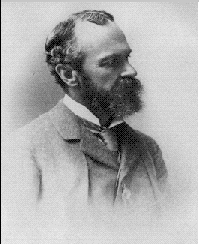
To get at this question, we should begin not with Jane Addams but with her contemporary, William James. James’s engagement in the debate over human volition was both important and typical of him, one of the important building blocks, as our good friend James Kloppenberg taught us, in the via media of American pragmatism. In Uncertain Victory, Kloppenberg described the “nature of the will” as “among the most vexing problems confronting late nineteenth-century thinkers.” Broadly speaking, that problem pitted the partisans of the physical sciences, “who dismissed religious arguments for free will as wishful thinking,” and the theologically inclined, who obliged themselves to believe in the complete independence of the individual human being. The automaton squared off against the autonomous, we might say. Clearly, these were just the broad parameters of a discourse that contained many variations—the intellectual mud-wrestling between Huxley and his scandalized critics; a revival of the debate over Calvinism among some American Christians; the growing importance of Freud; and, not least, Schopenhauer and Nietzsche. These variations indicated that high stakes were on the table, and that, combined with the irresolvable impasse between the two antagonistic positions, made the question of the will irresistible for American pragmatists. [5]
As Kloppenberg argues, the philosophers of the middle way crafted a philosophy of voluntary action that characteristically insisted on measuring any claims against experience. By the time they had arrived at a satisfactory position, their theory of voluntary action held that people were capable of choosing to sustain a thought and were therefore aware of the freedom to select between competing options; that the individual selects both what sensory data to act on and how to do so; that thought and sensation were mediated into action through volition; and that free will, though it clearly exists, is nonetheless constrained by social, and therefore historical, context. [6]
But what particularly attracts me to James was, as Kloppenberg also notes, that he immersed himself in the question of the will out of “the crucible of personal anxiety.” [7] The philosophical stakes aside, the personal capacity to will oneself, in James’s case, to some mental equilibrium that permitted engagement with the world was at the core of his philosophy of volition. Had James meekly accepted Huxley, he would have withered away. Instead, he climbed out of his debilitating mental exhaustion by translating into action one option from among a set of options. In a passage on the “psychology of volition” in Principles of Psychology, he offered a veiled description of his own experience. In trying to prove that ideas could be translated into action by suggesting that many ideas also inhibit action, James offered the example of arising out of bed on a cold morning. One knows that one must get up and face the day. “But still the warm couch feels too delicious, the cold outside too cruel, and resolution faints away and postpones itself again and again.” One mental urge throws itself against another; the imperatives compete. Extrapolating from “my own experience,” James asked: How do people ever raise themselves? “The idea flashes across us, ‘Hollo! I must lie here no longer.” [8]
Jackson Lears noted some time ago that James’s recovery was hardly so dramatic, that he recovered only gradually and then only after taking up his teaching career at Harvard. That said, what interests me is the connection between physical activity and mental health—a connection, incidentally, that Jane Addams also acknowledged. [9] We know today that physical activity is an important ingredient in the successful treatment of depression, and it begins with the Jamesian act of will—simply getting out bed and facing the day. More to the point, such an act of will, whatever its value to the philosophy of voluntary action, has real empirical value. It is possible to see in, and therefore to measure through, the improvement of the subject’s mental disposition the extent to which the subjective assertion of the self alters objective conditions. It is an example of the efficacy of the will.
If anything, James was overly insistent on the physiological origins of the will, at least in that long section on the subject in Principles of Psychology. Partly, his medical training explains his preoccupation with the “kinaesthetic idea.” But it is obvious that he was driven to scrutinize determinism more aggressively than its opposite, religious feeling. If I understand him correctly, James’s main intention in this bit of writing was to distance the source of sensation from the physical movement that is sensation’s effect. The simple distinction between involuntary and voluntary movements—the former were primary “functions of our organism”; the latter “secondary” ones—was his point of departure. But the distinction was not absolute, because in certain cases the body was capable of learning through motor memory from the first involuntary reaction to a particular sensation. The body learned other movements as well and at some point selected which action to undertake in response. (One example: The child who starts at the roar of a train as he stands on the platform does so involuntarily at first experience; thereafter, the same sensation might produce a similar response, but maybe not.) While this argument qualified the distinction between involuntary and voluntary movement, James used the point to separate out sensation from the response to sensation. “In reflex action, “and in its emotional expression,” he wrote, “the movements which are the effects are in no manner contained by anticipation in the stimuli which are their cause. The latter are subjective sensations and objective perceptions, which do not in the slightest degree resemble or prefigure the movements.” [10] Whereas determinism presumed a direct identity between sensation and movement, James insisted on a continuum that linked sensation, reflection, and action. By opening up room between the spark of motor movement and the actual movement itself, James crafted out space for volition, for the capacity of one to choose between impulses, and therefore for indeterminacy, or what he referred to elsewhere as “chance.” And chance, he knew, was the enemy of determinism. [11]
James always recognized the religious implications of this matter and understood perfectly well that the Huxleyan uproar was a resumption of the debate over free will. As he told Harvard Divinity students in a 1884 talk, while “common opinion” might be “that the juice has ages ago been pressed out of the free-will controversy, . . . I know of no subject less worn out, or in which inventive genius has a better chance of breaking open new ground.” [12] He joined the issue most clearly in “Reflex Action and Theism,” an address given to Unitarian ministers in 1881, whom he praised for their efforts to assimilate contemporary science into their world views. (He also praised them, by the way, for their rejection of Calvinism: “A God who gives so little scope to love, a predestination which takes from endeavor all its zest with all its fruit, are irrational conceptions, because they say to our most cherished prayers, There is no object for you.” [13]) James’s intention here, however, was to disabuse his open-minded brethren of any flirtation with the “doctrine of reflex action” then dominant in physiology and psychology, which dogmatically insisted that all “acts” are mere “discharges from the nervous centres” in response to external stimuli. The adherents to this theory, James claimed, were quite sure that it dealt the “coup de grace to the superstition of God.” The fallacy of the determinists, as anyone’s experience easily confirmed, was that the “real order of the world” was so overwhelmingly chaotic that individuals had to sort out what to respond to and what to ignore, and those decisions issued from “our subjective interests.” James maintained that subjective interests were given play in “the conceiving or theorizing faculty—the mind’s middle department,” and that they were independent of external stimuli. That middle department “is a transformer of the world of our impressions into a totally different world, . . . and the transformation is effected in the interests of our volitional nature.” [14] James reassured his theistic listeners that the middle department’s job was to adjust sensations until it mastered the chaos of the objective world. And that, he figured, was really what theology was about.
For James, then, the will connected the metaphysical and the phenomenological and was the bridge between subjective and objective realities. More than that, though: it was the activating agent in transforming belief into action, or abstract faith into faith revealed and affirmed. So it’s not too much to claim that James’s famous open-mindedness toward religious conviction grew out of his engagement with the free-will debate. If his main intention in “The Will to Believe” was to defend “our right to adopt a believing attitude in religious matters,” as he put it, what justified that right was belief’s place in the continuum of action. True, the believer could not will the existence of God. But our volitional nature could nonetheless translate belief in such a way as to “help create the fact” that belief sought out by making the faithful “better off even now.” In other words, the practical, objective effects of religious conviction concluded the continuum whereby the subjective was translated into an objective effect. [15]
This same formulation explains James’s interest in the “mind-cure” movement that proliferated after 1890. Self-evidently unscientific, mind-cure had to be understood as a religious movement, akin, he wrote, to Lutheranism or Methodism. Like earlier evangelical faiths, mind-cure banished original sin, which was probably enough in itself to appeal to James. Its practitioners harbored no “contrite hearts”; they were already “one with the Divine without any miracle of grace.” Much of what he read from mind-cure authors baffled him. But James took note of how the audacity of the advice had struck a vibrant chord among the public. “The leaders of the movement,” he observed, “have had an intuitive belief in the all-saving power of healthy-minded attitudes as such, in the conquering efficacy of courage, hope, and trust, and a correlative contempt for doubt, fear, and worry.” They cleverly packaged their sunny nostrums as “cures” and thereby trespassed on the turf of medical science. But the only sensible way to measure a “cure” was through its results, which in the case of mind-cure seemed to be promising. “The blind have been made to see, the halt to walk; life-long invalids have had their health restored. The moral fruits have been no less remarkable. The deliberate adoption of a healthy-minded attitude has proved possible to many who never supposed they had it in them; regeneration of character has gone on an extensive scale; and cheerfulness has been restored to countless homes.” The movement’s “practical fruits,” its “palpable experiential results,” were enough to warrant respect. [16] Here again, as with religious conviction, the will created the fact.
At the considerable risk of drawing up a genealogy that links pigmies to giants, it might be an interesting exercise to apply the Jamesian formula to the psychology of the self that blossomed in the late 1960s and 1970s. It is the case that the cult of the self, that great obsession of the Me Decade, evoked a fair amount of writing about the will—hence the second N-Gram hump. There was every bit as much charlatanry and snake-oil in the Seventies Era cult of the self as in the mind-cure days of James. But following James’s example, we are compelled to take seriously results, regardless of the means.
Humanistic psychology, for instance, rested on the subjective will. Leslie Farber, Viktor Frankl, and Rollo May all wrote on the subject. The Esalen Institute sanctioned such books as Roberto Assaglioli’s The Act of Will, which recommended the not unreasonable development of a “skillful will” as a psychological cog-wheel that could keep elemental instincts and behavioral impulses in alignment. [17] Abraham Maslow’s self-actualized person might be understood as a version of James’s once-born: free of illusions, guilt, shame, or anxieties, self-actualized people were driven to be what “they must be,” to realize their idiosyncratic potential and “become everything that one is capable of becoming.” [18]
The question, though, is whether self-actualization was a self-conscious achievement that bespoke the assertion of will, or whether it was a mental state to which one evolved as one moved through the needs hierarchy. Maslow was vague on this count. His motivation theory revolved around the satisfaction of needs, where will was largely a means to an end. Self-actualized people often did things without any motivation whatsoever; “expressive” actions, such as appreciating a great work of art, were intrinsically good and ends in themselves. Moreover, Maslow spoke of the self-actualized at times as though they were finished products, “fully evolved and authentic” people whose “needs” were all satisfied. Yet in his later writing he insisted that personal “growth” was a life-long process, “a never-ending series,” he wrote, “of free choice situations” where one assumes that “free choice” meant “the wisest choice.” Will must have mattered, except that “choice” was substituting for will. [19]
Let me suggest that perhaps what Maslow was doing here was updating conceptions to fit a consumer society, where choice, rather than freedom, was the defining virtue. In his psychology, choice was to have something of the purpose as James’s volition: it was a means of self-emancipation from the defining social-psychological burden of his day. Efficacious choice was a means for addressing alienation. And in my view, the energy invested in the self during the 1970s was a widespread effort to do just that.
If we can use Jane Addams and William James as examples of people who willed themselves to mental equilibrium and lived to write about it, can we locate any examples of people who “chose” to overcome alienation and lived to write about it? I actually think there are many of them, including the bulk of those from the self-help movement, Seventies era feminists such as Gloria Steinem, and psychoanalysts such as Heinz Kohut spring to mind. One of the more peculiar cases was that of Nathaniel Branden, Ayn Rand’s acolyte and lover, who turned himself into a self-help guru after their falling out.
I had, in fact, planned to conclude my remarks today by examining how Branden’s “new psychology” gave him an intellectual escape route from his personal enslavement to Rand into something that seems like self-assertive respectability. But I figured that even the slightest implication that William James and Ayn Rand were somehow distant relatives would be treated in this group as a form of heresy. So let me to Charles Reich.
Yes, I mean that Charles Reich.
Some of you may remember Reich, as the Yale law professor who authored the best-selling The Greening of America. I won’t belabor that book; properly much-ridiculed at the time, it’s an easy target for criticism. It will do to note that he depicted “youth” engaged in creating “Consciousness III” as fundamentally alienated from the deadening society of Consciousness II, and that the blessings of the economy of abundance held out the possibility of a “nonartificial and nonalienated” way of life, if only the appropriate values would take hold. [20]
Because Greening was such a flash-in-the-pan, such a quickly dated book, not much attention was paid to Reich’s next book, an autobiographical account of his coming out as a gay man. As he recounted the story, his life was one long string of unrelenting misery. Coming of age in a Cold War society that “dominates self,” he was denied “autonomy”; alienated, he was deprived of “self-knowledge.” He spent his early career in high places. He clerked for Justice Hugo Black and befriended William O. Douglas before landing a job at a prominent DC law firm. But he was agonizingly lonely. Stuck in Washington, “a city of loneliness,” condemned to starched collars and stuffy corporate lunches, Reich was incapable of forging decent friendships, much less enduring relationships. Taking a position at Yale in 1960 was but a tiny step from the button-down world of Washington, given the university’s solid place in the establishment. [21]
In New Haven, he settled into the cloistered world of the eccentric bachelor professor until a young man he had met only once insisted he visit Berkeley. There, during the Summer of Love, Reich discovered the “new consciousness,” and it changed his life. “More than any place I had ever seen,” he wrote, “Berkeley was populated by people who seemed to be doing what they chose to do, rather than what they had to do. . . . Berkeley culture was a proclamation of the freedom to choose.” From that point on, Reich described his life as a steady shedding of the stifled, repressed self that had always been him: first in adopting a new teaching style and closer, more informal relationships to his students; and finally to a full coming out in San Francisco. His was hardly an unusual story for a gay man of his particular age. What draws our attention here is that Reich’s emphasis was not so much on repressed sexuality as on his sense of a broader alienation, which was dispelled not only by finally coming to terms with his sexual orientation but through the assertion of will, cast as choice. “Alienation isolates each of us in a separate prison cell,” he wrote, but he came to see that “the way out” was to find “within us the ability to change.” “Growth and change opened people to dimensions of themselves which alienation had banished from awareness,” he wrote. [22]
What can one say but more power to him? James would have been pleased to see that choice, in this case, was efficacious in liberating a person from anguish.
We can, then, find many parallels between the two periods, not least a confidence in the efficacy of the assertive sense. The Calvinist in me remains suspicious though, and suspects that something is lost when free will becomes transmuted into choice. If nothing else, the latter seems to indicate that no great philosophical stakes remained by 1970. Indeed, what was the alternative to “choice” at that point? It would be prudent to keep in mind that James himself never thought that one could will happiness, anymore than the believer could will the actual existence of God. Efficacy, to him, really was nothing more triumphant than forcing oneself to get out of bed on a cold morning and begin life’s struggles. Even if it were just a matter of using resonant language to accord with consumer society, “choice” trivializes its own origins. Free-will philosophy was rooted in the claim that the truly important choices that a human being faced were between good and evil, and, further, that the very definition of freedom lay in having to make such choices. It was rooted, in other words, in the presumption that human beings are frail, if not inherently flawed, creatures. This reminds us, perhaps, that choice doesn’t carry much gravity unless Calvin’s hand is there, at least threatening to maintain its “death-grip.”
-----------
Endnotes
1. For an example of my position, as well as a dose of the relevant literature, see David Steigerwald, “All Hail the Republic of Choice: Consumer History as Contemporary Thought,” Journal of American History 93 (September 2006), 385-403.
2. T. M. Griffith, “The Methodist Doctrine of Free Will,” Methodist Review 10 (1894), 560.
3. Henry Blanchamp, “Thoughts of a Human Automaton,” The Eclectic Magazine of Foreign Literature 55 (May 1892), 600.
4. Jane Addams, Twenty Years at Hull-House (1910), 121-22.
5. James Kloppenberg, Uncertain Victory: Social Democracy and Progressivism in European and American Thought, 1870-1920 (Oxford, 1986), 79-80.
6. Ibid., 85.
7. Ibid., 80.
8. William James, Principles of Psychology, vol. 2 (New York, 1907), 524-25.
9. T. J. Jackson Lears, “William James,” The Wilson Quarterly 11 (Autumn 1987), 89-90. Addams understood the yearning for public engagement as partly instinctual, a biological inheritance from the primitives: “We all bear traces of the starvation struggle which for so long made up the life of the race. Our very organism holds memories and glimpses of that long life of our ancestors which still goes on among so many of our contemporaries. . . . We have all had longings for a fuller life which should include the use of these faculties. These longings are the physical complement of the "Intimations of Immortality" on which no ode has yet been written.” Addams, Twenty Years at Hull-House, 118.
10. James, Principle of Psychology, II: 494.
11. William James, “The Dilemma of Determinism,” in The Will to Believe and Other Essays in Popular Philosophy (New York, 1923), 153.
12. Ibid., 145.
13. William James, “Reflex Action and Theism,” in The Will to Believe, 126.
14. Ibid., 113, 115, 117-19.
15. William James, “The Will to Believe,” in ibid., 1, 9, 27. Also Patrick K. Dooley, “The Nature of Belief: The Proper Context for James' "The Will to Believe,’" Transactions of the Charles S. Peirce Society 8 (Summer 1972) 141-50.
16. William James, The Varieties of Religious Experience (New York, 1936), 92, 99, 93-94. See also Donald F. Duclow, “William James, Mind-Cure, and the Religion of Healthy-Mindedness,” Journal of Religion and Health 41 (Spring 2002), 45-56; and Jennifer Welchman, “’The Will to Believe’: and the Ethics of Self-Experimentation,” Transactions of the Charles S. Peirce Society 42 (Spring 2006), 229-241.
17. Leslie Farber, The Ways of the Will: Selected Essays (New York, 2000); Viktor Frankl, The Will to Meaning: Foundations and Applications of Logotherapy (New York, 1988); Rollo May, Love and Will (New York, 1969); and Roberto Assagioli, The Act of Will (New York, 1973).
18. Abraham Maslow, Toward a Psychology of Being 2nd ed. (New York, 1968), 141-42, 11-12; Abraham Maslow, Motivation and Personality, 3rd ed. (New York, 1987), 7, 131-36, 22.
19. Maslow, Motivation and Personality, 70-71; Maslow, Toward a Psychology of Being, 16, 47-48, 45.
20. Reich, The Greening of America: How the Youth Revolution is Trying to Make America Livable (New York, 1970), 24-26.
21. Charles A. Reich, The Sorcerer of Bolinas Reef (New York, 1976), 3-4, 9, 63.
22. Ibid., 99, 117, 10, 101.
“Hollo! I must lie here no longer”:
Versions of the Willful Self from the Gilded Age to the Me Decade
by David Steigerwald, The Ohio State University
As one or two of you may be aware, I’ve made a bit of a living over the last few years criticizing the concept of individual agency in postwar America, especially in its application to consumerism. Typically there it includes claims that consumers exercise some measure of decisive power over the marketplace when they make idiosyncratic choices about either what they purchase or how they interpret the goods they buy. Choice is good, this line of reasoning seems to go, and because it provides so much of it, contemporary consumerism must also be good. Because versions of this line of thought came to pervade a good deal of writing about consumerism from the 1980s on, it seemed to me worth poking a few sticks at. At its most serious and most fruitful, the consumer-as-agent argument was a necessary counter to Frankfurt School cultural determinism, that stifling intellectual blanket laying upon those who began writing in the 1970s and 1980s. [1}
Yet in criticizing the concept of consumer agency, I’m afraid that I left the impression that I was defending Frankfurt, which is only partly true. Adorno and Horkheimer’s most concise summary of their view of the radio listener (a paraphrase of Henry Ford, it seems to me), that the listener wants what they’re going to get anyway, still strikes me as sound. Still, I had this nagging fear that someone would say to me what a defender of free-will Methodism in the 1890s wrote in criticism of predestination: “Why hold on to [this belief] as with a death-grasp ruled by Calvin’s dead hand from his very grave, trying to soften its asperities, and still keep mumbling the decrees as Roman priests do the mass in an unknown tongue, patching new pieces of truth to old garments of error worn in the Dark Ages?” [2]
To skirt just that possibility, I’ve widened the inquiry into the doctrine of choice in a book on alienation and affluence in postwar America, which I’m now finishing. In it, I’m arguing that the doctrine of choice become the antidote to alienation not just in consumer culture, but as a means by which individuals might think of themselves as successfully negotiating through an age of automated labor, bureaucratic regimentation, political powerlessness, and a profound shift in values that issued from the evaporation of the Protestant ethic. “Choice” became the universal default, in part because it was easy-to-hand and in perfect harmony with consumer capitalism. But it also spoke to the essential social psychology of alienation: that is, the pervasive sense of individual estrangement and isolation. Even if only an invocation, the belief that individual choices are both freely rendered and individually efficacious can be enough to lift the pallor of alienation for any given person. To the extent that the late-20th century political economy promised choices across the board—not just in soaps and shampoos, but in churches, communities however ephemeral or “virtual,” and technologies that provided private access to all—it effectively institutionalized such efficacy. And all this goes a long way toward explaining why we’re not alienated any more.
Having arrived at a via media all my own, it makes sense to me to admit, and follow up on, what should be obvious: that a debate over agency, or the efficacy of choice, is nothing new. While of course it is drawn out of the clash between the old Marxism and the New Left, it may be fruitful to see it as part of an even longer historical trajectory. We should see it, accordingly, as another episode in the old division between determinism and free will that runs back, in American letters, to the antinomian critique of Calvinism, and that intensified between 1880 and 1920 in the important debate between Darwinists and the theologically inclined—between, as one Darwin partisan put it in 1892, the “intellectual measles” of religion and “scientific certitude.” [3] A cursory look at the literature tells me that these forty years will take up the bulk of a book on the subject of free will. But a quick glance at the Google NGRAM—one of my favorite new research tools—shows that the use of “free will” in modern American writing had two peaks: a double-humped one that began around 1870, dipped at the turn of the century, then accelerated through the Great War; the second erupting sometime around 1960 and running perhaps a decade or so. And the possible connections between these two periods, as well as the different uses and meanings of the ideas deployed, provide an intriguing and natural parameter for such a study.
The first question, then, should ask what structural similarities the Gilded Age shared with the 1960s and 1970s, or what I’ll call the mid-postwar period. What comes immediately my mind is that in both periods, fundamental socio-economic change apparently generated distinct social-psychological maladies: neurasthenia/hysteria, in the Gilded Age; alienation in the mid-postwar period.
These two forms of psycho-social maladjustment, moreover, themselves shared similarities. Both were commonly accounted for as reactions against the warp speed of modernity. Train schedules, factory whistles, and the clock were superimposed on nineteenth-century people physiologically attuned to the leisurely pace of the natural world, while automation and mass communications generated “future shock” in the latter case. Both nervous exhaustion and alienation seemed to have weighed most heavily on sensitive young adults.
I have always been impressed, for example, by how clearly the sentiments in the Port Huron Statement echoed Jane Addams’s self-analysis in that wonderful essay, “The Subjective Necessity for Social Settlements.” Addams, of course, knew a thing or two about damaged youth, having been one herself. And in that essay she described the personal debilitations, the spiritual enervation, that plagued educated young adults who found themselves rendered useless by modernity’s material well-being. Whereas the generation before them was absorbed in the “starvation struggle” against the frontier, Addams’s generation had been elevated into comfort and educated presumably in order to take on a purposeful life, only to be deprived of meaningful outlets for their abundant vitalities. This situation was particularly intense for young women like Addams, whose typical fate was to graduate backward into the “family claim.” In the passage that has always caught my eye, Addams described with her usual clarity the quiet agony of her peers:
We have in America a fast-growing number of cultivated young people who have no recognized outlet for their active faculties. They hear constantly of the great social maladjustment, but no way is provided for them to change it, and their uselessness hangs about them heavily. Huxley declares that the sense of uselessness results in atrophy of function. These young people have had advantages of college, of European travel, and of economic study, but they are sustaining this shock of inaction. . . . Many of them dissipate their energies in so-called enjoyment. . . . Many are buried beneath mere mental accumulation with lowered vitality and discontent. . . . This young life, so sincere in its emotion and good phrases and yet so undirected, seems to me as pitiful as the other great mass of destitute lives. . . . Our young people feel nervously the need of putting theory into action, and respond quickly to the Settlement form of activity. [4]
Some sixty years later, Paul Goodman described almost the exact same problem as “growing up absurd,” and it is no stretch at all to think that Addams would have had enormous sympathy for the young people who in 1962 began their Port Huron Statement with the rallying cry: “We are people of this generation, bred in at least modest comfort, housed now in universities, looking uncomfortably to the world we inherit.”
Every bit of Addams’s language in the “Subjective Necessity” points us to another similarity in the distress that reached across time: both nervous disorder and alienation were maladies of the self, and because of that, they recommended at least some measure of subjective assertion. This is precisely Addams’s point. Earnest young people cut off from the starvation struggle of the urban masses could recover their physical vitality and sustain selfhood through settlement house work. Let me suggest that those alienated young people who launched Students for a Democratic Society and scoured the social landscape in search of objects for their political energies were doing the exact same thing.
Rather than making that argument here, I want to muck around in what I’m thinking of as a prior, more distinctly subjective reaction to psycho-social maladjustment. Both Addams and her peers and Tom Hayden and his alleviated their distress by throwing themselves into the public arena with the intention of changing objective conditions, and it is my view that such an effort was undoubtedly the healthiest, most meaningful antidote. But it raises the question of whether it is possible to overcome personal agony through purely subjective assertion, through something we could profitably think of as “the will.” If indeed one can successfully will oneself to mental well-being, if indeed the subjective is sufficient, then perhaps those who put great stock in individual agency are on solid ground. If the subjective will can, in a tangible way, affect the practical conditions of one’s life, then self-assertion is not merely subjective; it has some objective consequence. This, I take it, is what people mean by “agency.”
To get at this question, we should begin not with Jane Addams but with her contemporary, William James. James’s engagement in the debate over human volition was both important and typical of him, one of the important building blocks, as our good friend James Kloppenberg taught us, in the via media of American pragmatism. In Uncertain Victory, Kloppenberg described the “nature of the will” as “among the most vexing problems confronting late nineteenth-century thinkers.” Broadly speaking, that problem pitted the partisans of the physical sciences, “who dismissed religious arguments for free will as wishful thinking,” and the theologically inclined, who obliged themselves to believe in the complete independence of the individual human being. The automaton squared off against the autonomous, we might say. Clearly, these were just the broad parameters of a discourse that contained many variations—the intellectual mud-wrestling between Huxley and his scandalized critics; a revival of the debate over Calvinism among some American Christians; the growing importance of Freud; and, not least, Schopenhauer and Nietzsche. These variations indicated that high stakes were on the table, and that, combined with the irresolvable impasse between the two antagonistic positions, made the question of the will irresistible for American pragmatists. [5]
As Kloppenberg argues, the philosophers of the middle way crafted a philosophy of voluntary action that characteristically insisted on measuring any claims against experience. By the time they had arrived at a satisfactory position, their theory of voluntary action held that people were capable of choosing to sustain a thought and were therefore aware of the freedom to select between competing options; that the individual selects both what sensory data to act on and how to do so; that thought and sensation were mediated into action through volition; and that free will, though it clearly exists, is nonetheless constrained by social, and therefore historical, context. [6]
But what particularly attracts me to James was, as Kloppenberg also notes, that he immersed himself in the question of the will out of “the crucible of personal anxiety.” [7] The philosophical stakes aside, the personal capacity to will oneself, in James’s case, to some mental equilibrium that permitted engagement with the world was at the core of his philosophy of volition. Had James meekly accepted Huxley, he would have withered away. Instead, he climbed out of his debilitating mental exhaustion by translating into action one option from among a set of options. In a passage on the “psychology of volition” in Principles of Psychology, he offered a veiled description of his own experience. In trying to prove that ideas could be translated into action by suggesting that many ideas also inhibit action, James offered the example of arising out of bed on a cold morning. One knows that one must get up and face the day. “But still the warm couch feels too delicious, the cold outside too cruel, and resolution faints away and postpones itself again and again.” One mental urge throws itself against another; the imperatives compete. Extrapolating from “my own experience,” James asked: How do people ever raise themselves? “The idea flashes across us, ‘Hollo! I must lie here no longer.” [8]
Jackson Lears noted some time ago that James’s recovery was hardly so dramatic, that he recovered only gradually and then only after taking up his teaching career at Harvard. That said, what interests me is the connection between physical activity and mental health—a connection, incidentally, that Jane Addams also acknowledged. [9] We know today that physical activity is an important ingredient in the successful treatment of depression, and it begins with the Jamesian act of will—simply getting out bed and facing the day. More to the point, such an act of will, whatever its value to the philosophy of voluntary action, has real empirical value. It is possible to see in, and therefore to measure through, the improvement of the subject’s mental disposition the extent to which the subjective assertion of the self alters objective conditions. It is an example of the efficacy of the will.
If anything, James was overly insistent on the physiological origins of the will, at least in that long section on the subject in Principles of Psychology. Partly, his medical training explains his preoccupation with the “kinaesthetic idea.” But it is obvious that he was driven to scrutinize determinism more aggressively than its opposite, religious feeling. If I understand him correctly, James’s main intention in this bit of writing was to distance the source of sensation from the physical movement that is sensation’s effect. The simple distinction between involuntary and voluntary movements—the former were primary “functions of our organism”; the latter “secondary” ones—was his point of departure. But the distinction was not absolute, because in certain cases the body was capable of learning through motor memory from the first involuntary reaction to a particular sensation. The body learned other movements as well and at some point selected which action to undertake in response. (One example: The child who starts at the roar of a train as he stands on the platform does so involuntarily at first experience; thereafter, the same sensation might produce a similar response, but maybe not.) While this argument qualified the distinction between involuntary and voluntary movement, James used the point to separate out sensation from the response to sensation. “In reflex action, “and in its emotional expression,” he wrote, “the movements which are the effects are in no manner contained by anticipation in the stimuli which are their cause. The latter are subjective sensations and objective perceptions, which do not in the slightest degree resemble or prefigure the movements.” [10] Whereas determinism presumed a direct identity between sensation and movement, James insisted on a continuum that linked sensation, reflection, and action. By opening up room between the spark of motor movement and the actual movement itself, James crafted out space for volition, for the capacity of one to choose between impulses, and therefore for indeterminacy, or what he referred to elsewhere as “chance.” And chance, he knew, was the enemy of determinism. [11]
James always recognized the religious implications of this matter and understood perfectly well that the Huxleyan uproar was a resumption of the debate over free will. As he told Harvard Divinity students in a 1884 talk, while “common opinion” might be “that the juice has ages ago been pressed out of the free-will controversy, . . . I know of no subject less worn out, or in which inventive genius has a better chance of breaking open new ground.” [12] He joined the issue most clearly in “Reflex Action and Theism,” an address given to Unitarian ministers in 1881, whom he praised for their efforts to assimilate contemporary science into their world views. (He also praised them, by the way, for their rejection of Calvinism: “A God who gives so little scope to love, a predestination which takes from endeavor all its zest with all its fruit, are irrational conceptions, because they say to our most cherished prayers, There is no object for you.” [13]) James’s intention here, however, was to disabuse his open-minded brethren of any flirtation with the “doctrine of reflex action” then dominant in physiology and psychology, which dogmatically insisted that all “acts” are mere “discharges from the nervous centres” in response to external stimuli. The adherents to this theory, James claimed, were quite sure that it dealt the “coup de grace to the superstition of God.” The fallacy of the determinists, as anyone’s experience easily confirmed, was that the “real order of the world” was so overwhelmingly chaotic that individuals had to sort out what to respond to and what to ignore, and those decisions issued from “our subjective interests.” James maintained that subjective interests were given play in “the conceiving or theorizing faculty—the mind’s middle department,” and that they were independent of external stimuli. That middle department “is a transformer of the world of our impressions into a totally different world, . . . and the transformation is effected in the interests of our volitional nature.” [14] James reassured his theistic listeners that the middle department’s job was to adjust sensations until it mastered the chaos of the objective world. And that, he figured, was really what theology was about.
For James, then, the will connected the metaphysical and the phenomenological and was the bridge between subjective and objective realities. More than that, though: it was the activating agent in transforming belief into action, or abstract faith into faith revealed and affirmed. So it’s not too much to claim that James’s famous open-mindedness toward religious conviction grew out of his engagement with the free-will debate. If his main intention in “The Will to Believe” was to defend “our right to adopt a believing attitude in religious matters,” as he put it, what justified that right was belief’s place in the continuum of action. True, the believer could not will the existence of God. But our volitional nature could nonetheless translate belief in such a way as to “help create the fact” that belief sought out by making the faithful “better off even now.” In other words, the practical, objective effects of religious conviction concluded the continuum whereby the subjective was translated into an objective effect. [15]
This same formulation explains James’s interest in the “mind-cure” movement that proliferated after 1890. Self-evidently unscientific, mind-cure had to be understood as a religious movement, akin, he wrote, to Lutheranism or Methodism. Like earlier evangelical faiths, mind-cure banished original sin, which was probably enough in itself to appeal to James. Its practitioners harbored no “contrite hearts”; they were already “one with the Divine without any miracle of grace.” Much of what he read from mind-cure authors baffled him. But James took note of how the audacity of the advice had struck a vibrant chord among the public. “The leaders of the movement,” he observed, “have had an intuitive belief in the all-saving power of healthy-minded attitudes as such, in the conquering efficacy of courage, hope, and trust, and a correlative contempt for doubt, fear, and worry.” They cleverly packaged their sunny nostrums as “cures” and thereby trespassed on the turf of medical science. But the only sensible way to measure a “cure” was through its results, which in the case of mind-cure seemed to be promising. “The blind have been made to see, the halt to walk; life-long invalids have had their health restored. The moral fruits have been no less remarkable. The deliberate adoption of a healthy-minded attitude has proved possible to many who never supposed they had it in them; regeneration of character has gone on an extensive scale; and cheerfulness has been restored to countless homes.” The movement’s “practical fruits,” its “palpable experiential results,” were enough to warrant respect. [16] Here again, as with religious conviction, the will created the fact.
At the considerable risk of drawing up a genealogy that links pigmies to giants, it might be an interesting exercise to apply the Jamesian formula to the psychology of the self that blossomed in the late 1960s and 1970s. It is the case that the cult of the self, that great obsession of the Me Decade, evoked a fair amount of writing about the will—hence the second N-Gram hump. There was every bit as much charlatanry and snake-oil in the Seventies Era cult of the self as in the mind-cure days of James. But following James’s example, we are compelled to take seriously results, regardless of the means.
Humanistic psychology, for instance, rested on the subjective will. Leslie Farber, Viktor Frankl, and Rollo May all wrote on the subject. The Esalen Institute sanctioned such books as Roberto Assaglioli’s The Act of Will, which recommended the not unreasonable development of a “skillful will” as a psychological cog-wheel that could keep elemental instincts and behavioral impulses in alignment. [17] Abraham Maslow’s self-actualized person might be understood as a version of James’s once-born: free of illusions, guilt, shame, or anxieties, self-actualized people were driven to be what “they must be,” to realize their idiosyncratic potential and “become everything that one is capable of becoming.” [18]
The question, though, is whether self-actualization was a self-conscious achievement that bespoke the assertion of will, or whether it was a mental state to which one evolved as one moved through the needs hierarchy. Maslow was vague on this count. His motivation theory revolved around the satisfaction of needs, where will was largely a means to an end. Self-actualized people often did things without any motivation whatsoever; “expressive” actions, such as appreciating a great work of art, were intrinsically good and ends in themselves. Moreover, Maslow spoke of the self-actualized at times as though they were finished products, “fully evolved and authentic” people whose “needs” were all satisfied. Yet in his later writing he insisted that personal “growth” was a life-long process, “a never-ending series,” he wrote, “of free choice situations” where one assumes that “free choice” meant “the wisest choice.” Will must have mattered, except that “choice” was substituting for will. [19]
Let me suggest that perhaps what Maslow was doing here was updating conceptions to fit a consumer society, where choice, rather than freedom, was the defining virtue. In his psychology, choice was to have something of the purpose as James’s volition: it was a means of self-emancipation from the defining social-psychological burden of his day. Efficacious choice was a means for addressing alienation. And in my view, the energy invested in the self during the 1970s was a widespread effort to do just that.
If we can use Jane Addams and William James as examples of people who willed themselves to mental equilibrium and lived to write about it, can we locate any examples of people who “chose” to overcome alienation and lived to write about it? I actually think there are many of them, including the bulk of those from the self-help movement, Seventies era feminists such as Gloria Steinem, and psychoanalysts such as Heinz Kohut spring to mind. One of the more peculiar cases was that of Nathaniel Branden, Ayn Rand’s acolyte and lover, who turned himself into a self-help guru after their falling out.
I had, in fact, planned to conclude my remarks today by examining how Branden’s “new psychology” gave him an intellectual escape route from his personal enslavement to Rand into something that seems like self-assertive respectability. But I figured that even the slightest implication that William James and Ayn Rand were somehow distant relatives would be treated in this group as a form of heresy. So let me to Charles Reich.
Yes, I mean that Charles Reich.
Some of you may remember Reich, as the Yale law professor who authored the best-selling The Greening of America. I won’t belabor that book; properly much-ridiculed at the time, it’s an easy target for criticism. It will do to note that he depicted “youth” engaged in creating “Consciousness III” as fundamentally alienated from the deadening society of Consciousness II, and that the blessings of the economy of abundance held out the possibility of a “nonartificial and nonalienated” way of life, if only the appropriate values would take hold. [20]
Because Greening was such a flash-in-the-pan, such a quickly dated book, not much attention was paid to Reich’s next book, an autobiographical account of his coming out as a gay man. As he recounted the story, his life was one long string of unrelenting misery. Coming of age in a Cold War society that “dominates self,” he was denied “autonomy”; alienated, he was deprived of “self-knowledge.” He spent his early career in high places. He clerked for Justice Hugo Black and befriended William O. Douglas before landing a job at a prominent DC law firm. But he was agonizingly lonely. Stuck in Washington, “a city of loneliness,” condemned to starched collars and stuffy corporate lunches, Reich was incapable of forging decent friendships, much less enduring relationships. Taking a position at Yale in 1960 was but a tiny step from the button-down world of Washington, given the university’s solid place in the establishment. [21]
In New Haven, he settled into the cloistered world of the eccentric bachelor professor until a young man he had met only once insisted he visit Berkeley. There, during the Summer of Love, Reich discovered the “new consciousness,” and it changed his life. “More than any place I had ever seen,” he wrote, “Berkeley was populated by people who seemed to be doing what they chose to do, rather than what they had to do. . . . Berkeley culture was a proclamation of the freedom to choose.” From that point on, Reich described his life as a steady shedding of the stifled, repressed self that had always been him: first in adopting a new teaching style and closer, more informal relationships to his students; and finally to a full coming out in San Francisco. His was hardly an unusual story for a gay man of his particular age. What draws our attention here is that Reich’s emphasis was not so much on repressed sexuality as on his sense of a broader alienation, which was dispelled not only by finally coming to terms with his sexual orientation but through the assertion of will, cast as choice. “Alienation isolates each of us in a separate prison cell,” he wrote, but he came to see that “the way out” was to find “within us the ability to change.” “Growth and change opened people to dimensions of themselves which alienation had banished from awareness,” he wrote. [22]
What can one say but more power to him? James would have been pleased to see that choice, in this case, was efficacious in liberating a person from anguish.
We can, then, find many parallels between the two periods, not least a confidence in the efficacy of the assertive sense. The Calvinist in me remains suspicious though, and suspects that something is lost when free will becomes transmuted into choice. If nothing else, the latter seems to indicate that no great philosophical stakes remained by 1970. Indeed, what was the alternative to “choice” at that point? It would be prudent to keep in mind that James himself never thought that one could will happiness, anymore than the believer could will the actual existence of God. Efficacy, to him, really was nothing more triumphant than forcing oneself to get out of bed on a cold morning and begin life’s struggles. Even if it were just a matter of using resonant language to accord with consumer society, “choice” trivializes its own origins. Free-will philosophy was rooted in the claim that the truly important choices that a human being faced were between good and evil, and, further, that the very definition of freedom lay in having to make such choices. It was rooted, in other words, in the presumption that human beings are frail, if not inherently flawed, creatures. This reminds us, perhaps, that choice doesn’t carry much gravity unless Calvin’s hand is there, at least threatening to maintain its “death-grip.”
-----------
Endnotes
1. For an example of my position, as well as a dose of the relevant literature, see David Steigerwald, “All Hail the Republic of Choice: Consumer History as Contemporary Thought,” Journal of American History 93 (September 2006), 385-403.
2. T. M. Griffith, “The Methodist Doctrine of Free Will,” Methodist Review 10 (1894), 560.
3. Henry Blanchamp, “Thoughts of a Human Automaton,” The Eclectic Magazine of Foreign Literature 55 (May 1892), 600.
4. Jane Addams, Twenty Years at Hull-House (1910), 121-22.
5. James Kloppenberg, Uncertain Victory: Social Democracy and Progressivism in European and American Thought, 1870-1920 (Oxford, 1986), 79-80.
6. Ibid., 85.
7. Ibid., 80.
8. William James, Principles of Psychology, vol. 2 (New York, 1907), 524-25.
9. T. J. Jackson Lears, “William James,” The Wilson Quarterly 11 (Autumn 1987), 89-90. Addams understood the yearning for public engagement as partly instinctual, a biological inheritance from the primitives: “We all bear traces of the starvation struggle which for so long made up the life of the race. Our very organism holds memories and glimpses of that long life of our ancestors which still goes on among so many of our contemporaries. . . . We have all had longings for a fuller life which should include the use of these faculties. These longings are the physical complement of the "Intimations of Immortality" on which no ode has yet been written.” Addams, Twenty Years at Hull-House, 118.
10. James, Principle of Psychology, II: 494.
11. William James, “The Dilemma of Determinism,” in The Will to Believe and Other Essays in Popular Philosophy (New York, 1923), 153.
12. Ibid., 145.
13. William James, “Reflex Action and Theism,” in The Will to Believe, 126.
14. Ibid., 113, 115, 117-19.
15. William James, “The Will to Believe,” in ibid., 1, 9, 27. Also Patrick K. Dooley, “The Nature of Belief: The Proper Context for James' "The Will to Believe,’" Transactions of the Charles S. Peirce Society 8 (Summer 1972) 141-50.
16. William James, The Varieties of Religious Experience (New York, 1936), 92, 99, 93-94. See also Donald F. Duclow, “William James, Mind-Cure, and the Religion of Healthy-Mindedness,” Journal of Religion and Health 41 (Spring 2002), 45-56; and Jennifer Welchman, “’The Will to Believe’: and the Ethics of Self-Experimentation,” Transactions of the Charles S. Peirce Society 42 (Spring 2006), 229-241.
17. Leslie Farber, The Ways of the Will: Selected Essays (New York, 2000); Viktor Frankl, The Will to Meaning: Foundations and Applications of Logotherapy (New York, 1988); Rollo May, Love and Will (New York, 1969); and Roberto Assagioli, The Act of Will (New York, 1973).
18. Abraham Maslow, Toward a Psychology of Being 2nd ed. (New York, 1968), 141-42, 11-12; Abraham Maslow, Motivation and Personality, 3rd ed. (New York, 1987), 7, 131-36, 22.
19. Maslow, Motivation and Personality, 70-71; Maslow, Toward a Psychology of Being, 16, 47-48, 45.
20. Reich, The Greening of America: How the Youth Revolution is Trying to Make America Livable (New York, 1970), 24-26.
21. Charles A. Reich, The Sorcerer of Bolinas Reef (New York, 1976), 3-4, 9, 63.
22. Ibid., 99, 117, 10, 101.
Senin, 26 Desember 2011
Varel, "Saving the Self" (Personality and the Self Panel, Part I)
Dear Readers: As a special holiday season treat, I give you one of the more interesting panels from our recent conference--"Personality and the Self in Twentieth-Century American Social Thought"--with papers by Dave Varel and Dave Steigerwald, followed up with comments by Leo Ribuffo.
Saving the Self:
Henry Murray and Humanistic Personality Psychology, 1920-1940
by Dave Varel
PhD Candidate, University of Colorado-Boulder
When asked about the reasons for his shift from physiology to psychology in the 1920s, Henry Murray, a leading early personality psychologist, explained: “human personality, because of its present sorry state, had become the problem of our time—a hive of conflicts, lonely, half-hollow, half-faithless, half-lost, half-neurotic, half-delinquent, not equal to the problems that confronted it, not very far from proving itself an evolutionary failure.” [1] T his comment reveals Murray’s concern for the fate of the individual in modern society at the same time that it suggests an activist element inspiring his work in the field. Yet too often scholarship on Murray has overlooked the social and cultural context in which he self-consciously functioned, instead highlighting his place in the disciplinary dialogue of psychology and the interpersonal relationships that informed his life. [2] This paper argues that the life, work, and significance of Murray can only be fully understood by linking his personal and professional life with the broader historical context. It also shows how Murray, in addition to reflecting the emergent “culture of personality” and fear over the “masses,” imbued the concept of personality with mystery, complexity, and uniqueness through his work in the social sciences. [3]
Despite his important later accomplishments in the discipline, there was nothing inevitable about Murray’s turn to psychology, and, in fact, it appeared highly unlikely at first. Born into a conservative, moderately wealthy family in New York City in 1893, Murray remained an indifferent student through grade school and college at Harvard, where he mused that his “two fields of concentration had been rowing and romance.” [4] Despite a troubled relationship with his mother, some eye problems, and stuttering issues, Murry’s childhood was that of “an average, privileged American boy.” [5] Murray became a more serious student after marrying the upper-class Josephine Lee Rantoul in 1916 and entering medical school at Columbia. He took an M.D. from there in 1919 and a Ph.D. in biochemistry from Cambridge in 1927, where he conducted extensive research on chicken embryos. In other words, the evolution of his professional career still revealed few signs that he would be a man to enter the field of psychology, much less revolutionize it.
Beneath the impressive veneer of this professional career was a much less stable and complacent personal life. Murray described the 1920s as a period of “profound affectional upheaval” for him. He began cultivating his emotional potential, which he felt had been denied by the exacting biochemical work in the lab, by engrossing himself in humanistic literature like that by Melville and Proust, in music by Beethoven and Wagner, in poetry by E.A. Robinson, and in plays by Eugene O’Neill. [6] This was a man searching for deeper meaning and understanding of the human experience, and in 1923 two experiences changed his life. The first was his reading of Carl Jung’s Psychological Types and the subsequent personal relationship he struck up with the famous Swiss psychiatrist. The second was his encounter with a young woman named Christiana Morgan, whose beauty, intelligence, and fascination with psychology excited in Murray feelings previously unknown to him. [7] These two relationships – one unlocking profound insight into the human being through the unconscious, the other unleashing intense sexual and emotional desires – pushed Murray away from biochemistry and into psychology. In 1926, while still finishing up his Ph.D., Murray took an assistantship position under Morton Prince of Harvard, who had just founded the Harvard Psychological Clinic to study hypnosis and abnormal psychology. Soon after, Harvard appointed Murray as an assistant faculty member of the psychology department, though he had never received any formal training in the discipline (unbeknownst to most of the faculty). [8]
Culture conditioned Murray’s personal experiences and his path towards psychology. Take his feelings of superficiality and his longing for deep experience and fulfillment. This was a common feeling among Americans at the turn of the twentieth century. T.J. Jackson Lears has written about this extensively, contending that Americans began to feel that their “sense of selfhood had become fragmented, diffuse, and somehow ‘weightless’ or ‘unreal’” as a result of “the corrosive impact of the market on familiar values, the dislocating impact of technological advance on everyday experience—and above all in the secularization of Protestantism.” [9] Lears traces how consumption and the “therapeutic ethos” associated with it became the major way Americans attempted to secure their identity and attain personal fulfillment in the modern world. Along with consumption, Americans at the turn of the century sought fulfillment through bodily vigor and emotional intensity, evident in a range of popular activities from the Arts and Crafts movement to camping and competitive sports. [10] Murray’s longing for deep experience and emotional intensity can only be understood as part of this larger context.
Murray responded to this sense of weightlessness in both common and unique ways. His immersion in literature and music, as well as his prolonged extramarital affair with Christiana Morgan, were not atypical ways Americans dealt with modern life. His interest in psychology and selfhood, furthermore, was widespread. Murray’s privileged life and education, however, positioned him to use the social sciences to explore his ideas and thus shape an academic discipline in ways obviously unavailable to most. Though helping to forge the field of personality psychology would certainly not fall into the category of a “typical” response to modernity, his life and work only makes real sense when understood in that light.
While modernity conditioned his movement towards personality psychology as a career (and, indeed, the career itself was a distinctively modern one, with Gordon Allport founding the sub-discipline in the 1920s), it also informed his entire research agenda. As mentioned previously, Carl Jung had a decisive impact on Murray’s early career, for in the unconscious Murray saw an avenue to exploring the complexity, nuance, and mystery of human beings. Murray came to Harvard intending to explore the unconscious through psychoanalysis and other techniques, only to discover that mainstream American psychology had very different interests. The discipline remained dominated by psychometrics and behaviorism, which Murray explained as: “almost everyone was nailed down to some piece of apparatus, measuring a small segment of the nervous system as if it were isolated from the entrails.” [11] While Murray longed to study people holistically, most of academic psychology concerned itself with outwardly measurable behaviors perceived as reactions to external stimuli. Murray’s uniqueness here can be explained partly by his training outside of formal American psychology, but it also must be seen as part of his activism to rescue modern selfhood. Regardless, Murray’s frustration prompted him to unleash a virulent attack on the discipline in a published paper in 1935, where he complained that mainstream psychology “has contributed practically nothing to the knowledge of human nature…It has not only failed to bring light to the great, hauntingly recurrent problems, but it has no intention, one is shocked to realize, of attempting to investigate them.” [12] Much to his dismay, he perceived personality psychology as simply mirroring and reinforcing the plight of the individual in a mass society.
In direct opposition to most practitioners of the discipline in the U.S., then, Murray set out to investigate the self in a holistic, comprehensive, often psychoanalytic way. Here he borrowed from Freud as well as Jung, all the while maintaining a methodological independence, insisting “I have never called myself a Freudian, a Jungian, or any other –ian.” [13] In terms of psychoanalysis, he accepted “a large part (more than half) of the psychoanalytic scheme,” but he used it only to inform his research, not totally direct it. [14] His specific entrees into personality research reveal his eclecticism, as his magnum opus, Explorations in Personality, published in 1938, drew from interviews, self-report questionnaires, and a whole host of projective tests. This eclecticism underscored Murray’s wider goal of developing a comprehensive view of the human personality, using any and all tests that would move in the direction of that goal.
A closer look at Explorations and at the now famous Thematic Apperception Test (TAT) reveals how Murray attempted to deal with the self in modern society. He based the project on two premises: 1) personality can be measured comprehensively, and 2) personality needs to be measured. The first premise reveals Murray’s faith in science to approach something as complex and amorphous as “personality.” Despite his insistence on the complexity and final mystery of human beings, he maintained that science could provide a valuable, comprehensive framework for evaluating the self. The second premise reveals Murray’s unease with the place of the individual in modern society – his insistence that “human personality…had become the problem of our time.” [15] He believed that a more complete portrait of human beings was needed because, like many modernists, he saw the modern self as fractured, shallow, and weightless due to the dislocations of urban, industrial society. In a footnote in Explorations, he comments directly on this superficiality, saying there is:
A general disposition which is widespread in America, namely, to regard the peripheral personality—conduct rather than inner feeling and intention—as of prime importance. Thus, we have the fabrication of a ‘pleasing personality,’ mail courses in comportment, courtesy as good business, the best pressed clothes, the best barber shops, Listerine and deodorants, the contact man, friendliness without friendship, the prestige of movie stars and Big Business, quantity as an index of worth, a compulsion for fact-getting, the statistical analysis of everything, questionnaires and behaviorism. [16]
Here, in his focus on “inner feeling and intention” over “conduct” and performance, we see his criticism of Victorian culture and his espousal of more modern ideas of selfhood. We also see his disdain for reducing human beings and their world to an endless stream of shallow statistics. So, for Murray, by mapping the self in a comprehensive way that accounted for the unconscious and the conscious, he hoped to add depth to the human personality.
From the very beginning, the massive project that would be published as Explorations aimed to further this goal. Rather than focusing on “the perceptive and cognitive functions of the human mind” or “the behaviour of animals” in laboratory settings, Murray analyzed “emotional and behavioural reactions” in conditions that “resembled as nearly as possible those of everyday life.” [17] The project examined 51 male subjects of college age over the course of several weeks or several months. An eclectic group of researchers administered an equally eclectic array of 29 procedures and tests to each subject. [18] The research began with self-report questionnaires, free association exercises, and interviews to gain as much background information as possible, but then researchers gave a broad array of projective tests. The staff administered these tests and then collaborated to determine the major aspects of each subject’s personality. This was a massive project that presumed the complexity of each subject – a complexity that could only be approached through the thorough, sustained, and diverse testing of each candidate by a collection of variously-trained researchers. This was in stark contrast to the simple personality inventories and questionnaires dominating much of the field, which naturally had very different assumptions about the human personality and how it could be measured.
Despite the diversity of approaches utilized by Murray, the most important tests were “projective” ones. Freud first developed the theory of projection in 1894, and it held that people unconsciously cast outward onto other people or objects any unacceptable thoughts or feelings they have. [19] Murray drew from a host of projective tests that attempted to penetrate the unconscious in a variety of creative ways. By far the most important and enduring of these was the Thematic Apperception Test – “Thematic” because “it elicited the animating themes of a person’s life, ‘Apperception’ because it drew on the internal imaginative process.” [20] The TAT presented subjects with a variety of provocative images that they then had to narrate into a story. The directions for this test are as follows:
This is a test of creative imagination. I am going to show you some pictures. Around each picture I want you to compose a story. Outline the incidents which have led up to the situation depicted in the picture, describe what is occurring at the moment—the feelings and thoughts of the characters—and tell what the outcome will be. Speak your thoughts aloud as they come to your mind. I want you to use your imagination to the limit. [21]
Murray and other psychologists found the test so useful because they believed patients reveal a great deal about their unconscious in narrating a story, but they do not realize it because it is focused on a particular external image.
The TAT and its projective nature reflect Murray’s wider humanistic ideals. Murray, quoting George Santayana, declared that “in the human being imagination is more fundamental than perception.” [22] He saw humans as creative, self-actualizing beings, where the whole being is “as essential to an understanding of the parts as the parts are to an understanding of the whole.” [23] In other words, individuals are “dynamic” and “goal-directed,” not merely a collection of competing impulses reacting to external stimuli. Seeing imagination and creativity as the most basic elements that defined humanity, he found continuity among Native American art, the great literature of Melville, and the stories formulated during the sessions of the TAT. This was a direct repudiation of behaviorist scientists as well as cultural commentators who lambasted the irrational, lemming-like quality of individuals in crowds – ideas that came to enjoy further prestige amid the spread of fascism in Europe. These ideas also rebuffed Freudian conceptions of the unconscious. Murray saw Freudian psychoanalysis as excessively pessimistic and overly focused on neuroses. The unconscious, for Murray, was more than merely a repository of repressed drives, it was also a bastion of creativity and human mystery. In this way, Murray used the unconscious partly as a shelter for Romantic ideas. Precisely because of its final immeasurability, the unconscious would remain a source of mystery and individuality that neither the impositions of mass society nor the incursions of scientific and technocratic rationality could extinguish. [24] In the end, Murray insisted that both human rationality and irrationality were central in coming to terms with the full human personality, thus revealing his part in the modernist project, which aimed to overcome false dichotomies and integrate and synthesize opposites into something new. [25]
The word best describing Murray’s philosophical position, then, is “humanist.” He was far from a behaviorist and departed crucially from psychoanalysts. More than anything else, he was a man reacting to the fractured and superficial aspects of the self that permeated modern American culture. In his personal life he fought against the superficial nature of modern life by attempting to live deeply through intense emotional experiences with Morgan and through immersing himself in literature, music, and art. In his professional life, he fought the same battles in attempting to map the personality in a way that revealed the depth and ultimate uniqueness of every human being. Every person, for Murray, had his or her own unique mind, individual experiences, and singularly creative imagination. This emphasis on unique individuality was a clear response to the fears over the fate of the individual in a mass society that homogenized people.
By imbuing “personality” with this rich uniqueness through his work in the field, in turn, Murray helped load the term with a meaning that could resolve these fears. Though the richness of Murray’s humanism would lessen among the commercial and clinical success of the TAT, Murray’s ideas and his test would live on in personality psychology and in popular culture as symbols of the complexity and mystery of human beings. [26] These ideas would always exist in dialectic with behaviorist and psychometric psychology, as well as with a wider culture increasingly obsessed with mapping the “average” with statistics, both of which tend to reduce the complexity of human beings by breaking them into their component parts. [27] Perhaps ultimately then, it is “personality’s” ability as a concept to house such competing impulses regarding the self that allow it to function so well as the concept we now use to embody our modern, complicated selves. [28]
So Murray’s final significance, I think, lies in how his life and work both reflected the emerging “culture of personality” and helped to reinforce and redirect it. Contra Warren Susman and some later cultural historians, personality was no simplistic modal type in line neatly with the evolving economic structure. Instead, that term was capacious and contested. Joan Shelley Rubin, for one, has shown this contestation among middlebrow literature. [29] But social scientists like Murray deserve more attention here, for as experts in an age of science, they enjoyed particular prestige, and, hence, particular power to infuse notions of the self with specific meanings. Despite being a minority voice in his field, Murray’s conceptions of the self are still with us today. With his characteristic sense of excitement and optimism, he insisted upon the creativity and final mystery of human beings. In his own words, he called for us all to “Await the unforeknown. Expect the unforeseeable. Welcome the improbable.” [30]
-----------
Endnotes
1. Henry Murray quoted in Salvatore R. Maddi and Paul T. Costa, Humanism in Personology: Allport, Maslow, and Murray (Chicago: Aldine Atherton, Inc., 1972), 38.
2. See, for example: James William Anderson, “The Life of Henry A. Murray: 1893-1988” in Studying Persons and Lives, edited by A. I. Rabin, et al (New York: Springer Publishing Company, 1990), 304-334; Also: Lon Gieser and Morris Stein, eds, Evocative Images: The Thematic Apperception Test and the Art of Projection (Washington, D.C.: American Psychological Association, 1999).
3. Research on the “culture of personality” is rich, but it began with Warren I. Susman’s “‘Personality’ and the Making of Twentieth Century Culture,” in Culture as History: The Transformation of American Society in the Twentieth Century (New York: Pantheon Books, 1973).
4. Murray quoted in Anderson, “The Life of Henry A. Murray,” 311.
5. Ibid., 305.
6. Ibid., 315.
7. For a full account of this relationship and its professional and personal implications, see: Forrest Robinson, Love’s Story Told: A Life of Henry A. Murray (Cambridge, MA: Harvard University Press, 1998).
8. Paul, 76-78. Murray was very much an outsider in this department, and many faculty members resented his presence there – especially after learning of his formal training in biochemistry and not psychology. He was almost let go a number of times, and he did not earn tenure for another two decades.
9. T.J. Jackson Lears, “From Salvation to Self-Realization: Advertising and the Therapeutic Roots of the Consumer Culture, 1880-1930” in The Culture of Consumption: Critical Essays in American Essays, 1880-1980, edited by Richard Wrightman Fox and T.J. Jackson Lears (New York: Pantheon Books, 1983), xiii.
10. As a formative example of this literature, see: Fox and Lears, The Culture of Consumption.
11. Murray quoted in Annie Murphy Paul, The Cult of Personality: How Personality Tests are Leading Us to Miseducate Our Children, Mismanage Our Companies, and Misunderstand Ourselves (New York: Free Press, 2004), 78.
12. Murray quoted in Anderson, “Life of Henry A. Murray,” 319.
13. Murray quoted in Paul, 80.
14. Murray quoted in Anderson, “Life of Henry A. Murray,” 320.
15. Henry Murray quoted in Maddi and Costa, Humanism in Personology, 38.
16. Henry A. Murray, Explorations in Personality: A Clinical and Experimental Study of Fifty Men of College Age (New York: Oxford University Press, 1938), 9.
17. Ibid., vii-viii.
18. The diverse staff of researchers was “composed of poets, physicists, sociologists, anthropologists, criminologists, physicians; of democrats, fascists, communists, anarchists; of Jews, Protestants, Agnostics, Atheists; of pluralists, monists, solipsists; of behaviourists, configurationists, dynamicists, psycho-analysts; of Freudians, Jungians, Rankians, Adlerians, Lewinians, and Allportians.” Ibid., xi.
19. Paul, 86.
20. Ibid., 85.
21. Murray, “Techniques for a Systematic Investigation of Fantasy,” 130-31.
22. Henry A. Murray. “In Nomine Diaboli,” The New England Quarterly 24 (December 1951): 438.
23. Murray, Explorations in Personality, 38-39.
24. Robert C. Fuller, Americans and the Unconscious (New York: Oxford University Press, 1986), 199-200.
25. Maddi and Costa, Humanism in Personology, 25-26. On modernism, see Daniel Singal, “Modernist Culture in America,” American Quarterly 39 (1987).
26. See Paul, 90-103.
27. See Sarah Igo, The Averaged American: Surveys, Citizens, and the Making of a Mass Public (Cambridge: Harvard University Press, 2007).
28. See also Ian Nicholson, Inventing Personality: Gordon Allport and the Science of Selfhood (Washington D.C.: American Psychological Association, 2003).
29. Joan Shelley Rubin, The Making of Middlebrow Culture (Chapel Hill: The University of North Carolina Press, 1992).
30. Murray quoted in Paul, 103.
Saving the Self:
Henry Murray and Humanistic Personality Psychology, 1920-1940
by Dave Varel
PhD Candidate, University of Colorado-Boulder
When asked about the reasons for his shift from physiology to psychology in the 1920s, Henry Murray, a leading early personality psychologist, explained: “human personality, because of its present sorry state, had become the problem of our time—a hive of conflicts, lonely, half-hollow, half-faithless, half-lost, half-neurotic, half-delinquent, not equal to the problems that confronted it, not very far from proving itself an evolutionary failure.” [1] T
 his comment reveals Murray’s concern for the fate of the individual in modern society at the same time that it suggests an activist element inspiring his work in the field. Yet too often scholarship on Murray has overlooked the social and cultural context in which he self-consciously functioned, instead highlighting his place in the disciplinary dialogue of psychology and the interpersonal relationships that informed his life. [2] This paper argues that the life, work, and significance of Murray can only be fully understood by linking his personal and professional life with the broader historical context. It also shows how Murray, in addition to reflecting the emergent “culture of personality” and fear over the “masses,” imbued the concept of personality with mystery, complexity, and uniqueness through his work in the social sciences. [3]
Despite his important later accomplishments in the discipline, there was nothing inevitable about Murray’s turn to psychology, and, in fact, it appeared highly unlikely at first. Born into a conservative, moderately wealthy family in New York City in 1893, Murray remained an indifferent student through grade school and college at Harvard, where he mused that his “two fields of concentration had been rowing and romance.” [4] Despite a troubled relationship with his mother, some eye problems, and stuttering issues, Murry’s childhood was that of “an average, privileged American boy.” [5] Murray became a more serious student after marrying the upper-class Josephine Lee Rantoul in 1916 and entering medical school at Columbia. He took an M.D. from there in 1919 and a Ph.D. in biochemistry from Cambridge in 1927, where he conducted extensive research on chicken embryos. In other words, the evolution of his professional career still revealed few signs that he would be a man to enter the field of psychology, much less revolutionize it.
Beneath the impressive veneer of this professional career was a much less stable and complacent personal life. Murray described the 1920s as a period of “profound affectional upheaval” for him. He began cultivating his emotional potential, which he felt had been denied by the exacting biochemical work in the lab, by engrossing himself in humanistic literature like that by Melville and Proust, in music by Beethoven and Wagner, in poetry by E.A. Robinson, and in plays by Eugene O’Neill. [6] This was a man searching for deeper meaning and understanding of the human experience, and in 1923 two experiences changed his life. The first was his reading of Carl Jung’s Psychological Types and the subsequent personal relationship he struck up with the famous Swiss psychiatrist. The second was his encounter with a young woman named Christiana Morgan, whose beauty, intelligence, and fascination with psychology excited in Murray feelings previously unknown to him. [7] These two relationships – one unlocking profound insight into the human being through the unconscious, the other unleashing intense sexual and emotional desires – pushed Murray away from biochemistry and into psychology. In 1926, while still finishing up his Ph.D., Murray took an assistantship position under Morton Prince of Harvard, who had just founded the Harvard Psychological Clinic to study hypnosis and abnormal psychology. Soon after, Harvard appointed Murray as an assistant faculty member of the psychology department, though he had never received any formal training in the discipline (unbeknownst to most of the faculty). [8]
Culture conditioned Murray’s personal experiences and his path towards psychology. Take his feelings of superficiality and his longing for deep experience and fulfillment. This was a common feeling among Americans at the turn of the twentieth century. T.J. Jackson Lears has written about this extensively, contending that Americans began to feel that their “sense of selfhood had become fragmented, diffuse, and somehow ‘weightless’ or ‘unreal’” as a result of “the corrosive impact of the market on familiar values, the dislocating impact of technological advance on everyday experience—and above all in the secularization of Protestantism.” [9] Lears traces how consumption and the “therapeutic ethos” associated with it became the major way Americans attempted to secure their identity and attain personal fulfillment in the modern world. Along with consumption, Americans at the turn of the century sought fulfillment through bodily vigor and emotional intensity, evident in a range of popular activities from the Arts and Crafts movement to camping and competitive sports. [10] Murray’s longing for deep experience and emotional intensity can only be understood as part of this larger context.
Murray responded to this sense of weightlessness in both common and unique ways. His immersion in literature and music, as well as his prolonged extramarital affair with Christiana Morgan, were not atypical ways Americans dealt with modern life. His interest in psychology and selfhood, furthermore, was widespread. Murray’s privileged life and education, however, positioned him to use the social sciences to explore his ideas and thus shape an academic discipline in ways obviously unavailable to most. Though helping to forge the field of personality psychology would certainly not fall into the category of a “typical” response to modernity, his life and work only makes real sense when understood in that light.
While modernity conditioned his movement towards personality psychology as a career (and, indeed, the career itself was a distinctively modern one, with Gordon Allport founding the sub-discipline in the 1920s), it also informed his entire research agenda. As mentioned previously, Carl Jung had a decisive impact on Murray’s early career, for in the unconscious Murray saw an avenue to exploring the complexity, nuance, and mystery of human beings. Murray came to Harvard intending to explore the unconscious through psychoanalysis and other techniques, only to discover that mainstream American psychology had very different interests. The discipline remained dominated by psychometrics and behaviorism, which Murray explained as: “almost everyone was nailed down to some piece of apparatus, measuring a small segment of the nervous system as if it were isolated from the entrails.” [11] While Murray longed to study people holistically, most of academic psychology concerned itself with outwardly measurable behaviors perceived as reactions to external stimuli. Murray’s uniqueness here can be explained partly by his training outside of formal American psychology, but it also must be seen as part of his activism to rescue modern selfhood. Regardless, Murray’s frustration prompted him to unleash a virulent attack on the discipline in a published paper in 1935, where he complained that mainstream psychology “has contributed practically nothing to the knowledge of human nature…It has not only failed to bring light to the great, hauntingly recurrent problems, but it has no intention, one is shocked to realize, of attempting to investigate them.” [12] Much to his dismay, he perceived personality psychology as simply mirroring and reinforcing the plight of the individual in a mass society.
In direct opposition to most practitioners of the discipline in the U.S., then, Murray set out to investigate the self in a holistic, comprehensive, often psychoanalytic way. Here he borrowed from Freud as well as Jung, all the while maintaining a methodological independence, insisting “I have never called myself a Freudian, a Jungian, or any other –ian.” [13] In terms of psychoanalysis, he accepted “a large part (more than half) of the psychoanalytic scheme,” but he used it only to inform his research, not totally direct it. [14] His specific entrees into personality research reveal his eclecticism, as his magnum opus, Explorations in Personality, published in 1938, drew from interviews, self-report questionnaires, and a whole host of projective tests. This eclecticism underscored Murray’s wider goal of developing a comprehensive view of the human personality, using any and all tests that would move in the direction of that goal.
A closer look at Explorations and at the now famous Thematic Apperception Test (TAT) reveals how Murray attempted to deal with the self in modern society. He based the project on two premises: 1) personality can be measured comprehensively, and 2) personality needs to be measured. The first premise reveals Murray’s faith in science to approach something as complex and amorphous as “personality.” Despite his insistence on the complexity and final mystery of human beings, he maintained that science could provide a valuable, comprehensive framework for evaluating the self. The second premise reveals Murray’s unease with the place of the individual in modern society – his insistence that “human personality…had become the problem of our time.” [15] He believed that a more complete portrait of human beings was needed because, like many modernists, he saw the modern self as fractured, shallow, and weightless due to the dislocations of urban, industrial society. In a footnote in Explorations, he comments directly on this superficiality, saying there is:
A general disposition which is widespread in America, namely, to regard the peripheral personality—conduct rather than inner feeling and intention—as of prime importance. Thus, we have the fabrication of a ‘pleasing personality,’ mail courses in comportment, courtesy as good business, the best pressed clothes, the best barber shops, Listerine and deodorants, the contact man, friendliness without friendship, the prestige of movie stars and Big Business, quantity as an index of worth, a compulsion for fact-getting, the statistical analysis of everything, questionnaires and behaviorism. [16]
Here, in his focus on “inner feeling and intention” over “conduct” and performance, we see his criticism of Victorian culture and his espousal of more modern ideas of selfhood. We also see his disdain for reducing human beings and their world to an endless stream of shallow statistics. So, for Murray, by mapping the self in a comprehensive way that accounted for the unconscious and the conscious, he hoped to add depth to the human personality.
From the very beginning, the massive project that would be published as Explorations aimed to further this goal. Rather than focusing on “the perceptive and cognitive functions of the human mind” or “the behaviour of animals” in laboratory settings, Murray analyzed “emotional and behavioural reactions” in conditions that “resembled as nearly as possible those of everyday life.” [17] The project examined 51 male subjects of college age over the course of several weeks or several months. An eclectic group of researchers administered an equally eclectic array of 29 procedures and tests to each subject. [18] The research began with self-report questionnaires, free association exercises, and interviews to gain as much background information as possible, but then researchers gave a broad array of projective tests. The staff administered these tests and then collaborated to determine the major aspects of each subject’s personality. This was a massive project that presumed the complexity of each subject – a complexity that could only be approached through the thorough, sustained, and diverse testing of each candidate by a collection of variously-trained researchers. This was in stark contrast to the simple personality inventories and questionnaires dominating much of the field, which naturally had very different assumptions about the human personality and how it could be measured.
Despite the diversity of approaches utilized by Murray, the most important tests were “projective” ones. Freud first developed the theory of projection in 1894, and it held that people unconsciously cast outward onto other people or objects any unacceptable thoughts or feelings they have. [19] Murray drew from a host of projective tests that attempted to penetrate the unconscious in a variety of creative ways. By far the most important and enduring of these was the Thematic Apperception Test – “Thematic” because “it elicited the animating themes of a person’s life, ‘Apperception’ because it drew on the internal imaginative process.” [20] The TAT presented subjects with a variety of provocative images that they then had to narrate into a story. The directions for this test are as follows:
This is a test of creative imagination. I am going to show you some pictures. Around each picture I want you to compose a story. Outline the incidents which have led up to the situation depicted in the picture, describe what is occurring at the moment—the feelings and thoughts of the characters—and tell what the outcome will be. Speak your thoughts aloud as they come to your mind. I want you to use your imagination to the limit. [21]
Murray and other psychologists found the test so useful because they believed patients reveal a great deal about their unconscious in narrating a story, but they do not realize it because it is focused on a particular external image.
The TAT and its projective nature reflect Murray’s wider humanistic ideals. Murray, quoting George Santayana, declared that “in the human being imagination is more fundamental than perception.” [22] He saw humans as creative, self-actualizing beings, where the whole being is “as essential to an understanding of the parts as the parts are to an understanding of the whole.” [23] In other words, individuals are “dynamic” and “goal-directed,” not merely a collection of competing impulses reacting to external stimuli. Seeing imagination and creativity as the most basic elements that defined humanity, he found continuity among Native American art, the great literature of Melville, and the stories formulated during the sessions of the TAT. This was a direct repudiation of behaviorist scientists as well as cultural commentators who lambasted the irrational, lemming-like quality of individuals in crowds – ideas that came to enjoy further prestige amid the spread of fascism in Europe. These ideas also rebuffed Freudian conceptions of the unconscious. Murray saw Freudian psychoanalysis as excessively pessimistic and overly focused on neuroses. The unconscious, for Murray, was more than merely a repository of repressed drives, it was also a bastion of creativity and human mystery. In this way, Murray used the unconscious partly as a shelter for Romantic ideas. Precisely because of its final immeasurability, the unconscious would remain a source of mystery and individuality that neither the impositions of mass society nor the incursions of scientific and technocratic rationality could extinguish. [24] In the end, Murray insisted that both human rationality and irrationality were central in coming to terms with the full human personality, thus revealing his part in the modernist project, which aimed to overcome false dichotomies and integrate and synthesize opposites into something new. [25]
The word best describing Murray’s philosophical position, then, is “humanist.” He was far from a behaviorist and departed crucially from psychoanalysts. More than anything else, he was a man reacting to the fractured and superficial aspects of the self that permeated modern American culture. In his personal life he fought against the superficial nature of modern life by attempting to live deeply through intense emotional experiences with Morgan and through immersing himself in literature, music, and art. In his professional life, he fought the same battles in attempting to map the personality in a way that revealed the depth and ultimate uniqueness of every human being. Every person, for Murray, had his or her own unique mind, individual experiences, and singularly creative imagination. This emphasis on unique individuality was a clear response to the fears over the fate of the individual in a mass society that homogenized people.
By imbuing “personality” with this rich uniqueness through his work in the field, in turn, Murray helped load the term with a meaning that could resolve these fears. Though the richness of Murray’s humanism would lessen among the commercial and clinical success of the TAT, Murray’s ideas and his test would live on in personality psychology and in popular culture as symbols of the complexity and mystery of human beings. [26] These ideas would always exist in dialectic with behaviorist and psychometric psychology, as well as with a wider culture increasingly obsessed with mapping the “average” with statistics, both of which tend to reduce the complexity of human beings by breaking them into their component parts. [27] Perhaps ultimately then, it is “personality’s” ability as a concept to house such competing impulses regarding the self that allow it to function so well as the concept we now use to embody our modern, complicated selves. [28]
So Murray’s final significance, I think, lies in how his life and work both reflected the emerging “culture of personality” and helped to reinforce and redirect it. Contra Warren Susman and some later cultural historians, personality was no simplistic modal type in line neatly with the evolving economic structure. Instead, that term was capacious and contested. Joan Shelley Rubin, for one, has shown this contestation among middlebrow literature. [29] But social scientists like Murray deserve more attention here, for as experts in an age of science, they enjoyed particular prestige, and, hence, particular power to infuse notions of the self with specific meanings. Despite being a minority voice in his field, Murray’s conceptions of the self are still with us today. With his characteristic sense of excitement and optimism, he insisted upon the creativity and final mystery of human beings. In his own words, he called for us all to “Await the unforeknown. Expect the unforeseeable. Welcome the improbable.” [30]
-----------
Endnotes
1. Henry Murray quoted in Salvatore R. Maddi and Paul T. Costa, Humanism in Personology: Allport, Maslow, and Murray (Chicago: Aldine Atherton, Inc., 1972), 38.
2. See, for example: James William Anderson, “The Life of Henry A. Murray: 1893-1988” in Studying Persons and Lives, edited by A. I. Rabin, et al (New York: Springer Publishing Company, 1990), 304-334; Also: Lon Gieser and Morris Stein, eds, Evocative Images: The Thematic Apperception Test and the Art of Projection (Washington, D.C.: American Psychological Association, 1999).
3. Research on the “culture of personality” is rich, but it began with Warren I. Susman’s “‘Personality’ and the Making of Twentieth Century Culture,” in Culture as History: The Transformation of American Society in the Twentieth Century (New York: Pantheon Books, 1973).
4. Murray quoted in Anderson, “The Life of Henry A. Murray,” 311.
5. Ibid., 305.
6. Ibid., 315.
7. For a full account of this relationship and its professional and personal implications, see: Forrest Robinson, Love’s Story Told: A Life of Henry A. Murray (Cambridge, MA: Harvard University Press, 1998).
8. Paul, 76-78. Murray was very much an outsider in this department, and many faculty members resented his presence there – especially after learning of his formal training in biochemistry and not psychology. He was almost let go a number of times, and he did not earn tenure for another two decades.
9. T.J. Jackson Lears, “From Salvation to Self-Realization: Advertising and the Therapeutic Roots of the Consumer Culture, 1880-1930” in The Culture of Consumption: Critical Essays in American Essays, 1880-1980, edited by Richard Wrightman Fox and T.J. Jackson Lears (New York: Pantheon Books, 1983), xiii.
10. As a formative example of this literature, see: Fox and Lears, The Culture of Consumption.
11. Murray quoted in Annie Murphy Paul, The Cult of Personality: How Personality Tests are Leading Us to Miseducate Our Children, Mismanage Our Companies, and Misunderstand Ourselves (New York: Free Press, 2004), 78.
12. Murray quoted in Anderson, “Life of Henry A. Murray,” 319.
13. Murray quoted in Paul, 80.
14. Murray quoted in Anderson, “Life of Henry A. Murray,” 320.
15. Henry Murray quoted in Maddi and Costa, Humanism in Personology, 38.
16. Henry A. Murray, Explorations in Personality: A Clinical and Experimental Study of Fifty Men of College Age (New York: Oxford University Press, 1938), 9.
17. Ibid., vii-viii.
18. The diverse staff of researchers was “composed of poets, physicists, sociologists, anthropologists, criminologists, physicians; of democrats, fascists, communists, anarchists; of Jews, Protestants, Agnostics, Atheists; of pluralists, monists, solipsists; of behaviourists, configurationists, dynamicists, psycho-analysts; of Freudians, Jungians, Rankians, Adlerians, Lewinians, and Allportians.” Ibid., xi.
19. Paul, 86.
20. Ibid., 85.
21. Murray, “Techniques for a Systematic Investigation of Fantasy,” 130-31.
22. Henry A. Murray. “In Nomine Diaboli,” The New England Quarterly 24 (December 1951): 438.
23. Murray, Explorations in Personality, 38-39.
24. Robert C. Fuller, Americans and the Unconscious (New York: Oxford University Press, 1986), 199-200.
25. Maddi and Costa, Humanism in Personology, 25-26. On modernism, see Daniel Singal, “Modernist Culture in America,” American Quarterly 39 (1987).
26. See Paul, 90-103.
27. See Sarah Igo, The Averaged American: Surveys, Citizens, and the Making of a Mass Public (Cambridge: Harvard University Press, 2007).
28. See also Ian Nicholson, Inventing Personality: Gordon Allport and the Science of Selfhood (Washington D.C.: American Psychological Association, 2003).
29. Joan Shelley Rubin, The Making of Middlebrow Culture (Chapel Hill: The University of North Carolina Press, 1992).
30. Murray quoted in Paul, 103.
Rabu, 23 November 2011
Twittering

Here are some of Moravec's thoughts on the conference (
hey guess what it can be BOTH an intellectual history panel AND a Women's Studies panel #SUSIH
hmm well WHY has it taken so long for women's history & intellectual history to meet up? #SUSIH
yes ideas can't transcend embodiment unless you are bodied in the norm (mythical white male norm) #SUSIH
writing about women of color intellectuals as an act of willful anachronism because they had no "discourse community." Maria Cotera #SUSIH
welcoming = outreach, which means something is wrong with your discourse community #SUSIH
tweeting conference papers. click on #SUSIH to get narrative MRT @ProfessMoravec it's so hard to understand
decentering the subject as project of radical feminism linked to death of the author? Links b/n black nationalism & radical feminism #SUSIH
intellectual history has narrative, historiography, individuals are important as exemplars of larger things, use women as such #SUSIH
when you travel b/n social movement you co-author/co-edit yet you are forced to give up certain benefits in that process #SUSIH
native ethnographers turned to mixed genre story telling, a literary voice allows difference to be authority. #SUSIH
Maria Cotera, University of Michigan mechanics of invisibilization how do dominant intellectual history narratives exclude? #SUSIH
Political theory message oppressions damage all sorts of people, not just women. anti-normative "black queer thought" intersectional #SUSIH
Plenary Event, 6:00-8:00 p.m. (C201-202)
U.S. Women’s Intellectual Traditions (Roundtable) Introduction of panel by Mike O’Connor, chair, 2011 conference committee Chair: Louise W. Knight, Northwestern University Maria Cotera, University of Michigan Megan Marshall, Emerson College Philippa Strum, Woodrow Wilson International Center for Scholars Sherie M. Randolph, University of Michigan |
No says SC Contributing to discipline, a writing life, or learning demonstration. For SC register=scholarly voice w/ tone & quality #SUSIH
NEXT UP Steven Weiland, Michigan St Univ “Academic Autobiography and Intellectual History: The Late Life Register of Stanley Cavell” #SUSIH
movement from theology to less well defined intellectual space, Beyond God The Father pivotal work in this move #SUSIH
Daly's persistent anxiety about her academic credentials "Dr Mary Daly ... is an imposter" #SUSIH
Kathryn Telling, University of Nottingham Mary Daly’s Changing Relation to Institutionalized Education, 1968-2006 #SUSIH
Panel C3
C203
C203
Biography, Autobiography and Memoir in American Intellectual History
Mark Smith, University of Texas at Austin
“What Makes a Good Biography from an Intellectual History Perspective?: Grappling with Richmond Pearson Hobson”
Steven Weiland, Michigan State University
“Academic Autobiography and Intellectual History: The Late Life Register of Stanley Cavell”
Kathryn Telling, University of Nottingham
“‘Unfree, Uncourageous, and Radically Uneducated’: Mary Daly’s Changing Relation to Institutionalized Education, 1968-2006”
Chair/Commentator: Marilyn Fischer, University of DaytonWho gets to decide what actions count as “protests” why are some actions considered politically significant #SUSIH
hmmm Who produces ideas & who gets to decide what counts as ideas, whose ideas count do you have to be seeking ” the meta-narrative? #SUSIH
leads to splintering between praxis and professionalism, the influence of local workers declined #SUSIH
NU professionalized social work at Atl Univ which diminished ties to academic sociologists and practicing social workers #SUSIH
1914 NU oversaw almost all aspect of ATL black neighborhoods settlement house, municipal housekeeping, educational etc #SUSIH
Neighborhood Union (1908) woman sickened & neighbor's didn't notice until too late. or 1899 single black mothers needed help #SUSIH
next up Jennifer Eckel, UT “‘And Thy Neighbor as Thyself’: Atlanta University Sociology and Lugenia Burns Hope's Neighborhood Union” #SUSIH
IR =persuade individuals out of their racism, gradually gave way to forced change with mixed results #SUSIH
IR = insight. Juliette Derricotte dialogue across races = personal transformation and change #SUSIH
3 views on inter-racialism (via Marion Cuthbert) magical, nauseating, real insight #SUSIH
Panel B4
C204
C204
Islands in the Southern Stream? Safety, Sublimation and Interracialism on Black College Campuses, 1874-1930
Jennifer Eckel, University of Texas
“‘And Thy Neighbor as Thyself’: Atlanta University Sociology and Lugenia Burns Hope's Neighborhood Union”
Lauren Kientz Anderson, University of Kentucky
“A Nauseating Sentiment, a Magical Device, or a Real Insight? Interracialism at Fisk University in 1930”
Chair/Commentator: James A. Levy, University of Wisconsin, WhitewaterHeather Murray quite possibly most tweetable comment on panel EVER "politics of the orgasm" #SUSIH #twitterstorians
Heather Murray comments Hannah Arendt "Self-Hating Jewess Writes Pro-Eichmann Series for the New Yorker" #SUSIH
WLM participated in radical therapy movement, therapy change not adjustment so OK for feminism, RTM also rejected trad. psych #SUSIH
1.women's lib familiar w/ therapeutic discourses 2.vareity of ther. disc. stressed human potential 3.feminists selectively adopted #2 #SUSIH
rejected psych experts as normalizing gender roles, at same time as embraced ideas about self and society from psych #twitterstorians #SUSIH
CR was therapy despite radical #feminist denials, but still political perspective and purpose. #twitterstorians #SUSIH
resituate women's liberation not from #socialmovements but postwar U.S. therapeutic culture. Consciousness is psych #twitterstorians #SUSIH
3rd ppr Voichita Nachescu “Radical Feminism and the Psychotherapeutic Sensibility" #twitterstorians #SUSIH
neuro psych grasp of brain bio --> self as organism. Anxiety=organism's reaction to a state of catastrophe unfree #SUSIH #twitterstorians
M.D. view anxiety pathological condition that interferes with interpersonal relationships, cure = love #SUSIH #twitterstorians
heidegger anxiety has no fixed obj but cause is "being as such" #SUSIH #Twitterstorians
kirk. Anxiety has an indeterminate object unlike fear. Stems from theological guilt over original sin #twitterstorians #SUSIH
Kierkegaard anxiety = feminine weakness. Now medical dx via 3 step secularization medicalization pharmacologization #SUSIH #twitterstorians
Kenneth Clark doll studies --> pscyhological damage of racism (ll process for jews) --> S.C. Brown decision #twitterstorians #SUSIH
oh goody #bourne & #cultural #pluralism! sympathy req 4 modernism (cosmopolitanism) req. reject of former ways? #twitterstorians #SUSIH
A smith Imagined condemnation by impartial observer leads self to ID with them over self, sympathy regulates self #twitterstorians #SUSIH
Direct line from Adam Smith Sympathy to 20th American sociology #SUSIH #twitterstorians
Self-hating as veiled criticism n liberal discourse of lack of commitment to ID politics/failure to act #SUSIH #twitterstorians
1st up Daniel Wickberg UT, Dallas “Sympathy & Self-Hatred" or liberalism & the psychoanalytical turn in P '45 US #SUSIH #twitterstorians
deja vu already overheard 2 conversations about should we encourage students to apply to grad school. #twitterstorians #SUSIH
Session A, 10:00-11:45 a.m.
Panel A1 C201 | Psychology, Psychiatry and American Social Thought Daniel Wickberg, University of Texas at Dallas “Sympathy and Self-Hatred in American Social Thought” Simon Taylor, Columbia University “The Influence of Anxiety: American Psychiatry and the Culture of Dread, 1950-1970” Voichita Ileana Nachescu, Raritan Valley Community College “Radical Feminism and the Psychotherapeutic Sensibility of the 1960s” Chair/Commentator: Heather Murray, University of Ottawa |
first panel about to begin Psychology, Psychiatry and American Social Thought us-intellectual-history.blogspot.com/2011/08/progra… #twitterstorians #SUSIH
Th and Fri this week, live tweeting from U.S. Intellectual History conf Don't miss the fun us-intellectual-history.blogspot.com/2011/11/confer… #SUSIH #twitterstorians
Langganan:
Postingan (Atom)