Tampilkan postingan dengan label Leo Strauss. Tampilkan semua postingan

Selasa, 20 November 2012

Bloom Beyond the Culture Wars, or How The Closing of the American Mind Changed My Life: a Testimonial


Guest post by Rivka Maizlish, University of Wisconsin-Madison

One of the things I most appreciated about the U.S. Intellectual History Conference's annual return to the CUNY Graduate Center was my faithful pilgrimage up the thirty blocks from the conference to the Metropolitan Museum of Art, where I would sit before Jacques-Louis David's The Death of Socrates, and listen. People rarely walk by this painting in silence. Young students attempt to impress their parents by rehearsing lessons from history class about Socrates and Plato. Older visitors recall their education, uncovering buried memories of the Phaedo or the Apology and the philosopher's final words. Gazing at Socrates' hand over the cup, people often ask a companion, “remind me again why he was put to death?” It's always a “remind me,” as if the story was already within them, but lately lost somehow (in Plato's dialogue, the Meno, Socrates suggests that all learning is remembering). A few people stop at the painting just long enough to murmur “the unexamined life is not worth living,” while cantankerous philosophy students pass by shaking their heads, declaiming to their friends that Socrates need not have died, if only he hadn't been such a jerk to the jury that sentenced him. 

Sometimes, sitting in front of the painting, I overheard a question and offered an answer, starting a conversation about democracy or the soul. It seemed fitting to end an inspiring day at a conference about ideas in America by descending into the agora (or ascending the steps of the Met) to observe Americans confronted with philosophy-- at least in the form of David's painting, the story it tells, and the figure of Socrates. The dozens of visitors who stop and consider this painting experience a rare, if brief, interaction with the meaning of philosophy.


I made my first pilgrimage to visit Socrates after a conference panel discussion about Allan Bloom's The Closing of the American Mind left me frustrated. Amid snickers and one whispered, “he was gay!” panel attendees mocked Bloom's description of his excitement when his college girlfriend explained that the University of Chicago clock-tower was a phallic symbol. This admittedly silly line is followed by a more serious declaration. “It was hard to tell whether the meaning of it all was that I was about to lose my virginity or penetrate the mysteries of being,” confesses Bloom. “An admirable confusion,” he adds. (1) The discrepancy between these two lines from Bloom's infamous best-seller— the goofy business about the clock-tower phallus on the one hand, and the embrace of a salutary confusion between sex and education on the other— illustrates the mistake historians have made in considering Bloom and the meaning of Closing. Jumping at the easy opportunity to ridicule this book, they have neglected its more compelling themes. 

Sure, much of Closing is absurd at best. Exhibit A: “Women,” Bloom asserts, “have no basis for claiming that men should share their desire for children or assume responsibility for them.” (2) This is one of the least sexist statements in Bloom's published works; his words about rape in Love and Friendship would have the RNC clamoring for his resignation, were he a Republican candidate. And let's not forget my favorite line in Closing: “Richard Nixon, with his unerring instinct for the high moral ground . . .” (3) Part of me still thinks this must be a joke. But all this is the Culture Wars Bloom, the only Bloom present when the conference panel attendees discussed and ridiculed Closing. Behind this Bloom is the Bloom that asks “Are we lovers anymore?” and then boldly declares, “this is my way of putting the educational question of our times.” (4) Without impugning the value of studying Closing in connection with the contest to direct American values in an anti-foundationalist world that became known as the “Culture Wars,” I submit that this book inhabits several other contexts, and that historians have much to gain—both personally and professionally—from considering Bloom beyond the Culture Wars.
My first encounter with Closing, in the middle of the last year of my undergraduate studies, was liberating. Naive and privileged, I had come to college convinced that I could change the world, and spent most of my time telling myself it would happen if I just kept doing useful things like knocking on doors, registering voters, and reminding my classmates how much money the U.S. government had spent in Iraq. Closing showed me that if I could follow Socrates' exhortation to “know thyself,” and encourage my peers to do the same by building intellectual community based on friendship and pursuit of truth (even unto its innermost parts), I would be doing more good than could ever come from my political work. Furthermore, Closing suggested that I had my whole life to conform to some external notion of justice. College education was about creatively challenging conventional ideas of the good, the just, the virtuous. And one did not have to do this alone. Past thinkers, from Homer to Nietzsche, could help my friends and me explore different ideas and re-imagine what was possible (“So this has existed once, at least—and is therefore a possibility, this way of life, this way of looking at the human scene,” wrote Nietzsche). (5) As a freshman I had been assigned Plato's Republic in an introduction to political theory course. I never opened it. I think I figured that something so old couldn't possible be of any use to me. Three years later, I was home for winter vacation when I finished Closing. The first thing I did after putting the book down was frantically search my parents' house for anything by Plato. Bloom wrote so lovingly about reading the ancient philosopher, I wanted to experience the pleasure myself. I found a copy of the Apology and have been hooked on Plato ever since. 

This, then, is the value of Closing. It can be read as a Culture War document. But Bloom intended it to be nothing less than a gateway drug to philosophy, literature and the examined life (plus a way to finance his Emma Bovary-esque spending habits). An appreciation of the book on this level can lead intellectual historians to do much more with it than they have by simply placing it in the context of the Culture Wars. Carrying Caroline Winterer's work into the second half of the twentieth-century, historians could examine Bloom's rhapsodic endorsement of Plato in terms of the reception and use of the Classics in America. One could fit Bloom into the postwar literary turn that Michael Kimmage describes, and examine him as one of several intellectuals, such as Vladimir Nabokov, Lionel Trilling, Edmund Wilson, and Peter Viereck, who found meaning in poetry and philosophy, as opposed to politics. Bloom also belongs in the anti-historicist tradition of his teacher, Leo Strauss. Writing that education is about satisfying erotic longing for completeness, Bloom complains in Closing that “the university does not see itself as ministering to such needs and does not believe the mummies on display in its museum can speak to the visitors or, horrors, go home to live with them.” (6) Here is the Bloom whose main concern is the tyranny of the living over the dead, and who belongs in an intellectual tradition that transcends the Culture Wars and the “Great Books” debates. 

In American Nietzsche, Jennifer Ratner-Rosenhagen has demonstrated how historians could examine Bloom in new contexts. Placing him in an American intellectual tradition that far transcends the Culture Wars, she reveals Bloom “enacting an American way of knowing Nietzsche, or an Emersonian way of thinking.” (7) Indeed, in the tradition of Emerson, Closing contains fascinating thoughts on the fate of philosophy in America. “Contrary to the popular prejudice that America is the nation of unintellectual and anti-intellectual people, where ideas are at best means to ends,” Bloom argues, “America is actually nothing but a great stage on which theories have been played as tragedy and comedy.” “This is a regime,” he continues, “founded by philosophers and their students. All the recalcitrant matter of the historical is gave way here before the practical and philosophical ought to be, as the raw natural givens of this wild continent meekly submitted to the yoke of theoretical science.” (8) Bloom, therefore, is valuable to U.S. intellectual historians for his understanding of the relationship between ideas, intellectuals, and democratic society in America, as well as his views on the role of educational institutions, such as the university, and cultural institutions, such as music and the family, in negotiating this relationship. “This is the American moment in world history,” Bloom concludes his book, “the one for which we shall forever be judged. Just as in politics the responsibility for the fate of freedom in the world has devolved upon our regime, so the fate of philosophy in the word has devolved upon our universities, and the two are related as they have never been before.” (9)
Historians can, and should, criticize Closing. We can, and should, oppose Bloom's sexist conviction that women are bound by nature, while the purpose of education, for men, is to overcome nature. We can scrutinize his arguments in favor of a core curriculum founded upon the Western cannon. And, of course, we can bristle at his critique of pop music (I write this while listening to Exile on Main Street). But historians should not dismiss this book; nor should they reduce it to a Culture War document. In a recent article, David C. Engerman argues that historians should broaden the intellectual context of the Cold War, in order to understand certain figures as intellectuals in the Cold War, instead of “Cold War intellectuals,” whose work is reducible to reigning U.S. geopolitical concerns. Similarly, Closing may be a key document in the Culture Wars, but it is so much more than a “Culture War book.” We remain under the shadow of the Culture Wars until we can broaden Bloom's intellectual context and tap the full potential of this remarkable book.

After my first read of Closing, I sought out one of my professors, who had been a student of Bloom, to ask what the man was like, explaining that I was deeply moved by his best-seller. I will never forget my professor's response: “Hmm, so it still works,” he said simply, suggesting that Bloom's ability to inspire undergraduates to pursue the examined life— or at least to read literature and philosophy—survives him. When I left the U.S. Intellectual History Conference panel, where attendees went to court about Bloom's wisdom, and connected with visitors at the Met over the life and death of Socrates, I continued Bloom's true legacy. The Closing of the American Mind did not make me stop listening to the Stones, but it has inspired me to read Plato, Rousseau, Tolstoy, Stendhal, Flaubert, and Shakespeare, to connect with friends and strangers in pursuit of new ideas, and to think creatively about justice, virtue, the good life, and, indeed, about how historians conceive of intellectual context. 

Notes


1. Allan Bloom, The Closing of the American Mind (New York: Simon and Schuster Paperbacks), 1987, 136.
2. Bloom, 114
3. Bloom, 329.
4. Bloom, 133.
5. Friedrich Nietzsche, Philosophy in the Tragic Age of the Greeks, Marianne Cowan, trans. (United States: Regnery Publishing, Inc.), 1962, 23-24.
6. Bloom, 136.
7. Jennifer Ratner-Rosenhagen, American Nietzsche (Chicago: University of Chicago Press), 2012, 312.
8. Bloom, 97.
9. Bloom, 382.

Senin, 15 Oktober 2012

Three Masters

"If you figure out a way to live without a master, any master, be sure to let the rest of us know, for you would be the first in the history of the world." -- Lancaster Dodd (Philip Seymour Hoffman) in The Master (2012)

I.

L. Ron Hubbard (c. 1950)
Paul Thomas Anderson's new film The Master has already received an enormous amount of critical attention...and rightly so.  Like all Anderson's other films (Hard Eight, Boogie Nights, Magnolia, Punch Drunk Love, and There Will Be Blood) it's a movie that rewards careful thought. A number of his earlier films (most notably Boogie Nights and There Will Be Blood), are built on a very careful evocation of a particular time and place.   Most of the action in The Master is very specifically set in 1950..though rather than being set in a particular place, The Master, as its title suggests, revolves around a person: Lancaster Dodd (Philip Seymour Hoffman), though the film's protagonist is its other main character, Freddie Quell (Joaquin Phoenix), a troubled navy veteran drawn into Dodd's circle.

If you know anything about The Master, you probably know that Dodd is an only-slightly-fictionalized version of L. Ron Hubbard, and his movement / cult (called "The Cause" in the movie), is very closely based on Dianetics, the immediate precursor to Scientology.  Although the director--and his stars--have occasionally tried to downplay the connections between Dodd and Hubbard and the Cause and Dianetics / Scientology, Anderson very carefully researched the early days of Dianetics and changed relatively little in his movie, beyond altering some terminology (e.g., in The Cause, recruits undergo "processing"; in Scientology, they undergo "auditing") and creating some composite characters.*


But like Boogie Nights and There Will Be Blood, The Master is not in any simple sense a historical picture, or even an exposé of Scientology. Instead, Anderson using his very specific historical setting to explore larger themes. And one of these themes is the place of men like Lancaster Dodd in American life.  The quote above comes from what's in many ways the film's climactic scene, the final meeting meeting its two main characters.  A number of critics have drawn parallels between it and There Will Be Blood's climactic confrontation between Daniel (Daniel Day-Lewis) and Eli (Paul Dano).  But what we are supposed to make of Lancaster Dodd's final meeting with Freddie Quell is less clear than how we are supposed to view Daniel's savaging of Eli.  For example, how seriouslyare we supposed to take Dodd's above-quoted statement about masters...and what does it tell us about Dodd and his world? 

II.


Among the many things that Lancaster Dodd shares with L. Ron Hubbard is a peculiar kind authoritarianism that presents itself as promoting radical individualism.  The Cause is about freeing oneself from the burdens of one's past lives in order to return one's mind to its "natural state of perfect."  And yet, the movement is built around the personal, and rather capricious, authority of Dodd. And the path to liberation is through often humiliating "processing" games, the content of which is tightly controlled by Dodd himself.

One of the many ways in which the film is not a simple exposé of Scientology is the extent to which Dodd is presented as a kind of representative figure.  Anderson is after bigger game than just Scientology. The film does a nice job of suggesting that the promises of the Cause are a more fanciful and extreme variation of the promises of post-War America, which are conveyed, early in the film, by more conventional authority figures, as Freddie recovers from behavioral problems in a naval hospital immediately after the war. 

Ayn Rand
Indeed, I think that Hubbard and Scientology are of interest--or at least ought to be of interest--to historians of mid-to-late twentieth-century U.S. thought and culture precisely because they are not unique.  In ways that I haven't yet entirely worked out**, Dodd also reminded me of another authoritarian leader of a movement promoting a vision of individualism in the immediate post-War era: Ayn Rand. Rand, of course, has attracted a lot more attention from historians than has Hubbard, in part because her ideas are both slightly more respectable and her impact on arenas of traditional interest to historians--especially politics--is more direct.***

The differences between Rand's Objectivism and  Hubbard's Scientology are obvious and numerous. Nonetheless, the similarities between the two "masters" are also clear: Both propounded grand, totalizing philosophies that claimed to be scientific.  Both began their careers writing works of fiction and became public figures through surprise bestsellers. Both wrapped themselves in the mantle of anti-communism. Both simultaneously proclaimed a radical version of individualism while imagining the social sphere in a deeply hierarchical way (Rand's makers and takers and Hubbard's tone scale). And each ran his or her movement in often tyrannical ways.


III.

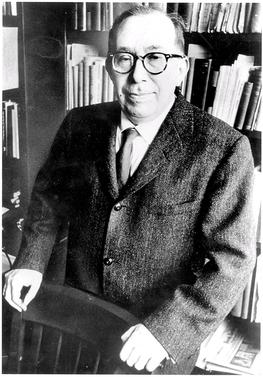
Leo Strauss
These figures are of more than casual interest to me because I'm working on a third "master" from this era: Leo Strauss.  Strauss is obviously different from Rand and Hubbard in important ways. He was a more serious thinker than they were (even his fiercest detractors would at least grant that he was more learned).  Just as importantly, he neither attained--nor tried to attain--a mass readership, let alone conventional fame (in his lifetime, at least) or fortune.  He did, however, lead a tight group of extraordinarily devoted students. And, from very early on, critics of Strauss made note of--and criticized--Strauss's following, arguing that it was a "cult" or a "cabal."

I've always tended to view the circle of students that formed around Strauss as an example of a typical German intellectual formation.  The world of early twentieth-century German thought, in which Leo Strauss came of age, was full of such Kreise ("circles").  The poet Stefan George had one.  So did Martin Heidegger.****  What was unusual about Strauss is that he (re)produced this very typically German phenomenon in his adoptive country.

But Strauss's circle was unusual in the American academic context. And his American students came to him in the midst of that American academic context, which viewed--and continues to view--his students' devotion to him with often quite fierce suspicion.  

Perhaps figures like Hubbard and Rand, and their followings, might provide an alternative context for understanding Strauss's American circle, though I have not yet worked out the most productive way to map the similarities and differences among them...and I certainly don't mean to imply that it is helpful to understand "Straussianism" as a "cult," either literally or metaphorically.


______________________________________________________
* Tony Ortega, the former editor-in-chief of The Village Voice, who has written about Scientology for close to two decades, has written about some of these parallels.

** Thank goodness for blogs!

*** The other relevant difference is that Scientology is deeply secretive and rather brutally litigious. Nevertheless, serious historical work about it is beginning to get produced.

**** In the late '20s and early '30s, first at Marburg and then in Freiburg, Heidegger led a tight group of students who saw him as, in the words of Hannah Arendt (who was one of their number), "the secret king of philosophy."  Interestingly, when, in the mid-1960s, a North American organization was formed devoted to Heidegger, it called itself the Heidegger Circle.


Senin, 24 September 2012

Revisiting Leo Strauss's "Why We Remain Jews" (A High Holidays Post)

We're currently in the middle of the Jewish High Holidays: last Monday and Tuesday were Rosh Hashanah; Yom Kippur starts this Tuesday at sunset.  I have a fairly complicated, and fluctuating, personal relationship to Judaism. I can't--and don't--claim to be a believer of any sort. Yet I always celebrate Rosh Hashanah and Yom Kippur. Since moving to Norman, I've attended a traditional High Holiday minyan that a number of faculty and community members put together at the University of Oklahoma's Hillel.  Being essentially a non-believer yet spending all day on Yom Kippur fasting and attending shul both is, and isn't, unusual.  It's unusual because, on the face of it, it doesn't make a lot of sense (it puzzled many of my non-Jewish friends in college). Yet, within the Jewish community, it's its own kind of tradition. People like me are often called "three-day Jews," a term that began life entirely pejoratively within the late-nineteenth or early twentieth-century German Jewish community, but now has slightly less negative baggage associated  with it.*

Thinking about these issues this year led me to reread Leo Strauss's lecture, "Why We Remain Jews," which was given at the University of Chicago's Hillel half a century ago, on February 4, 1962.  This talk has received much attention since its initial publication in the 1990s.** The lecture's appearance in print, and the subsequent interest in it, has reflected a more general reconsideration of Strauss as a Jewish thinker and as a thinker about Jewish things that has taken place in the last two decades or so, and which has led Strauss to be taken more seriously by a variety of academics outside the intellectual circle defined by his students and his students' students.


"Why We Remain Jews," in particular, seems to have an appeal for people who have an otherwise ambivalent relationship to Strauss.  To take two examples:  Eugene Sheppard concludes his critical, but not hostile, intellectual biography of the young Leo Strauss, Leo Strauss and the Politics of Exile (Brandeis, 2006), with a discussion of "Why We Remain Jews." This leads into the book's two concluding, unusually personal paragraphs, in which Sheppard notes that while he "reject[s] many of Strauss's fundamental convictions about humanity and politics," he sees a "progressive and radical alternative" in Strauss that has been, as yet, too little explored.*** The political scientist and anti-Straussian student of Straussians Anne Norton provides another example. Norton, author of Leo Strauss and the Politics of American Empire (Yale, 2004), which excoriates the Straussians while attempting to rescue Strauss's legacy from them, gave a talk at a conference I attended on Leo Strauss in Nottingham, England, in which she used "Why We Remain Jews" as the (somewhat, but only somewhat, ironic) basis of a bitterly righteous critique of Guantanamo and the torture and detention policies initiated by George W. Bush.  Having largely blamed Straussians for what went wrong in the Bush years in her book, Norton managed to find in Strauss's "Why We Remain Jews" resources with which to attack what she saw as his students' works.

In the broadest sense, Strauss makes a case in "Why We Remain Jews" that Judaism as a religion, very traditionally conceived, remains necessary, even for those Jews for whom religious belief "is not feasible, humanly speaking" (320).  Such a message might, in principle, be illuminating for Jews like myself.  And it was in this spirit that I reread the text during these High Holidays.

What I found, however, was not a particularly usable Strauss, at least not for me.

Like practically everything written by Leo Strauss, "Why We Remain Jews" is a complicated, multilayered text, and I'm not going to be able to summarize it comprehensively in a blog post (it's available, if you're interested, at the Internet Archive, at the link above).  The title as well as the subtitle ("Can Jewish Faith and History Still Speak to Us?") were not chosen by Strauss. Instead, his talk was one of a series of lectures on this theme, which seems to have been chosen by the U of C Hillel Rabbi Maurice Pekarsky.  Strauss reframes the theme in terms of "the Jewish Question," which Strauss does not explicitly define, but which he seems to understand very traditionally.  And his overall thesis about it is, at first glance, very straightforward: "there is no solution to the Jewish problem" (317).

Much of the talk consists of rejecting a series of potential solutions.  Individual acts of assimilation are generally doomed to failure, as people will continue to recognize the assimilated Jew (whether he has assimilated to Christianity or to secularism) as a Jew and will continue to discriminate against him (313-317).****  Collective assimilation "as a sect like any other sect" is also, in Strauss's view impossible, in part because such sects are entirely voluntary, while one's status as a Jew is a matter, in the first instance, of birth (318).  A third possible solution is "assimilation as a nation," i.e. Zionism.  But Strauss, who had been active in Zionist circles in his youth, rejects Zionism as a solution to the Jewish problem, as well. "Political Zionism," which stressed the creation of a Jewish state was too strictly political: "The mind was in no way employed, or even the heart was in no way employed, in matters Jewish" (319).  "Cultural Zionism," created in reaction to this deficit, hoped to supplement political Zionism by making "products of the Jewish mind" central to Zionism. But Strauss suggests that this effort was doomed to fail, as the "rock bottom of any Jewish culture is the Bible, the Talmud, and the Midrash. And if you take these things with a minimum of respect or seriousness, you must say that they were not meant to be products of the Jewish mind"(319-20).  This leads, in turn, to "religious Zionism," which runs aground on the fact that some Jews simply cannot return to the faith of their ancestors.

Nonetheless, argues Strauss, "[i]t is necessary to accept one's past. That means that out of this undeniable necessity one must make a virtue. The virtue in question is fidelity, loyalty, piety in the old Latin sense of the word pietas" (320). There follows a long discussion of varieties of anti-Jewish sentiment through the ages, meant to establish both the noble nature of Jewish belief and the heroic nature of Jewish struggle against persecution.  After a somewhat ironic side journey to Nietzsche's Morgenröte (The Dawn), aphorism 205 ("Of the people of Israel"), which Strauss uses to suggest that the creation of the state of Israel is, in a positive sense, the fulfillment of Nietzsche's radical vision of Jewish assimilation, Strauss reaches his conclusion:  Judaism is a "heroic delusion."  After referencing the prayer Aleinu as "the greatest expression" of this delusion, Strauss elaborates: "What is a delusion? We also say a 'dream.' No nobler dream was ever dreamt. It is surely nobler to be a victim of the most noble dream than to profit from a sordid reality and wallow in it." (328)

Strauss concludes with a discussion of the insufficiency of "positivism" and the need for science, too, to strive for the infinite:
the object of science is everything that is--being.  The belief admitted by all believers in science today--that science is by its nature essentially progressive, and eternally progressive--implies, without saying it, that being is mysterious.  And here is the point where the two lines I have tried to trace do not meet exactly, but where they come within hailing distance. And, I believe, to expect more in a general way, of people in general, would be unreasonable. (329)

After Strauss finished, Joseph Cropsey, Strauss's old friend and colleague, who had introduced the talk, noted "Dr. Strauss is known to have spoken other times on the theme of 'Jerusalem and Athens.' My only observation tonight is, I believe he has done it again." (329)

In a sense, I think Cropsey has hit the nail on the head, despite the fact that classical philosophy ("Athens") goes virtually unmentioned in the talk. Strauss's theme of "Jerusalem and Athens" consisted of the notion that revealed religion and classical philosophy were in constant tension with each other, and that the vibrancy of the West had historically depended on this tension. But modern political philosophy threatened both sides of this binary.

Classical philosophy's most significant appearance in "Why We Remain Jews" is Strauss's invocation of the virtue of pietas as underscoring the need for Jews who cannot believe to nonetheless remain loyal to the faith of their ancestors.  Strauss, it should be said, was such a Jew: an atheist by belief, but willing to affirm the importance of the most traditional understanding of Jewish religion as revealed, divine law. Strauss himself embraced neither of the possibilities that he invokes at the end of his talk, science and revealed religion. Then again, the careful listener will have noted that these are all that can be expected of "people in general." And, in Strauss's view, those fit for philosophy are, by definition, not "people in general."

For all its intellectual interest and occasional elegance, "Why We Remain Jews" remains rather unappealing to me, for the same reason that I find most of Strauss's political and philosophical conceptions unappealing.  At its heart is a rather pessimistic and deeply hierarchical understanding of human possibilities. Whatever else it may mean, my fasting on Wednesday will not be an attempt on my part to forestall nihilism by publicly reaffirming a necessary, noble delusion.

To all our Jewish readers: G'mar chatima tovah!
____________________________________________
* In the interest of full disclosure, like many contemporary American "three-day Jews," I actually only celebrate one day of Rosh Hashanah, but I also celebrate Hanukkah and Passover. Yet the old German epithet remains.

** "Why We Remain Jews" first appeared in print in Kenneth Deutch and Walter Nicgorski (eds), Leo Strauss: Political Philosopher and Jewish Thinker (Lanham, MD: Rowman & Littlefield, 1994), pp. 43-79.  It was subsequently reprinted in Leo Strauss (Kenneth Hart Green, ed.), Jewish Philosophy and the Crisis of Modernity: Essays and Lectures in Modern Jewish Thought (Albany: SUNY, 1997), pp. 311-356. Page numbers above reference this second work, which is also what I have linked to above.

*** Sheppard, Leo Strauss and the Politics of Exile, pp. 119-130.

**** This point is accompanied by a rather Friedmanite discussion of the impossibility of preventing discrimination in a liberal society, complete with warnings that the USSR is a fine example of a country that has tried to legally prohibit discrimination.  Like his fellow German-Jewish émigré Hannah Arendt, Strauss was skeptical about the advisability--or even the possibility--of attempting to legally end racial discrimination.


UPDATE (5:36 pm CDT, 9/25):  I've corrected the title of the Norton book above. I had mistakenly repeated the (very similar) title of the Sheppard book when originally posting this.

Senin, 17 September 2012

An Audio Intellectual History Bleg

A second little post for the day...

I'm trying to make out the last word in the introduction of Leo Strauss prior to his lecture on "The Socratic Question," given in Claremont, California, on February 15, 1968.*   Here's the text of the introduction (as I hear it):
Several of us contended for this honor. And, in deference to that specific spirit that characterizes Professor Strauss--if not every, single syllable of his work--we tossed a coin, thinking by that means to avoid any conflict. In this instance, chance or fortuna seized me, I hesitate to say, by the forelock.  Everyone in this room knows of Professor Strauss. There is thus no necessity, whatsoever, here to describe him to you.  I therefore say this only: Since we know him, we know, therefore how fortunate and how honored CMC and Claremont Graduate School and Claremont are that he has chosen to retire here and to teach here. Those of us who have studied with him know what a blessing it is to be able to sit before him again. Those of us who are his friends keep silent in public as to the extent of our [????].
You can find the audiofile of the lecture here. The introduction takes up the first minute-and-a-half or so.

What do you hear at the end of the intro?

_____________________________________
* I've already sent a query to the Leo Strauss Center to identify the (presumably bald) speaker.

Selasa, 05 Juni 2012

Earl Shorris and Popular Anti-Straussianism

Earl Shorris
Last week, author and educator Earl Shorris passed away at the age of 75 from non-Hodgkin's lymphoma. His New York Times obituary rightly focuses on his creation of the Clemente Course in the Humanities, the program he created in 1995 to bring a broad, liberal arts curriculum to the economically disadvantaged, which earned him a National Humanities Medal in 2000.

But the first thing I thought of when I heard of Shorris's passing was a piece that he wrote for Harper's, published in June, 2004, entitled "Ignoble Liars: Leo Strauss, George Bush, and the Philosophy of Mass Deception" (.pdf available here).  Shorris's piece was one of a series of popular works from the middle of the last decade that sought to blame Leo Strauss and his acolytes for all that had gone wrong during the Bush years.  In May, 2003, Seymour Hersh had argued in The New Yorker that a Straussian cabal was responsible for cooking U.S. intelligence on Iraq to bring about war, a charge echoed that same month by James Atlas in a New York Times op-ed.  This flurry of articles, in turn, inspired the actor Tim Robbins to write Embedded, a play that premiered in L.A. in July, 2003, which dramatized the notion that Leo Strauss was pulling the strings of the Iraq War from beyond the grave.  Shortly after Shorris's article appeared, in the fall of 2004, the documentarian Adam Curtis's The Power of Nightmares premiered on BBC television, arguing that Leo Strauss had not only been the intellectual font of neoconservatism, but had also inspired American policymakers to invent Al Qaeda.

How do these attempts to argue that Leo Strauss was the power behind the Bush throne hold up almost a decade later?  How does Shorris's piece fare among them?


My provisional answer is to the first question is that these articles, plays, and documentaries explained both too little and too much.  On the one hand, they were part of a much larger tendency to see the Bush Administration--especially post-9/11--as representing a much more radical break with the past than it in fact did.  The too-little-acknowledged continuities have become clearer now that we have had three years during which a Democratic administration has not, in fact, reversed many of the policies that critics found so appalling during the Bush years. Discovering a previously obscure, foreign, reactionary thinker as the secret cause of an administration's actions nicely fit the view of the Bush administration as a radical break from the past.  The focus on Strauss and his followers as the secret power behind the Bush administration tended to produce elaborate explanations for fairly historically common phenomena, like administrations' lying to the public about wars, while providing far too shallow critiques of other phenomena, such as long-standing problems with the national security state that had developed during the Cold War and lived on long after its end.  Stories of the trahison des Straussians also uncomfortably resembled a long tradition of anti-intellectual counter-subversive narratives, the most famous modern examples of which involved Communists during the Cold War.

All that being said, Straussians have played a smaller, but nonetheless important, role in modern American conservatism. The fact that some false conspiracy theories have been constructed about them no more makes them unimportant on the right than the falsity of most anti-Communist conspiracy theories means that Communists weren't important in the Old Left.

In the context of the popular anti-Straussian writings of the Bush years, Shorris's piece is measured and interesting, if nonetheless off-base in many typical ways.  Shorris makes his share of sloppy mistakes, some of them understandable and basically unimportant (e.g. identifying Strauss's hometown as "Kirchheim" rather than "Kirchhain") some of them significant and less defensible (e.g. identifying Grover Norquist as a Straussian).

To his credit, Shorris sets his critique in a world in which Leo Strauss did not invent public dishonesty:
It is safe to say that neither Ronald Reagan nor the Bushes have read Leo Strauss, and certainly no politician needs to be taught how to lie by a professor of philosophy.
Nevertheless, as Shorris notes in a footnote to this statement,
we need not be concerned with proving direct lines of influence. A brief summary of Straussian doctrine suffices to demonstrate its affinity with what one might call the "mind of the regime," whether any particular member of the Bush Administration has read Strauss or not.
But Shorris is sensibly uncomfortable at leaving the matter at merely identifying similarities between the behavior of the administration and (his understanding of) Strauss, so he continues in the main text of his article:
Perhaps William Kristol, while serving as Dan Quayle's chief of staff, tutored the vice president in the finer points of Platonic politics. But it is unlikely. The step from philosophy to action is almost always circuitous, Machiavelli being one of the rare exceptions. Strauss's ideas about ideas took the usual path, picked and poked and punched, mutating here, understood selectively there. At one time, Strauss wrote a sentence in which he opposed preventive war. How disappointed his followers in the Department of Defense would be to read it now in light of the wreckage they have made!  
The career of Strauss's teachings is one of the wonders and the dangers of the book, as the master himself might have said, knowing that the long life of books, unlike newspapers or television, is bound up with history in a process of indirection. The ideas in books somehow manage to wiggle through the morass of individuals and information in large modern societies and become effective. The way is not clear, but the fact of it often gives surcease to the pains of laboring in obscurity.
Two things are notable about this passage. First, it shows a much subtler understanding of the actual ways that ideas affect society than the sometimes Dan Brownish intellectual conspiracy theories that have been written about the Straussians. Secondly, there's some suggestion that Shorris sees Strauss himself as similar to Prof. Rupert Cadell (Jimmy Stewart) in Alfred Hitchcock's Rope, whose Nietzschean ideas are transformed by a student into an act of murder.  In fact, around the time Shorris wrote his Harper's piece, a number of critics of the Straussians, including both Anne Norton and Mark Lilla, began to suggest that Strauss was not a Straussian and that the master should not be blamed for the sins of his acolytes.

Shorris himself, however, is not clear on this point. One of the striking things about his article is the poignancy of his (essentially negative) portrait of Leo Strauss.  Shorris has virtually nothing good to say about Strauss's writings (which he sees as intentionally impossible to decipher and largely dedicated to bad writing for bad writing's sake) or about his political commitments (which he sees as reactionary, hierarchical, and anti-democratic).  Yet he also sees Strauss as an essentially tragic figure, whose politics were almost entirely determined by his intellectual hero Heidegger's embrace of Nazism, and who seemed (somewhat like Stewart's Prof. Cadell) to have had little desire for the powers sought by his followers:
Without question he was a brilliant professor, a frightened man whose ideas, having been battered into hiding by historic events, were eccentric. He had produced some journal articles, delivered the Walgreen Lectures, never to my knowledge appeared in the "public press," made no radio or television appearances, and during his lifetime found but a small group of readers for his books. He died obscure and far from home.
Ultimately, Shorris's take on Strauss's life and ideas is overly reductive, though much of the blame no doubt lies with the format--a seven page magazine article--as well as the unavailability of decent secondary sources about Strauss: although the situation would change drastically over the next five years, at the time Shorris wrote, not a single scholarly biography of Strauss had been published in English, and there were still very few scholarly monographs dedicated to explicating his thought.

But perhaps the most interesting thing about Shorris's article on Strauss is something that goes unstated in it.  Early in the piece, Shorris notes that Strauss
had but one core idea: read old books carefully. It was a stroke of genius, and nothing more invigorating or enlightening could be said about education, but it was not news on a campus run by Robert Maynard Hutchins, one of the inventors of the Great Books curriculum.
What Shorris doesn't mention is that he himself was very much a product of that curriculum.  Shorris attended U of C in the late '40s and early '50s, arriving there as a thirteen year-old (Chicago was known for accepting very young undergraduates) within a year or two of Leo Strauss himself.  Though he left before receiving his degree, Shorris was deeply influenced by his university's commitment to the Great Books, as his creating of the Clemente Course some four decades later attests.  As Tim Lacy has written on this blog, there were many flavors of commitment to the Great Books at Chicago.  And Shorris, like Mortimer Adler, was deeply attached to great books liberalism. As the Clemente Course suggests, Shorris saw the Great Books as documents of democratic empowerment.  But he saw Strauss as attempting to wed these books to a doctrine of elitism and obscurantism.

Shorris's piece ends with a call to resist the "Nietzschean dreams of power" that he saw as regnant, thanks to Strauss, in the Bush administration.  He's largely silent--other than those passing words of praise in that last blockquote, which could incorrectly be read as ironic--on his own abiding commitment to the Great Books.  What is clear is that Shorris saw ideas as mattering and feared not so much a conspiratorial cabal (though his article is not entirely free of loose accusations about who were Straussians in the halls of power) as the potentially catastrophic effects of bad philosophy.  And this, too, was something he shared with Leo Strauss.


Senin, 23 April 2012

On Listening to Leo Strauss


The perfect book or speech obeys in every respect the pure and merciless laws of what has been called logographic necessity.  The perfect speech contains nothing slipshod; it in there are no loose threads; it contains no word that has been picked at random; it is not marred by errors due to faulty memory or to any other kind of carelessness; strong passions and a powerful and fertile imagination are guided with ease by a reason which knows how to use the unexpected gift, which knows how to persuade and which knows how to forbid; it allows of no adornment which is not imposed by the gravity and aloofness of the subject matter; the perfect writer rejects with disdain and with some impatience the demand of vulgar rhetoric that expressions must be varied since change is pleasant. 
-- Leo Strauss, Thoughts on Machiavelli (1958), p. 121

Let me say only this: Don't pay too great attention to that [unintelligible] of mine. What I said about this prehistory of Hegel--Kant and Spinoza--was a deliberately provisional statement to lead up to this new kind of thinking. If you have any difficulty, forget about it. . . .  
Just forget about it. Don't worry too much.  I just tried...And you are not a...you probably have no teaching experience. As a teacher one has to lead up from all parts of the horizon to something. And, uh, one is not always successful at that. That has to be...I mean, teaching can never become a scientifically conductible affair. 
--Leo Strauss, Seminar on Hegel's The Philosophy of History, University of Chicago,
 Winter Quarter 1965, Session 1, January 5, 1965

In my post several weeks ago on Embodiment and Intellectual History, I mentioned the audio recordings of courses taught by Leo Strauss that are now available at the website of the Leo Strauss Center at the University of Chicago.  Here are a few preliminary thoughts about them...


I

Those of us who study the last century-and-a-quarter or so of history have at least the possibility of hearing the voices of the people about whom we write. Some historical voices are familiar to almost all of us who study the past.  My guess is that the voices of every President going back to FDR are familiar to those who read this blog.  So are the voices of other major political figures of the recent past, such as Martin Luther King, Jr.

Other voices may be less familiar but are readily available...especially in the age of the internet. The voices of poets, for example, have been of interest since the beginning of sound recording. At the click of a mouse, you can hear Walt Whitman, William Butler Yeats, T.S. Eliot, Elizabeth Bishop, Robert Lowell,   Sylvia Plath, Theodore Roethke, Allen Ginsberg, Adrienne Rich, or virtually any other well-known poet of the recent past.

But away from politics and literature, the ability to hear voices from the past is a bit more hit-and-miss. While some of the people about whom I wrote in my first book have voices that are familiar to me--Orson Welles, Franklin Roosevelt, even Frank Capra and Hannah Arendt--I know others only through their literary voices.  My guess is that there are plenty of sound recordings of Erich Fromm, Bruno Bettelheim, Dwight Macdonald, and Clement Greenberg, but if I've heard them, I forget the qualities of their voices.  I don't know if there are any readily available recordings of many of the other, more obscure, figures about whom I wrote, like Calvin B. Hoover, the Duke University economist who was one of the first to use "totalitarian" as a term to link Stalinism and Nazism, and my guess is, if such recordings exist, they'd be harder to come by.

Encountering for the first time the (actual) voice of someone whose literary voice is familiar is always an odd experience, one which we often have with the living as well as the dead. Sometimes the voice is exactly what one expects. Or, at least, it matches one's literary experience. I remember, for example, the first time I heard J.G.A. Pocock give a lecture and being struck by both the oddness of his voice and how perfectly it fit the voice on the page.

More often, at least for me, the voices I hear of those whose words are familiar to me are somewhat different from what I expected. Mind you, I don't usually formulate a precise expectation of someone's voice by reading her prose. But like literary characters whom we meet in novels, we fill in the blanks about real people whom we encounter on the page. And the initial experience of hearing their voices is often like encountering a familiar literary character in a film or stage adaptation.  What we hear is often not what we imagined.

But there is of course a big difference. Especially if we are careful readers, the image of a literary character that we develop from the page has at least as great a claim to authenticity as the adapted versions we see on the screen. To the extent that those screen versions begin to displace the versions we imagined for ourselves, something real is lost.  But the voice we hear in a recording of an historical person is that person's voice...or at least a good deal closer to it than any imagined reconstruction we come up with when reading their prose.

I'm not sure how I imagined that Leo Strauss would sound, but I was surprised when I first encountered his voice, which reminded me in many ways of my Russian grandfather, who was just a few years younger than Strauss and who learned English well after becoming fluent in German and earning a PhD at a German university (at least that's my best explanation of whatever similarity I hear).  But now that I've heard it, Strauss's voice is inseparable in my mind from Leo Strauss, who has become more concretely embodied for me than he was before.

II

As I wrote in my post on embodiment, Strauss's recorded seminars are of particular interest because of the esteem in which his students held him as a teacher.  Richard G. Stevens's claim that Strauss was "the greatest classroom teacher in the history of Western civilization" is only the most extravagant of countless celebrations of his pedagogical charisma.

As the Strauss Center's webpage notes, for years, transcripts of these recordings were passed around among a select group of Strauss's students and his students' students, always with the admonition "Recipients are emphatically requested not to seek to increase the circulation of the transcription."

The preciousness, care, and even secrecy with which these transcripts were treated reflect Strauss's peculiar notions about the relationship of oral philosophical teaching to written philosophical works. The former can be much more frank than the latter, as they are addressed to a select audience and are not available to the vulgar.*

One of the things most immediately striking about the recordings of Strauss's seminars is how different they are from his writings. Not so much in content--I have yet to encounter any "secret teachings" in my listening--as in tone.  The two passages I quote above--the first in writing about writing, the second on tape about oral teaching--capture at least part of the theoretical aspect of this difference.  The second comes from Strauss's answer to a student's question about Strauss's very condensed discussion of Kant, Spinoza, and Jacobi with which Strauss had begun his introductory meeting of his seminar on Hegel's Philosophy of History.  In this quotation, Strauss puts forward a vision of classroom teaching that is utterly different from his notion of philosophical writing, which is, in turn, nicely captured in the quotation above it from his Thoughts on Machiavelli.  Strauss's method of reading philosophy entails assuming that serious philosophers are simply incapable of making errors...so any apparent error in a philosophical text (or at least in a pre-modern philosophical text) is an indication of some sort of esoteric teaching.  But clearly Strauss understands the task of oral instruction differently.  I suspect I am not alone, among those who find Straussian (written) hermeneutics hard to swallow, in finding Strauss's humility about the provisional nature of teaching refreshing.

And indeed the feeling of Strauss's seminar lectures (and these are very much lectures) is utterly different from the feelings of his writings.  Strauss's written work is dense, allusive, and often elusive.  Although followers of Strauss deeply value these written for, among other things, their style, many non-Straussians find them exquisitely dull.  "It is a general observation," Strauss writes in his essay "How to Study Spinoza's Theologico-Political Treatise" from Persecution and the Art of Writing, "that people write as they read."**  And Leo Strauss certainly treated the writings of other philosophers as esoteric puzzle palaces.

His lectures, on the other hand, seem different.  They are much more typical of good lectures in their approach than his books are typical of good books. Strauss emphasizes and reemphasizes important points. He incorporates examples from current events to illustrate his points. He interacts with his students in a way that indicates both that he takes them seriously, but that he knows exactly where he wants to lead them (his pedagogical persona is, unsurprisingly, old-fashioned in this regard).  While they certainly do not move me to agree that he was the greatest teacher since Plato, Strauss's pedagogical charisma is clear in them.

III

Now broadly available, the lectures provide an excellent new (to the rest of us) way to get a sense of Leo Strauss's approach to political philosophy. Take, for example, the Introduction to Political Philosophy that Strauss offered at the U of C during the Winter Quarter of 1965.  Like most of the courses for which recordings are available, this one is incomplete; only nine of the sixteen sessions are preserved on tape. As far as I can tell, the recordings represent nine of the first ten class meetings, with the last five meetings missing (the recordings are numbered one to nine, but there appears to be a lecture skipped in the midst of them).

For those unversed in Strauss, the arrangement of material might seem odd. Strauss begins his opening lecture by noting that political philosophy, in the classical sense, seems utterly impossible today.  He then spends the next six, hour-and-a-half-long sessions elaborating the reasons for this sense of impossibility. All of the first two lectures and the beginning of the third concern Auguste Comte and positivism.  The rest of Lecture Three, all of Lecture Four, and the beginning of Lecture Five concern the notion of value-free social science...and its inadequacy in Strauss's view.  The remainder of Lecture Five and all of Lecture Six concern historicism.

Strauss thus spends more than the first third of his class meticulously describing three of his major bêtes noires: positivism, the fact-value distinction, and historicism. All of this, again, is by way of explaining why political philosophy seems impossible in 1965.

Finally, in Lecture Seven, Strauss begins to tackle the history of political philosophy, which, Strauss argues, unlike political philosophy itself, is still seen as necessary.  He begins discussing the history of political philosophy by way of another great Straussian trope, the quarrel between the ancients and the moderns. This then leads to a discussion of Hobbes and Rousseau, who represent what Strauss sees as the first and second waves of modernity.*** 

Lecture Eight continues to describe the ways in which modern political philosophy departs from classical political philosophy, which Strauss has still not discussed at any length. At various times, Kant, Descartes, Hegel, and Nietzsche, the last the representative figure from Strauss's third wave of modernity, come into the discussion.  The lecture concludes with the thought that, unlike modern political thought, which locates itself outside the realm of everyday politics, classical political philosophy "has its stand within the political sphere."

In Lecture Nine, Strauss finally works his way to classical political philosophy and a discussion of Aristotle's Politics.

Strauss's extraordinarily long journey to the subject at hand in these lectures seems to instantiate his notion  (in his written works) of modernity's constituting a second cave from which we must crawl merely to find ourselves in the "natural" cave described by Plato.  The lectures also provide a concrete answer to what is sometimes seen as a core paradox of Strauss's work: the fact that this implacable foe of historicism appears to have devoted his career to explicating the history of political philosophy.  As Strauss explains in exhaustive detail in the early lectures, given that political philosophy seems impossible today, while the history of political philosophy seems not only possible but necessary, that history must be our path back to political philosophy itself.

I'm not sure that I would have gotten all of this out of these lectures had I not first read much Strauss, and much about Strauss. And from the point of view of intellectual history, the status of these seminars is complicated: they are both public and private documents, depending on how one looks at them. But they are a fascinating resource.
______________________________________
* For more on this issue, see Strauss's Persecution and the Art of Writing (1952), esp. Chapter 2.  This is also not to say that Strauss is being entirely frank in his seminars. But he is certainly addressing a more select audience.

** Persecution and the Art of Writing, 144.

*** Strauss does not talk of the three waves in this lecture, but the idea structures his discussion of modern political philosophy here in many ways.


Senin, 20 Februari 2012

Embodiment and Intellectual History


I recently came across this picture of a Palestinian / American Jewish Roundtable sponsored by the journal Tikkun in the late 1980s. It shows (from left to right) Michael Walzer, Ibrahim Abu-Lughod, Michael Lerner, Edward Said, and Letty Pogrebin.*

What struck me immediately about this image, really the instant I saw it, was how distinctly both Walzer and Said are performing themselves in it.  My ability to say this about Walzer and Said comes from having seen both of them in action:  Said, twice, in graduate school, and Walzer, on a number of occasions over the years, most recently at the latest S-USIH conference last November.  For anyone who experienced Said, or who has experienced Walzer, in person, their gestures in the above photograph are extraordinarily evocative.  (For all I know, the same might be said about Abu-Lughod, Lerner, or Pogrebin, but I have no personal experience of any of them.)

Long before I experienced Walzer or Said in person I had read Just and Unjust Wars and (parts of) Orientalism.**  But seeing each in person altered my relationship to the words on the page...and indeed, expanded my sense of each as a thinker beyond the words on the page.

Historians--perhaps especially intellectual historians--tend to be oriented toward the written word. Over the years some of us have become better at working with media like film, photography, radio, or the plastic arts that are less dependent on the written word.  But one thing I don't think intellectual historians always do as well as we might is deal with the way intellectuals -- and I mean that term broadly -- embody their ideas, the way in which the physical qualities of an intellectual -- the tone of her voice, his self-presentation, her very physical presence -- can have an impact on the transmission, perhaps even the shape, of thought.


If anything, reminding ourselves and our students of the importance of intellectuals' physical presences may grow more important as disembodied communication technologies become more and more ubiquitous.

These questions are a particular issue in my current project on the legacies of Leo Strauss in American public culture.  Leo Strauss by all accounts possessed an extraordinary pedagogical charisma.  Richard G. Stevens has even declared that Strauss was "the greatest classroom teacher in the history of Western Civilization."***  Strauss's students and students's students so esteemed Leo Strauss's classroom performances that, for decades, they privately circulated transcribed recordings of Strauss's classroom lectures.****

But these transcriptions were not generally publicly available. And such a written record would presumably be a pale reflection of the purportedly extraordinary performances that they recorded.

In recent years, however, the Leo Strauss Center at the University of Chicago has begun to put online recordings of classes offered by Leo Strauss at the University of Chicago, Claremont Men's College, and St. John's College from 1958 through 1973.  This effort is the culmination of a slow but steady growth in the openness with which Strauss's students and his students' students have treated the legacy of Strauss. Through the 1970s, many of his students avoided even mentioning Strauss's name in print.  By the late 1990s, the classicist and Strauss student Seth Benardete published Leo Strauss on Plato's Symposium, based on transcribed lectures from a course on Plato's political philosophy that Strauss had given some four decades earlier.*****

There are now recordings of more than thirty courses taught by Strauss available online; twenty more will soon join them.  For those of us interested in Leo Strauss, they're an extraordinary resource that gets us a big step closer to the experience of sitting in the classroom with Strauss himself.

And yet, a voice recording is still not the same thing as watching someone lecture.  I would not have my reaction to the photograph above had I only listened to audio recordings of Walzer and Said.

Having access to such records of the objects of a study is, of course, a luxury reserved for historians of the fairly recent past.  Motion picture records of historical actors are only a little over a century old; audio recordings just a few decades older.


And experiencing these recordings only raises again the question that I've asked above: as intellectual historians, how do we deal with these embodied aspects of the people we study?  

Broader cultural changes certainly affect my reactions to a half-century old recording of Leo Strauss, which might be utterly different from those of a University of Chicago student taking the course at the time the recording was made.  Listening to such a recording while walking my dog as a tenured faculty member in Norman, Oklahoma, is very obviously a different experience from sitting in a no doubt challenging class as an undergraduate in Hyde Park.  


And to the extent that we can translate from our experience of such recordings to that of those present for the original performance (we often have the written remembrances of those who experienced the person in question to help with this process), how should we incorporate this knowledge into the intellectual history we produce?

Most often, I think, these embodied aspects of the people about whom we write get relegated to introductory paragraphs, in which we describe the person we're writing about before turning to the more important matters of the ideas (and texts!) they produced.  But I suspect, at least in certain cases, these embodied aspects of intellectual production are more important than we usually make them out to be.  But I'm not sure what to do with this thought in my own historical practice.

_________________________________
* This picture appeared in Allen Graubard, "From Commentary to Tikkun: The Past and Future of 'Progressive Jewish Intellectuals,'"  Middle East Report, May-June 1989, 17-23 (JSTOR Link).

** In the interest of full disclosure, I may have experienced Said as a dinner guest of my parents during the year they were all at the Center for Advanced Study in the Behavioral Sciences at Stanford (t-shirt slogan: "The Leisure of the Theory Class").  But as I was in fifth grade at the time, I don't think this counts.

*** Richard G. Stevens, "Martin Diamond's Contribution to American Political Thought: Editor's Preface," The Political Science Reviewer v. XXVIII (1999), 3.

**** These transcriptions were also particularly valued for another reason:  Strauss and his students, drawing in part on Plato (as they understand him), have often prized philosophers' oral "teachings" above written ones.  This is, in effect, a special case of the general Straussian assumption that careful speakers and writers tailor their words for their audience. The audience for a written work is necessarily broader and less in the author's control (which is just one of the reasons, Strauss believed, that philosophers write esoterically).  But philosophers can be more frank when talking to their students. For decades, students of Strauss (and their students in turn) privately circulated transcriptions of Leo Strauss's classroom lectures, each bearing the headnote "Recipients are emphatically requested not to seek to increase the circulation of the transcription."

***** This project began while Strauss was still alive, but he was apparently never satisfied with the material so it remained unpublished for decades.

Senin, 24 Oktober 2011

"Positivism": A Bleg

A Word of Many Meanings
One of the bêtes noires of Leo Strauss and his students is "positivism."  The term appears frequently in Strauss's own (English-language) writings of the 1950s and beyond.  For example, Strauss's essay "The Liberalism of Classical Political Philosophy," which originally appeared in 1959 in The Review of Metaphysics and was later published as Chapter 3 of Liberalism Ancient and Modern (1968), begins with a polemic against "positivism":

Classical political philosophy--the political philosophy originated by Socrates and elaborated by Plato and by Aristotle--is today generally rejected as obsolete. The difference between, not to say the mutual incompatibility of, the two grounds on which it is rejected corresponds to the difference between the two schools of thought which predominate in our age, namely, positivism and existentialism. Positivism rejects classical political philosophy with a view to its mode as unscientific and with a view to its substance as undemocratic. There is a tension between these grounds, for, according to positivism, science is incapable of validating any value judgment and therefore science can never reject a doctrine because it is undemocratic. But "the heart has its reasons which reason does not know," and not indeed positivism but many positivists possess a heart. Moreover there is an affinity between present day positivism and sympathy for a certain kind of democracy; that affinity is due to the broad, not merely methodological, context out of which positivism emerged or to the hidden premises of positivism which positivism is unable to articulate because it is constitutionally unable to conceive of itself as a problem. Positivism may be said to be more dogmatic than any other position of which we have records.
Strauss's identification of positivism and existentialism as "the two schools of thought which predominate in our age" may have been something of an exaggeration, but was, at the time in which he wrote these words in the late 1950s, at least grounded in intellectual reality.  "Positivism" was a powerful, positive word in the American academy at the time, though it often meant different things in different intellectual places, from social scientists' adherence to certain empirical approaches to its use by early analytic philosophers, for whom the Vienna Circle's logical positivism was very important. In the context of legal scholarship, "positivism" has yet another set of connotations.

Today, Strauss's critique of positivism remains vitally important for younger thinkers in the Straussian vein.  For example, Nasser Behnegar's Leo Strauss, Max Weber, and the Scientific Study of Politics (2005) is largely a recapitulation of Strauss's critique of positivism.

But what exactly do Strauss and his followers mean by positivism?

Political scientist Stanley Rothman, an early critic of Strauss and his school of thought, noted in 1962 that Strauss "never really defines with any precision" what he means by the label "positivist."*

And, as even some Straussians note, today the term "positivism," if it appears at all in American academic writing, tends to be a pejorative.** For example, "positivism" is the charge leveled against Sam Harris by Jackson Lears in a recent, scathing Nation review.***  And logical positivism, once a dominant view in philosophy of science, is in the words of John Passmore, "dead, or as dead as a philosophical movement ever becomes."****

But while it's clear that positivism's fortunes were up in the 1950s and down half a century later,  the diversity of meanings attached to the term makes its history more difficult to grasp.

The term "positivism" was coined by the 19th-century French philosopher and sociologist Auguste Comte.  The social scientific usages of "positivism" in the 20th century seem to be in many ways direct descendents of Comte's thought. But the stream of ideas that led to the Vienna Circle's logical positivism is usually seen as flowing from the philosophical work of Ernst Mach.*****

So here's the bleg: does anyone know of any fairly comprehensive treatment of the history of the term "positivism" in its various national and disciplinary contexts?

My hunch is that the role of positivism in Strauss's mature works of the 1950s and '60s has something to do with his international intellectual biography. His education took place in the early interwar period in German intellectual circles that had just finished beating back Machian positivism and were then battling the emergent logical positivism of the Vienna Circle. Strauss arrived in the quite different intellectual context of the U.S. in the late 1930s and took some years establishing himself as  a major intellectual figure in his adoptive country.  Strauss may well have recognized the ascendent positivism of the post-World War II American academy as an old, familiar foe.  But was it, in fact, the same opponent?
___________________________________
* Stanley Rothman, "The Revival of Classical Political Philosophy: A Critique," The American Political Science Review, Vol. 56, No. 2 (Jun., 1962), 350.

** Strauss student Thomas Pangle in Leo Strauss: An Introduction to His Thought and Intellectual Legacy (Johns Hopkins, 2006) notes that "positivism" is currently out of fashion...though the thought is relegated to a footnote (pp. 135-6).


*** I thank Andrew Hartman for pointing me in the direction of this review in a post on this blog

**** Quoted in the Wikipedia entry on logical positivism

***** Mach's positivism and its relationship to the later logical positivism of the Vienna Circle is nicely covered in Edward Sidelsky's fascinating intellectual biography of Strauss's Doktorvater, Ernst Cassirer, who was himself a significant critic of logical positivism.


Senin, 17 Oktober 2011

Will "Straussianism" Become Like "Deconstruction" in Popular Discourse?

 Begging for a Straussian Reading of Some Kind?
Yesterday, Tim Lacy called my attention to this piece by Matt Yglesias in which he analyzes a recent piece by New York Times columnist David Brooks.

"David Brooks’ column 'The Thing Itself' is just begging for a Straussian reading of some kind," Yglesias begins.  Even as a student of popular anti-Straussianism, I was initially at something of a loss to see what Yglesias was talking about.

Brooks's column is--or perhaps one should say in deference to Yglesias "appears to be"--a celebration of outgoing Port Authority head Chris Ward and his, at least according to Brooks, extremely practical approach to rebuilding at Ground Zero.  Brooks then uses Ward's practicality-over-symbolism as a positive contrast to a variety of issues that Brooks argues have been dominated by "culture war" purism, e.g. the politics of gun ownership and Obama's Green Tech initiative.*

But according to Yglesias, this isn't really what the column is about.


Pointing out that the column's title phrase (repeated in its body) is a translation of Kant's Ding an sich, which is "unknowable and inexpressible," Yglesias suggests that the column is thus really arguing something quite different:
The basic topic of the column is perfectly plausible here. A call for people to be more practical. But why link that idea specifically to Kant’s phrase, and then use it to call for us to do something that Kant says is impossible? I get a distinct air of Leo Strauss and the University of Chicago around this. Brooks is winking at those of us in the know to signal to us that there’s a deeper meaning afoot. The esoteric argument, I think, is that people necessarily engage with mass politics on a symbolic and expressive level rather than a practical way (voting isn’t very practical) so our endeavors are doomed to failure.
Why would an argument of the sort that Yglesias suggests Brooks is making have to be presented esoterically? How does it in any way contradict the explicit message of the piece?  Far from challenging the conventional wisdom of our day, the idea that mass politics is inherently irrational and militates against practical solutions is practically a dogma of our nation's punditocracy.  And it certainly doesn't contradict Brooks's explicit praise for the practicality of an appointed official.

But there's a more basic problem here.  David Brooks isn't a Straussian.  Indeed, before I saw this piece, I would have told you that, in an era in which practically everyone on the right has gotten called a Straussian by somebody at one time or another, Brooks had the relatively rare distinction of never being so labelled. After all, Brooks seems more interested in the nonexistent salad bar at Applebee's than in the "timeless questions" that Straussians concern themselves with.  Even when Brooks considered questions of human nature in his latest book, The Social Animal, he turned to (poorly understood and popularized) neuroscience, rather than to Socratic philosophy, to explain it.

But then I discovered that Yglesias, at least, has been calling Brooks a Straussian for years.  The 2005 Brooks column Yglesias focuses on in this earlier piece is even less "Straussian" than  the one about Chris Ward. Written on the eve of President George W. Bush's first Supreme Court appointment, Brooks starts by calling on Dubya to look for a "philosophical powerhouse," then suggests Michael McConnell, whom Brooks praises for having a less strict understanding of the separation of church and state.  Yglesias correctly points out that the column's first argument--that Presidents should appoint smart people to the court--is not its most important, which is that the separation of church and state should be eased.  But burying the lede as Brooks does here is hardly an example of esotericism, let alone Straussianism.

As far as I can tell, the case that Brooks is a Straussian is based on guilt by extremely vague association. He is Jewish. He's arguably a neoconservative.  He went to the University of Chicago.

However, Brooks majored in history. And, as readers of this blog are well aware, there's nothing remotely Straussian about the History Department at Chicago...or for that matter about most departments at Chicago beyond Political Science and the Committee on Social Thought (even they include plenty of non-Straussians alongside their Straussians).

And what makes this column "Straussian"? It has a reference to a German philosophical concept that would likely go over the heads of many readers.  It disparages democratic politics. And it does so in a way that doesn't emphasize that argument.

But, like the earlier Brooks column that Yglesias called Straussian, this column's argument is not an instance of esotericism in the Straussian (or for that matter any other) sense. Brooks disparages politics entirely openly in the piece. Chris Ward, whom he praises, notably didn't get his job via election; he was appointed, first by Mayor Michael Bloomberg to another post, and then by Governor David Paterson, to his current one.  Brooks does like to sugarcoat his often quite conservative arguments in moderate-sounding rhetoric. But, again, that's not esotericism.

There are a number of pretty simple lessons here: Not all neoconservatives are Straussians.  Not all graduates of the University of Chicago are Straussians.  Not all elitists are Straussians. People besides Straussians sometimes make references to highfalutin' German philosophical concepts.  People besides Straussians try to tailor their arguments for their audience...and there are many ways to do so that do not involve esotericism. And people besides Straussians sometimes harbor anti-democratic political views.

But I also wonder whether we are beginning to see the term "Straussian" take a rhetorical journey similar to that which "deconstruction" took in the last quarter of the twentieth century. "Deconstruction" began life as a technical term coined by Jacques Derrida to describe his method of reading a text. It then entered popular language as a pejorative to describe any abstruse form of textual analysis. And then the pejorative connotation began to fall away.  Today people often say "deconstruct" when they really mean nothing more than "analyze carefully."
______________________________

* This argument really is classic Brooks.  Immediately after making a pseudo-moderate, pox-on-both-houses argument about the essentially dead issue of gun control, Brooks hauls out a standard, right-wing Republican talkingpoint about a very live issue:  "President Obama’s Green Tech initiative has become a policy disaster — not only at Solyndra but at one program after another — because its champions ignored basic practical considerations. They were befogged by their own visions of purity and virtue."

Senin, 19 September 2011

Sen. Charles Percy (1919-2011) and the Straussians

This Saturday, September 17, former Senator Charles Percy (R-IL) passed away after suffering for years with Alzheimer's disease.  Percy, who served in the Senate from 1967 to 1985, was a leading example of a now extinct breed: the liberal Republican. Within months of being elected to the Senate, Percy was spoken of as a likely GOP Presidential nominee. But his meteoric rise within the liberal wing of his party came as that wing was rapidly losing influence. In 1968, rather than run himself, he endorsed Nelson Rockefeller's Republican presidential primary bid.  He had planned a run in 1976, before Nixon's resignation meant that a GOP incumbent would run that year (in fact, Percy, no fan of Nixon, had been the first Senator to propose an independent prosecutor to investigate Watergate). So Percy endorsed Ford's reelection. In 1984, he lost his Senate seat to Paul Simon, in part due to AIPAC opposition to Percy, who had supported the sale of AWACS to Saudi Arabia.  Percy's career, first as President of Bell & Howell, and then in the U.S. Senate is covered well in his New York Times obituary and elsewhere.

But I want to focus on a little noted aspect of Percy's biography, one that links him to a strand of U.S. intellectual history that is rarely, if ever, mentioned in the same sentence as liberal Republicanism: the legacy of Leo Strauss. 

A key figure in Chuck Percy's move from the boardroom to the hustings was the political theorist Robert A. Goldwin.  Goldwin did his PhD under Leo Strauss at Chicago. And though he spent about a decade in the academy (at the University of Chicago, Kenyon College, and St. John's College, where he served as Dean, replacing Strauss's closest intellectual friend, Jakob Klein), Goldwin made his biggest mark as a public intellectual, putting leading figures in business and politics in contact with political theorists, especially Straussian ones, at the Public Affairs Conference Center which he directed, first at Chicago (1960-66) and then at Kenyon (1966-69). After a stint working in two presidential administrations, he finished his career as a resident scholar at the American Enterprise Institute.*

Percy had been President of the Bell & Howell Corporation since 1949. By the late 1950s, he had begun to consider a move to politics, apparently encouraged by President Eisenhower, among others. In 1960, he chaired the Platform Committee at the Republican National Convention.  But his first run for office would be in 1964, when he was the Republican candidate for Governor of Illinois, eventually losing a closely fought race to the Democratic incumbent Otto Kerner (who would later chair LBJ's National Advisory Commission on Civil Disorders, which popularly bears his name).

In the run-up to this foray into electoral politics, Robert Goldwin played a key role, an account of which can be found in David Murray's Charles Percy of Illinois (New York: Harper & Row, 1968), a campaign biography for a presidential run that never was:

One day in Pittsburgh, where he had gone for a Republican function, he met a young professor of political science from the University of Chicago, Robert A. Goldwin, a man with a basically conservative turn of mind, who talked with Percy at some length--then and later--about the theory that lay behind the everyday business of the ordering of man's life.  For Percy, Goldwin's book learning and philosophy filled a need; the successful pragmatist had to know not just the how but the why.  He and Goldwin talked more in the months that followed, and Goldwin was hired on a more or less regular basis, to come to [Percy's hometown of] Kenilworth each Saturday for several hours to conduct a one-student seminar.  It was the latter-day fulfillment of the definition of ideal American education--Mark Hopkins on one end of a log and a student on the other.

"He's the only businessman I know who has read all The Federalist papers," Goldwin said once.  "We used to have assignments--reading that he would do and essays he would write about what he had read--and we'd talk about the ideas that he had found. . . ."

Another Percy associate who was with him in those days with Goldwin said later: "Those talks and those sessions with Goldwin filled a gap in Chuck's approach to the world. He knew that some things happen which shouldn't happen and that other things that should happen don't happen. This told him some of the reasons for things.  He knew, for example, that he was a Republican; he'd always been one because his family was.  Now he knew what the philosophy behind his thinking really was, that there was, in many instances, a Republican way of getting at a problem and a Democratic way of getting at it. He found out why the two were different and--I think this is even more important--that the Republican way might not always be the best way to go about it." (pp. 44-45)
Goldwin apparently worked on Percy's unsuccessful 1964 gubernatorial campaign, though not on Percy's successful run for the Senate in 1966, when Percy defeated longtime Democratic Senator Paul Douglas (Goldwin had, by the fall of 1966, moved to Kenyon).  Percy, for his part, contributed an introduction to a book by another Straussian, Harry Jaffa's Equality and Liberty (1965).

But while Goldwin's connection to his other major political advisee--Congressman, and later Ambassador to NATO, Presidential Chief of Staff, and Secretary of Defense, Donald Rumsfeld--would be much more public, the connections of Goldwin and his fellow Straussians to Charles Percy apparently continued.   Nathan Tarcov, who is in the next intellectual generation of Straussians, told me that when he took a break from academia at the beginning of the 1980s, he put out feelers to Percy's office before eventually accepting a post in Reagan's State Department Policy Planning Office.

I find Percy's connection to the Straussians fascinating, in part because it violates so many clichés about Straussianism in American politics.  Percy was neither Jewish nor Catholic (he was, in fact, a practicing Christian Scientist).  He was a moderate liberal, not a conservative (let alone a neocon).  In the midst of the Watergate scandal he distinguished himself by opposing the Machiavellian political maneuvering of a President from his own party.  And his eventual political defeat came about in large measure because he was seen as soft on Israel.

None of this should lead us to see Percy as a typical Straussian (or, perhaps, as a Straussian at all). You may have noticed that even David Murray, in the passage quoted from his 1968 campaign biography of Percy, made a point of correctly stressing that Goldwin--unlike Percy--was "a man with a basically conservative turn of mind" (though interestingly, but not at all surprisingly, Leo Strauss's name never comes up in Murray's book).    And Jaffa, who had fallings out with many of his fellow Strauss students in the 1970s, wrote a bitter letter to Goldwin, during the latter's stint in the Ford Administration, mocking Chuck Percy and Goldwin's attempts to tutor him.

But Percy and his connection to the Straussians should lead us to realize that the legacy of Leo Strauss and his students in American public life is more complicated and polyvocal than it is often portrayed as being.
____________________________________________
* I've previously blogged about Goldwin in his later capacity as the "White House Intellectual" of the Ford Administration.