Tampilkan postingan dengan label high versus low thought. Tampilkan semua postingan

Rabu, 21 Oktober 2009

Brow-Beaten, or The Heimlich Maneuver

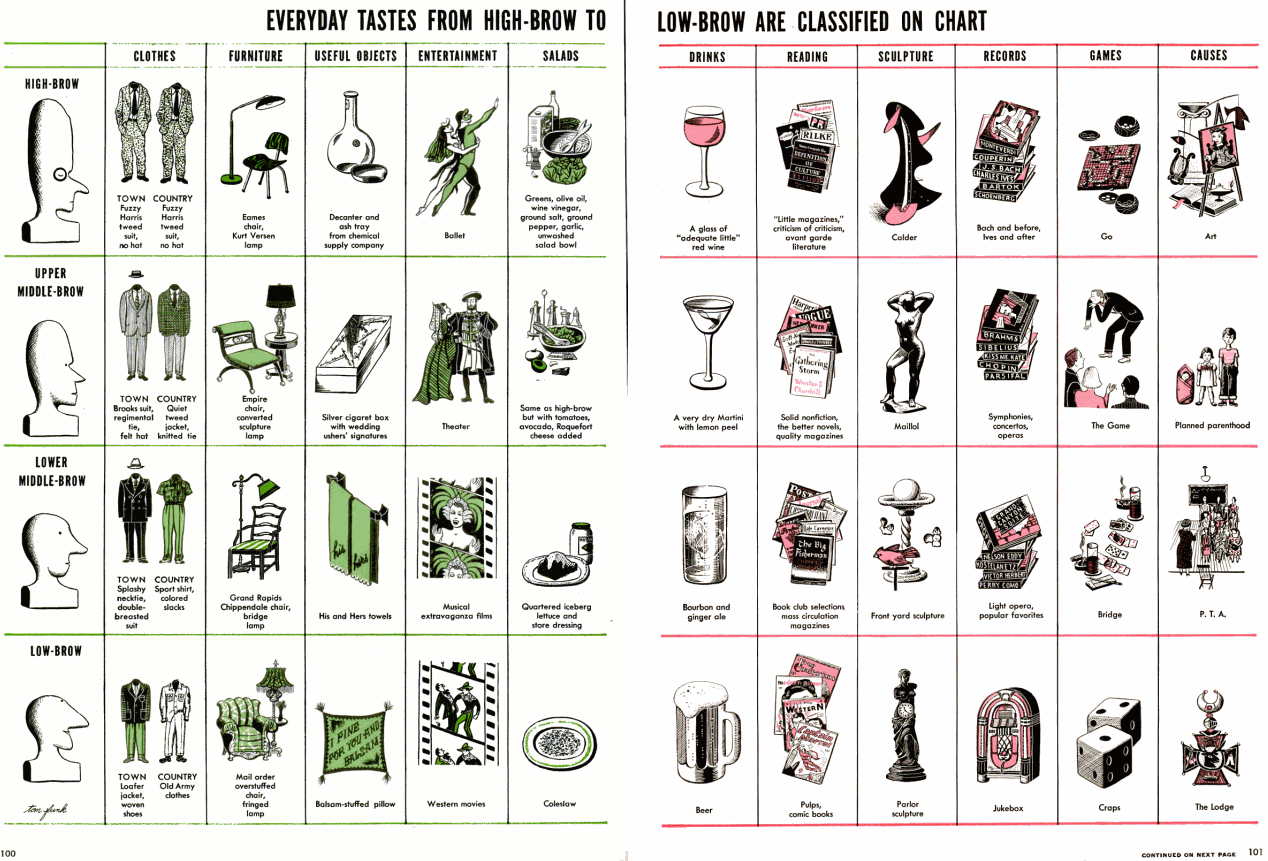
There's an interesting conversation afoot in two threads over on Crooked Timber about highbrow, middlebrow, and lowbrow (first post here, second here), which keeps leaping back and forth between intellectual history (the conversation begins with the 1949 Life magazine chart of highbrow, upper middlebrow, lower middlebrow, and lowbrow taste) and contemporary cultural analysis. In short, our kind of thing (or at least, my kind of thing....no need to unnecessarily implicate my fellow USIHers!).

Along the way we get some Lawrence Levine, a dash of Christopher Lasch, references to a couple recent books that I didn't know but really should have (just what I need....additions to the reading list), and, of course, Bourdieu sauvé des eaux.

Perhaps inevitably, it turns out there's an (actually interesting looking) blog devoted to this pursuit: Hilobrow. In the second Crooked Timber thread, Josh Glenn, one of the Hilorophants, complicates things:

Over at Hilobrow.com ... we agree with Bourdieu that aesthetics and lifestyle choices aren’t entirely independent of social class. Though (along with Carl Wilson) we reject the reductionism of his Distinction, we do rely on Bourdieu’s notion of the “disposition” (a tendency to act in a specified way, to take on a certain position in any field) and the “habitus” (the choice of positions in a field, according to one’s disposition). We’ve named and located 10 bourdieuian dispositions — 4 heimlich (Highbrow, Lowbrow, Neo-Aristocratic (Anti-Lowbrow), Quasi-Populist (Anti-Highbrow)); 2 gemütlich (High Middlebrow, or what Dwight Macdonald called Midcult; and Low Middlebrow, which Macdonald, following Adorno, called Masscult); 2 unheimlich (Nobrow, not to be confused with John Seabrook’s confused use of the term; and Hilobrow, our own coinage); and then there’s Unbrow, which Van Wyck Brooks confusingly called Lowbrow. There are various habituses possible within each of these dispositions, but since the mid-17th-century, these dispositions have formed into an invisible matrix of influence.


Who says intellectual history is dead?

Brow-Beaten, or The Heimlich Maneuver

There's an interesting conversation afoot in two threads over on Crooked Timber about highbrow, middlebrow, and lowbrow (first post here, second here), which keeps leaping back and forth between intellectual history (the conversation begins with the 1949 Life magazine chart of highbrow, upper middlebrow, lower middlebrow, and lowbrow taste) and contemporary cultural analysis. In short, our kind of thing (or at least, my kind of thing....no need to unnecessarily implicate my fellow USIHers!).

Along the way we get some Lawrence Levine, a dash of Christopher Lasch, references to a couple recent books that I didn't know but really should have (just what I need....additions to the reading list), and, of course, Bourdieu sauvé des eaux.

Perhaps inevitably, it turns out there's an (actually interesting looking) blog devoted to this pursuit: Hilobrow. In the second Crooked Timber thread, Josh Glenn, one of the Hilorophants, complicates things:

Over at Hilobrow.com ... we agree with Bourdieu that aesthetics and lifestyle choices aren’t entirely independent of social class. Though (along with Carl Wilson) we reject the reductionism of his Distinction, we do rely on Bourdieu’s notion of the “disposition” (a tendency to act in a specified way, to take on a certain position in any field) and the “habitus” (the choice of positions in a field, according to one’s disposition). We’ve named and located 10 bourdieuian dispositions — 4 heimlich (Highbrow, Lowbrow, Neo-Aristocratic (Anti-Lowbrow), Quasi-Populist (Anti-Highbrow)); 2 gemütlich (High Middlebrow, or what Dwight Macdonald called Midcult; and Low Middlebrow, which Macdonald, following Adorno, called Masscult); 2 unheimlich (Nobrow, not to be confused with John Seabrook’s confused use of the term; and Hilobrow, our own coinage); and then there’s Unbrow, which Van Wyck Brooks confusingly called Lowbrow. There are various habituses possible within each of these dispositions, but since the mid-17th-century, these dispositions have formed into an invisible matrix of influence.


Who says intellectual history is dead?
Rabu, 19 Agustus 2009

Proposition For Debate: Change In The Objects Of Study For Intellectual Historians

[Updated: 8/20/09, 9:35 CST]

Intellectual historians have traditionally been concerned with high and complex thought---traditional philosophical topics (Deweyan instrumentalism, Jamesian pragmatism, etc.) or practical applications thereof (Deweyites in education, Jamesians in psychology, etc.). These concerns might involve iterations of larger, more evident ideas or topics (e.g. freedom, democracy, knowledge, truth), or it might involve history books that make explicit subtle points of method (e.g. language theory, logic, arguments). The point is that a kind of top-down movement pervades this tradition---from complex ideas and/or prominent thinkers, to historical evidence.

But because higher thought exists and is on record, this does not necessitate that intellectual historians should neglect “lower thought.” By lower thought I mean that which is not recognized or always respected by philosophers or intellectual historians. This includes non-Western thought processes, the varieties of emotion, the appearance of unreasonableness (e.g. popular culture frivolity, ideologues), and less articulate attempts to rise above everyday circumstances. Of course this may involve occasional speculation on the part of historians to fill the gap inevitably left by the less articulate.

I do not mean to assert that a move toward the broad study of less complex thought should necessitate the neglect of higher modes of thought. A move toward more popular expressions of the intellect is meant only to (a) show the appeal of intellectual history to more readers and citizens, and (b) serve as a bulwark against the charge of elitism in intellectual history (e.g. concern only for those who express themselves well or in a complex fashion in the archives).

Be it resolved, then, that some significant portion of intellectual historians should, if not already doing so, concern themselves with classes of people traditionally considered less or in-articulate, irrational, emotional, or whose apparent actions would formerly indicate irrationality or radical differences in reasoning method.

-------------------------------------------

What am I forgetting? Is this proposition so obvious as to be irrelevant? Per the 1977 Wingspread Conference, has the history of culture, or cultural history, fulfilled this obligation? If so, has it done it satisfactorily? Is forwarding this proposition just another case of one forgetting about the “hidden intellectual history” of the past 30 years or so—--the kind of intellectual history that is now scattered over many other subfields? An example that might prove this point could be Michael Denning’s much-discussed and admired study, The Cultural Front. Are there not enough of those kinds of books? But have books on immigration history and the history of emotions, for instance, made an effort from the bottom up to connect historical actors to traditional streams of intellectual history? - TL

Proposition For Debate: Change In The Objects Of Study For Intellectual Historians

[Updated: 8/20/09, 9:35 CST]

Intellectual historians have traditionally been concerned with high and complex thought---traditional philosophical topics (Deweyan instrumentalism, Jamesian pragmatism, etc.) or practical applications thereof (Deweyites in education, Jamesians in psychology, etc.). These concerns might involve iterations of larger, more evident ideas or topics (e.g. freedom, democracy, knowledge, truth), or it might involve history books that make explicit subtle points of method (e.g. language theory, logic, arguments). The point is that a kind of top-down movement pervades this tradition---from complex ideas and/or prominent thinkers, to historical evidence.

But because higher thought exists and is on record, this does not necessitate that intellectual historians should neglect “lower thought.” By lower thought I mean that which is not recognized or always respected by philosophers or intellectual historians. This includes non-Western thought processes, the varieties of emotion, the appearance of unreasonableness (e.g. popular culture frivolity, ideologues), and less articulate attempts to rise above everyday circumstances. Of course this may involve occasional speculation on the part of historians to fill the gap inevitably left by the less articulate.

I do not mean to assert that a move toward the broad study of less complex thought should necessitate the neglect of higher modes of thought. A move toward more popular expressions of the intellect is meant only to (a) show the appeal of intellectual history to more readers and citizens, and (b) serve as a bulwark against the charge of elitism in intellectual history (e.g. concern only for those who express themselves well or in a complex fashion in the archives).

Be it resolved, then, that some significant portion of intellectual historians should, if not already doing so, concern themselves with classes of people traditionally considered less or in-articulate, irrational, emotional, or whose apparent actions would formerly indicate irrationality or radical differences in reasoning method.

-------------------------------------------

What am I forgetting? Is this proposition so obvious as to be irrelevant? Per the 1977 Wingspread Conference, has the history of culture, or cultural history, fulfilled this obligation? If so, has it done it satisfactorily? Is forwarding this proposition just another case of one forgetting about the “hidden intellectual history” of the past 30 years or so—--the kind of intellectual history that is now scattered over many other subfields? An example that might prove this point could be Michael Denning’s much-discussed and admired study, The Cultural Front. Are there not enough of those kinds of books? But have books on immigration history and the history of emotions, for instance, made an effort from the bottom up to connect historical actors to traditional streams of intellectual history? - TL