Tampilkan postingan dengan label Blogs. Tampilkan semua postingan

Minggu, 27 November 2011

2011 Cliopatria Award Nominations

You have until the end of November (only 3 more days!) to make nominations for the 2011 Cliopatria Awards, for which I'm serving as a judge.

The Cliopatria Awards recognize the best history writing in the blogosphere. There will be awards in eight categories:

Best Group Blog
Best Individual Blog
Best New Blog
Best Blog Post
Best Series of Blog Posts
Best Writer
Best Twitter Feed
Best Podcast Episode

Cliopatria, as host of the awards, is ineligible for the"Best Group Blog" category. Individual judges are ineligible for nomination in their respective categories, but may be nominated for other awards. Judges may also make nominations in other categories.

Bloggers, blogs and posts may be nominated in multiple categories. Individuals may nominate any number of specific blogs, bloggers or posts, even in a single category, as long as the nominations include all the necessary information (names, titles, URLs, etc).

Nominations will be open through November; judges will make the final determinations in December. The winners will be announced at the American Historical Association Annual Meeting in early January 2011; winners will be listed on HNN and earn the right to display the appropriate Cliopatria Award Logo on their blog.

Judges for 2011 are: Manan Ahmed, Kelly Baker, Jonathan Dresner, Mary Dudziak, Katrina Gulliver, Andrew Hartman, Brett Holman, Sharon Howard, Shane Landrum, Randall Stephens, Karen Tani, David Weinfeld.

Selasa, 30 Agustus 2011

I Love You but You're Going to Hell

A few weeks back I promoted a few of my favorite blogs--here. In adding to that list, I am intrigued by a new blog authored by Adam Laats from Binghamton University, who is on the program for our conference this year. The title of the blog is I Love You but You’re Going to Hell: A Primer for Peaceful Coexistence in an Age of Culture Wars. The current topic is evolution (which I wrote about last week here). In Laats's words: "The goal is to articulate the best arguments from each side; to show that evolutionists and creationists may disagree, but that doesn’t make them wicked, ignorant, or crazy, to paraphrase Richard Dawkins. Future plans include similar treatment of other 'culture war' issues, such as education, religion, race, family, etc."

Senin, 22 Agustus 2011

School’s Back From Summer

A message from Edward J. Blum, who just co-founded a new blog dedicated to discussing the teaching of U.S. History: Teaching United States History.


"Well, it’s about that time, that delightful and dreadful moment when classes begin again. Unless you are privileged to have a sabbatical or be on fellowship, the end of August is when the kids come back and time flies away. Alas, school’s back from summer! This marks the beginning of my second decade of teaching, and I wanted to try something new not just within my classes, but about my classes. So, I’ve decided to start an interactive blog about teaching the United States history survey. I wanted to work through the changes that I’ve made, give my fellow teachers a platform to post and to discuss their teaching strategies, and to give students an opportunity to see behind the process of teaching and to participate in what is taught. I grabbed one of my favorite colleagues and teachers, Kevin Schultz from the University of Illinois, Chicago, author of a great survey textbook, Hist, and author of the tremendous new monograph Tri-Faith America, to help with the endeavor, and away we go. I invite you to join us over there with your own posts, reflections, thoughts, and considerations. http://teachingunitedstateshistory.blogspot.com/"

Selasa, 16 Agustus 2011

Suggested Blogs

Since I am in the midst of preparing for the new semester, my time for blogging is limited. So instead of something substantial, today I suggest four blogs that I frequent. In the comments section, I would love for readers to likewise point out great blogs.


1. Ph.D. Octopus. Run by a group of intellectual historian graduate students, many of whom regularly attend our conference, this blog is a highly entertaining mix of academic, political, and cultural analysis.


2. The Gates of Mercy. Authored by LD, one of our best and most frequent commenters, this blog offers both intellectual content and personal rumination on life as a graduate student.


3. The New Inquiry. Great criticism, focusing on the cultural, from a number of young thinkers seeking to find a new space for the public intellectual in the digital age.


4. Jacobin. (Disclosure: I am a sometimes blogger here.) Like The New Inquiry, Jacobin's writers are mostly young and unaffiliated. The focus here is more on politics, from leftist, non-sectarian perspectives. Their recent discussions of neoliberalism have been fascinating, and remind me of our long conversation about that topic earlier this year.


So, dear readers, which blogs do you frequent. Do share.

Suggested Blogs

Since I am in the midst of preparing for the new semester, my time for blogging is limited. So instead of something substantial, today I suggest four blogs that I frequent. In the comments section, I would love for readers to likewise point out great blogs.


1. Ph.D. Octopus. Run by a group of intellectual historian graduate students, many of whom regularly attend our conference, this blog is a highly entertaining mix of academic, political, and cultural analysis.


2. The Gates of Mercy. Authored by LD, one of our best and most frequent commenters, this blog offers both intellectual content and personal rumination on life as a graduate student.


3. The New Inquiry. Great criticism, focusing on the cultural, from a number of young thinkers seeking to find a new space for the public intellectual in the digital age.


4. Jacobin. (Disclosure: I am a sometimes blogger here.) Like The New Inquiry, Jacobin's writers are mostly young and unaffiliated. The focus here is more on politics, from leftist, non-sectarian perspectives. Their recent discussions of neoliberalism have been fascinating, and remind me of our long conversation about that topic earlier this year.


So, dear readers, which blogs do you frequent. Do share.

Sabtu, 08 Januari 2011

"We'd like to thank the Academy..."

Though it's already been mentioned in passing and has been placed in the left column of this blog, USIH's receipt of the Cliopatria Award for Best Group Blog of 2010 deserves a post of its own.  This is the sixth year for the Cliopatrias, which are sponsored by History News Network's group blog of the same name and which recognize the year's best in history blogging.

The awards were announced at the AHA on Thursday.  You can read about all of 2010's winners here.  The citation for USIH reads as follows:

This well-staffed blog features frequent substantial discussions of books and issues including literature, law, culture, religion, politics and theory. Wide-ranging and widely respected, US Intellectual History is a powerful nexus of discussion and organization within the field and a bridge between American intellectual historians, broadly defined, and the rest of the profession.


Before the HNN Orchestra plays me off, I'd like to briefly thank Cliopatria's Ralph Luker, for organizing the awards, as well as this year's judges:  Joseph Adelman, Aaron Bady, Edward Cavanagh, Jonathan Dresner, Rick Herrera, Lucy Inglis, Ian Lekus, Andrew Seal, and David Silbey.  We (I think I can speak for USIH collectively on this) are truly honored to have been chosen by you for this award.

I'd also like to thank my fellow bloggers for all of your hard work, fascinating insights, and lively discussions.

Finally, I especially want to congratulate this blog's founding editors (many of whom are still around, but some of whom aren't):  Paul Anderson, Andrew Hartman, Tim Lacy, Paul Murphy, Mike O'Connor, Joe Petrulionis, Sylwester Ratowt, and  John Thomas Scott.*  Thanks for creating USIH!

USIH--as a blog and an organization-coming-into-being (there's probably a good German word for that)--enters 2011 with a real head of steam. Let's keep it up!

_________________________________
* This list is culled from the Internet Archive's earliest record of this blog, which is actually a few months into its existence. I'm embarrassed to admit that I'm not 100% sure who was around in January 2007, when this blog opened for business.  I came on board in November 2008.  Incidentally, there are no Internet Archive entries for USIH after 2007, which is too bad.  Can something be done about that for the future?

"We'd like to thank the Academy..."

Though it's already been mentioned in passing and has been placed in the left column of this blog, USIH's receipt of the Cliopatria Award for Best Group Blog of 2010 deserves a post of its own.  This is the sixth year for the Cliopatrias, which are sponsored by History News Network's group blog of the same name and which recognize the year's best in history blogging.

The awards were announced at the AHA on Thursday.  You can read about all of 2010's winners here.  The citation for USIH reads as follows:

This well-staffed blog features frequent substantial discussions of books and issues including literature, law, culture, religion, politics and theory. Wide-ranging and widely respected, US Intellectual History is a powerful nexus of discussion and organization within the field and a bridge between American intellectual historians, broadly defined, and the rest of the profession.


Before the HNN Orchestra plays me off, I'd like to briefly thank Cliopatria's Ralph Luker, for organizing the awards, as well as this year's judges:  Joseph Adelman, Aaron Bady, Edward Cavanagh, Jonathan Dresner, Rick Herrera, Lucy Inglis, Ian Lekus, Andrew Seal, and David Silbey.  We (I think I can speak for USIH collectively on this) are truly honored to have been chosen by you for this award.

I'd also like to thank my fellow bloggers for all of your hard work, fascinating insights, and lively discussions.

Finally, I especially want to congratulate this blog's founding editors (many of whom are still around, but some of whom aren't):  Paul Anderson, Andrew Hartman, Tim Lacy, Paul Murphy, Mike O'Connor, Joe Petrulionis, Sylwester Ratowt, and  John Thomas Scott.*  Thanks for creating USIH!

USIH--as a blog and an organization-coming-into-being (there's probably a good German word for that)--enters 2011 with a real head of steam. Let's keep it up!

_________________________________
* This list is culled from the Internet Archive's earliest record of this blog, which is actually a few months into its existence. I'm embarrassed to admit that I'm not 100% sure who was around in January 2007, when this blog opened for business.  I came on board in November 2008.  Incidentally, there are no Internet Archive entries for USIH after 2007, which is too bad.  Can something be done about that for the future?

Senin, 20 Desember 2010

So Long, Edge of the American West!; or, The Life and Death of Blogs

It's with some sadness that the online historical community notes the (temporary?) passing of The Edge of the American West, the Cliopatria-award-winning group blog that began in UC Davis's History Department in 2007 and exapnded into other places and fields over the last three years.  Although EotAW has always featured content that was not about history, and has long included non-historians among its writers, at its heart it was a history blog, and one that suggested much about the possibilities of this medium for our discipline.*

EotAW did many things well, but it probably had its greatest impact with a long series of posts, mainly authored by founding member Eric Rauchway, tagged "New Deal denialist truth squadding."  Beginning with a November 6, 1998 post entitled "Stop Lying About Roosevelt's Record," which got mentioned and linked by Paul Krugman,  EotAW has contributed in significant ways to the pushback against the many lies that have been published in recent years about the New Deal.   While there's been a fair amount of (deserved) public handwringing about the nonsense that Glenn Beck has tried to fob off as history, far too much serious attention has been given to the equally false, but superficially more respectable, "history" offered by Amity Shlaes. Though Shlaes is no more qualified as an historian than Mr. Beck, she has a better pedigree (a BA--in English--from Yale; a sinecure in "economic history" at the Council on Foreign Relations) and a more sophisticated audience, so the recycled rightwing lies that she peddles about the New Deal are treated more seriously by the media than Beck's similarly sourced garbage.  EotAW's rebuttals of Shlaes, her enablers, and allies took full advantage of the blogging medium, drawing on better and more recent scholarship than is usually seen in traditional media, while simultaneously eschewing the politeness and assumption of good faith that those media tend to grant people like Shlaes.

EotAW has also been very good at many other things that tend to typify good, academic blogging: scholarly informed commentary on the events of the day and reflections on their own professional experiences and academia in general (rather than load this post with links to examples of all of this, I'll just suggest that those unfamiliar with EotAW root around the site for yourselves).  Like most good blogs it was often funny.  And it had great comment threads.  Indeed, like the most successful blogs, it was defined as much as anything by its commentariat.  Great blogs build virtual communities, and EotAW was no exception.

Rauchway and his fellow EotAW founder Ari Kelman (who started his career as a colleague of mine in the University of Oklahoma's Honors College) were among the participants in a 2009 OAH panel entitled "Blogging History: Explorations in a New Medium." Both emphasized that they started their blog in order to reach a broader audience.  I think it's fair to say now (and, indeed, back in early 2009) that they succeeded.  At the time, I noted on this blog that the OAH panel, while effectively presenting a variety of ways in which historians could use blogs, offered little that was surprising.  After wishing that the panel had been more lively, I concluded:

perhaps that's the price of blogging's success. I imagine a panel entitled "The Scholarly Paper: Explorations in a Medium" that had a series of presentations by first-rate historians about the different kinds of papers that one might publish would also provide little that was unexpected.
Although it's still a very new medium by historical standards, blogs are, I think it's fair to say, here to stay, though their role in our profession is still evolving.  They will, to a greater or lesser extent, be part of all of our professional lives going forward. And, as future US intellectual historians start to study the early 21st century, they will offer a vital record of (important parts of) American thought at the turn of the millennium.

One of the things that we are still learning about blogs is their life cycles.  Individual blogs obviously come and go with the author's personal commitment--to the blog and to the rest of his or her life. But group blogs potentially have a longer life.  Some successful group blogs--Obsidian Wings and Pandagon are good examples--have gone through dramatic changes in personnel over the years, but have somehow maintained their voice, purpose and community.  Others have slowly added personnel, building the kind of critical mass that allows individuals to post more or less frequently without really affecting the core of the team or the "feel" of the blog.  Crooked Timber and Lawyers, Guns, and Money both fall into this category.

But blogging is a young enough medium that we don't really have a sense of how long a blog can live.  Will we, by the end of this century, see the blogging equivalents of The Atlantic Monthly, with uninterrupted publishing histories extending back generations?  Or will the life of blogs reflect the supposed shortness of our attention spans?  Only time will tell.

But even in our limited experiences of blogging, I think we can say that, if its hiatus is permanent, EotAW was with us very briefly. Plenty of other successful group blogs have eventually run out of steam--BitchPhD, which had a lot of personal links to EotAW closed up shop this October, or example. But their runs have generally been longer than EotAW's three years; BitchPhD began in 2004.

We will of course be hearing plenty in the future from Kelman, Rauchway, and the other EotAW bloggers in the more traditional media of our profession. But here's hoping that none of them give up on their very successful efforts to reach broader audiences with good history.
________________________________________________
* I am proud to say that I did some guest blogging, mainly on film history, for EotAW in its early days.  If these pieces were auditions, however, I must have failed them ;-)

So Long, Edge of the American West!; or, The Life and Death of Blogs

It's with some sadness that the online historical community notes the (temporary?) passing of The Edge of the American West, the Cliopatria-award-winning group blog that began in UC Davis's History Department in 2007 and exapnded into other places and fields over the last three years.  Although EotAW has always featured content that was not about history, and has long included non-historians among its writers, at its heart it was a history blog, and one that suggested much about the possibilities of this medium for our discipline.*

EotAW did many things well, but it probably had its greatest impact with a long series of posts, mainly authored by founding member Eric Rauchway, tagged "New Deal denialist truth squadding."  Beginning with a November 6, 1998 post entitled "Stop Lying About Roosevelt's Record," which got mentioned and linked by Paul Krugman,  EotAW has contributed in significant ways to the pushback against the many lies that have been published in recent years about the New Deal.   While there's been a fair amount of (deserved) public handwringing about the nonsense that Glenn Beck has tried to fob off as history, far too much serious attention has been given to the equally false, but superficially more respectable, "history" offered by Amity Shlaes. Though Shlaes is no more qualified as an historian than Mr. Beck, she has a better pedigree (a BA--in English--from Yale; a sinecure in "economic history" at the Council on Foreign Relations) and a more sophisticated audience, so the recycled rightwing lies that she peddles about the New Deal are treated more seriously by the media than Beck's similarly sourced garbage.  EotAW's rebuttals of Shlaes, her enablers, and allies took full advantage of the blogging medium, drawing on better and more recent scholarship than is usually seen in traditional media, while simultaneously eschewing the politeness and assumption of good faith that those media tend to grant people like Shlaes.

EotAW has also been very good at many other things that tend to typify good, academic blogging: scholarly informed commentary on the events of the day and reflections on their own professional experiences and academia in general (rather than load this post with links to examples of all of this, I'll just suggest that those unfamiliar with EotAW root around the site for yourselves).  Like most good blogs it was often funny.  And it had great comment threads.  Indeed, like the most successful blogs, it was defined as much as anything by its commentariat.  Great blogs build virtual communities, and EotAW was no exception.

Rauchway and his fellow EotAW founder Ari Kelman (who started his career as a colleague of mine in the University of Oklahoma's Honors College) were among the participants in a 2009 OAH panel entitled "Blogging History: Explorations in a New Medium." Both emphasized that they started their blog in order to reach a broader audience.  I think it's fair to say now (and, indeed, back in early 2009) that they succeeded.  At the time, I noted on this blog that the OAH panel, while effectively presenting a variety of ways in which historians could use blogs, offered little that was surprising.  After wishing that the panel had been more lively, I concluded:

perhaps that's the price of blogging's success. I imagine a panel entitled "The Scholarly Paper: Explorations in a Medium" that had a series of presentations by first-rate historians about the different kinds of papers that one might publish would also provide little that was unexpected.
Although it's still a very new medium by historical standards, blogs are, I think it's fair to say, here to stay, though their role in our profession is still evolving.  They will, to a greater or lesser extent, be part of all of our professional lives going forward. And, as future US intellectual historians start to study the early 21st century, they will offer a vital record of (important parts of) American thought at the turn of the millennium.

One of the things that we are still learning about blogs is their life cycles.  Individual blogs obviously come and go with the author's personal commitment--to the blog and to the rest of his or her life. But group blogs potentially have a longer life.  Some successful group blogs--Obsidian Wings and Pandagon are good examples--have gone through dramatic changes in personnel over the years, but have somehow maintained their voice, purpose and community.  Others have slowly added personnel, building the kind of critical mass that allows individuals to post more or less frequently without really affecting the core of the team or the "feel" of the blog.  Crooked Timber and Lawyers, Guns, and Money both fall into this category.

But blogging is a young enough medium that we don't really have a sense of how long a blog can live.  Will we, by the end of this century, see the blogging equivalents of The Atlantic Monthly, with uninterrupted publishing histories extending back generations?  Or will the life of blogs reflect the supposed shortness of our attention spans?  Only time will tell.

But even in our limited experiences of blogging, I think we can say that, if its hiatus is permanent, EotAW was with us very briefly. Plenty of other successful group blogs have eventually run out of steam--BitchPhD, which had a lot of personal links to EotAW closed up shop this October, or example. But their runs have generally been longer than EotAW's three years; BitchPhD began in 2004.

We will of course be hearing plenty in the future from Kelman, Rauchway, and the other EotAW bloggers in the more traditional media of our profession. But here's hoping that none of them give up on their very successful efforts to reach broader audiences with good history.
________________________________________________
* I am proud to say that I did some guest blogging, mainly on film history, for EotAW in its early days.  If these pieces were auditions, however, I must have failed them ;-)

Rabu, 21 Oktober 2009

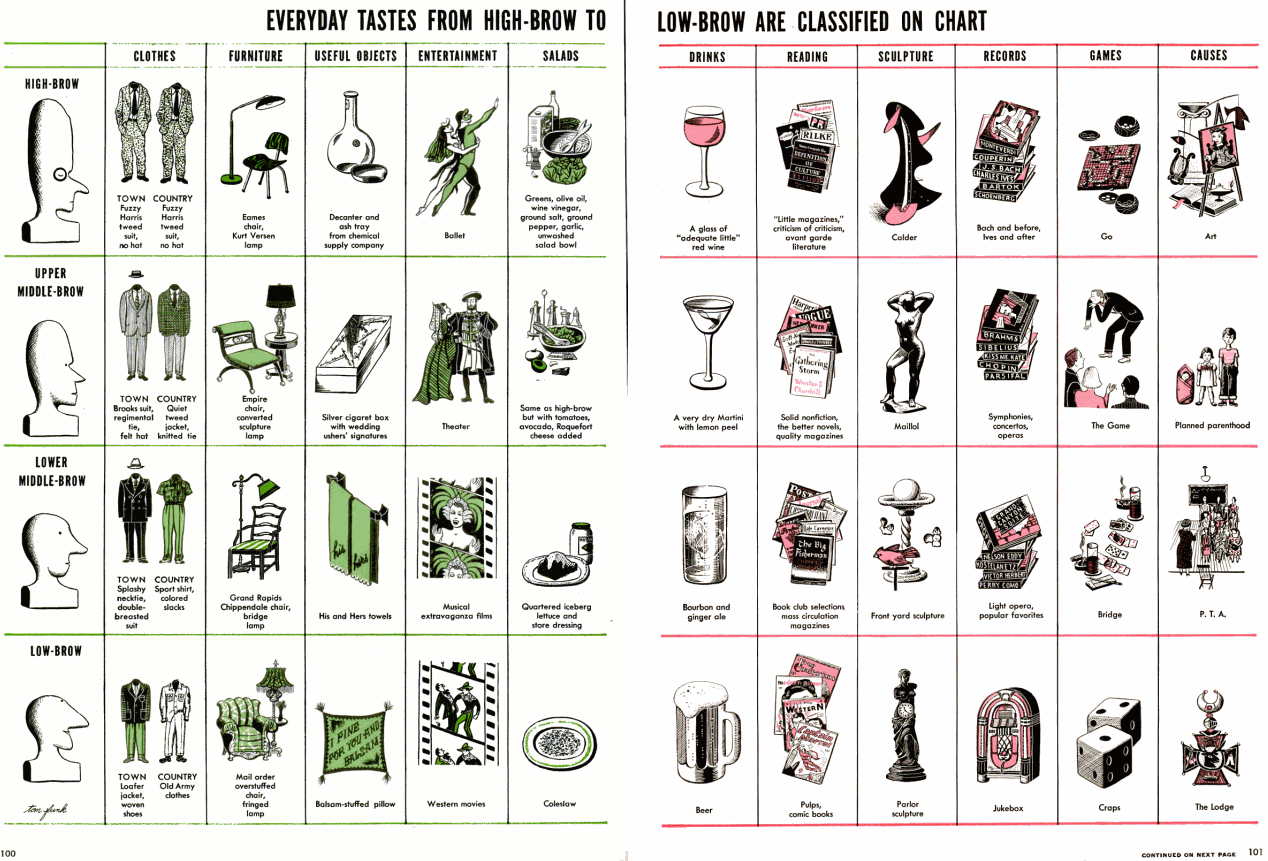
Brow-Beaten, or The Heimlich Maneuver

There's an interesting conversation afoot in two threads over on Crooked Timber about highbrow, middlebrow, and lowbrow (first post here, second here), which keeps leaping back and forth between intellectual history (the conversation begins with the 1949 Life magazine chart of highbrow, upper middlebrow, lower middlebrow, and lowbrow taste) and contemporary cultural analysis. In short, our kind of thing (or at least, my kind of thing....no need to unnecessarily implicate my fellow USIHers!).

Along the way we get some Lawrence Levine, a dash of Christopher Lasch, references to a couple recent books that I didn't know but really should have (just what I need....additions to the reading list), and, of course, Bourdieu sauvé des eaux.

Perhaps inevitably, it turns out there's an (actually interesting looking) blog devoted to this pursuit: Hilobrow. In the second Crooked Timber thread, Josh Glenn, one of the Hilorophants, complicates things:

Over at Hilobrow.com ... we agree with Bourdieu that aesthetics and lifestyle choices aren’t entirely independent of social class. Though (along with Carl Wilson) we reject the reductionism of his Distinction, we do rely on Bourdieu’s notion of the “disposition” (a tendency to act in a specified way, to take on a certain position in any field) and the “habitus” (the choice of positions in a field, according to one’s disposition). We’ve named and located 10 bourdieuian dispositions — 4 heimlich (Highbrow, Lowbrow, Neo-Aristocratic (Anti-Lowbrow), Quasi-Populist (Anti-Highbrow)); 2 gemütlich (High Middlebrow, or what Dwight Macdonald called Midcult; and Low Middlebrow, which Macdonald, following Adorno, called Masscult); 2 unheimlich (Nobrow, not to be confused with John Seabrook’s confused use of the term; and Hilobrow, our own coinage); and then there’s Unbrow, which Van Wyck Brooks confusingly called Lowbrow. There are various habituses possible within each of these dispositions, but since the mid-17th-century, these dispositions have formed into an invisible matrix of influence.


Who says intellectual history is dead?

Brow-Beaten, or The Heimlich Maneuver

There's an interesting conversation afoot in two threads over on Crooked Timber about highbrow, middlebrow, and lowbrow (first post here, second here), which keeps leaping back and forth between intellectual history (the conversation begins with the 1949 Life magazine chart of highbrow, upper middlebrow, lower middlebrow, and lowbrow taste) and contemporary cultural analysis. In short, our kind of thing (or at least, my kind of thing....no need to unnecessarily implicate my fellow USIHers!).

Along the way we get some Lawrence Levine, a dash of Christopher Lasch, references to a couple recent books that I didn't know but really should have (just what I need....additions to the reading list), and, of course, Bourdieu sauvé des eaux.

Perhaps inevitably, it turns out there's an (actually interesting looking) blog devoted to this pursuit: Hilobrow. In the second Crooked Timber thread, Josh Glenn, one of the Hilorophants, complicates things:

Over at Hilobrow.com ... we agree with Bourdieu that aesthetics and lifestyle choices aren’t entirely independent of social class. Though (along with Carl Wilson) we reject the reductionism of his Distinction, we do rely on Bourdieu’s notion of the “disposition” (a tendency to act in a specified way, to take on a certain position in any field) and the “habitus” (the choice of positions in a field, according to one’s disposition). We’ve named and located 10 bourdieuian dispositions — 4 heimlich (Highbrow, Lowbrow, Neo-Aristocratic (Anti-Lowbrow), Quasi-Populist (Anti-Highbrow)); 2 gemütlich (High Middlebrow, or what Dwight Macdonald called Midcult; and Low Middlebrow, which Macdonald, following Adorno, called Masscult); 2 unheimlich (Nobrow, not to be confused with John Seabrook’s confused use of the term; and Hilobrow, our own coinage); and then there’s Unbrow, which Van Wyck Brooks confusingly called Lowbrow. There are various habituses possible within each of these dispositions, but since the mid-17th-century, these dispositions have formed into an invisible matrix of influence.


Who says intellectual history is dead?

Senin, 21 September 2009

This Be The Verse

Twenty years ago, David Hackett Fischer published Albion's Seed: Four British Folkways in America, which attempts to explain U.S. political culture down to the present through the initial patterns of British immigration to North America. Historiographically, Fischer's project flowed from the twin streams of Annales School histoire totale, which was if anything losing influence at the time of the book's publication, and cultural history, which was very much on the rise. From the Annalistes, Fischer borrowed many of his interests (e.g. the longue durée; regionalism) and the scope of his project (this very hefty book announced itself as the first of a five-volume rewriting of the social and cultural history of the United States). But Fischer's approach stressed the importance of culture and ethnicity, both of which made this in-many-ways old-fashioned project seem more of its moment (though Fischer's conception of culture was itself rather anthropological and pre-"linguistic turn").*

Fischer's book was widely reviewed but got an almost universally mixed reception. Historians celebrated the audacity and ambition of the project, while questioning its details, logic, and conclusions. Charles Joyner, writing in the Journal of American Folklore, called it a "stunning but problematic achievement." Jack P. Greene, writing in the Journal of Social History, compared the book--in its extraordinary scope--to an encyclopedia, but worried that its individual components were not up to the historical standards one expects from encyclopedia entries. Darrett Rutman, reviewing the book for the American Historical Review, concluded that "Albion's Seed has borne at best questionable fruit." Albion's Seed stood as a kind of cautionary tale of the difficulties of writing total history. Though Fischer's career has continued to flourish, it has gone in other directions; the other four volumes of the project that Albion's Seed was supposed to inaugurate have never appeared.

But despite its rocky initial reception among historians, Albion's Seed has worked its way into the public discourse. Sara Robinson, co-author of the influential liberal blog Orcinus, devoted a two-part series to the book in 2007. And 2008 was a very good year for Albion's Seed. In trying to explain voting patterns during last year's protracted Democratic Presidential primary battle between Barack Obama and Hillary Clinton, many analysts turned to Albion's Seed and argued that Scots Irish culture in Appalachia made the region especially good for Clinton and bad for Obama (here's one random example of from The Seattle Times; googling "Scots Irish Fischer Obama" yields many others).

More recently, Albion's Seed has become a go-to explanation of what's going on with the Republican Party today. Indeed, at the time of this writing, the top-rated diary on DailyKos, the most influential Democratic blog, is "Yo, Pundits! Here's What's Up With the Republicans," which uses Albion's Seed to argue that each of the two major parties are based on two of Fischer's four ethno-regional groupings.**

(Lest anyone think that David Hackett Fischer has become the property of Democrats and progressives, it's worth noting that he was the 2006 recipient of the American Enterprise Institute's Irving Kristol Award for "notable intellectual or practical contributions to improved public policy and social welfare.")

While Albion's Seed has undoubtedly become something of a classic, I don't think that my fellow twentieth-century historians turn to it much to explain political cultural phenomena in our period. Rereading reviews from nearly two decades ago while putting together this post, I was tempted to agree with Fischer's critics about both its virtues and its flaws. Has it fared any better among historians of earlier periods of U.S. history? Or is this an example of a work of academic history that has become more read--or at least more significant--outside the profession than within it?

Perhaps Albion's Seed will do more to transform our political culture (or at least the ways that we talk about it) than it did to explain it.

___________________________________

* Albion's Seed was old-fashioned not only in its Annalistes qualities, but in its argument, which harkens back to the pre-Frederick Jackson Turner view of American history as best explained by the political traditions of the Germanic forebears of its founders.

** For those keeping score at home: Democrats = Puritans+Quakers while Republicans = Borderers+Cavaliers. Once again, the Scots Irish "Borderers" are the focus of the dKos diarist's attention.

This Be The Verse

Twenty years ago, David Hackett Fischer published Albion's Seed: Four British Folkways in America, which attempts to explain U.S. political culture down to the present through the initial patterns of British immigration to North America. Historiographically, Fischer's project flowed from the twin streams of Annales School histoire totale, which was if anything losing influence at the time of the book's publication, and cultural history, which was very much on the rise. From the Annalistes, Fischer borrowed many of his interests (e.g. the longue durée; regionalism) and the scope of his project (this very hefty book announced itself as the first of a five-volume rewriting of the social and cultural history of the United States). But Fischer's approach stressed the importance of culture and ethnicity, both of which made this in-many-ways old-fashioned project seem more of its moment (though Fischer's conception of culture was itself rather anthropological and pre-"linguistic turn").*

Fischer's book was widely reviewed but got an almost universally mixed reception. Historians celebrated the audacity and ambition of the project, while questioning its details, logic, and conclusions. Charles Joyner, writing in the Journal of American Folklore, called it a "stunning but problematic achievement." Jack P. Greene, writing in the Journal of Social History, compared the book--in its extraordinary scope--to an encyclopedia, but worried that its individual components were not up to the historical standards one expects from encyclopedia entries. Darrett Rutman, reviewing the book for the American Historical Review, concluded that "Albion's Seed has borne at best questionable fruit." Albion's Seed stood as a kind of cautionary tale of the difficulties of writing total history. Though Fischer's career has continued to flourish, it has gone in other directions; the other four volumes of the project that Albion's Seed was supposed to inaugurate have never appeared.

But despite its rocky initial reception among historians, Albion's Seed has worked its way into the public discourse. Sara Robinson, co-author of the influential liberal blog Orcinus, devoted a two-part series to the book in 2007. And 2008 was a very good year for Albion's Seed. In trying to explain voting patterns during last year's protracted Democratic Presidential primary battle between Barack Obama and Hillary Clinton, many analysts turned to Albion's Seed and argued that Scots Irish culture in Appalachia made the region especially good for Clinton and bad for Obama (here's one random example of from The Seattle Times; googling "Scots Irish Fischer Obama" yields many others).

More recently, Albion's Seed has become a go-to explanation of what's going on with the Republican Party today. Indeed, at the time of this writing, the top-rated diary on DailyKos, the most influential Democratic blog, is "Yo, Pundits! Here's What's Up With the Republicans," which uses Albion's Seed to argue that each of the two major parties are based on two of Fischer's four ethno-regional groupings.**

(Lest anyone think that David Hackett Fischer has become the property of Democrats and progressives, it's worth noting that he was the 2006 recipient of the American Enterprise Institute's Irving Kristol Award for "notable intellectual or practical contributions to improved public policy and social welfare.")

While Albion's Seed has undoubtedly become something of a classic, I don't think that my fellow twentieth-century historians turn to it much to explain political cultural phenomena in our period. Rereading reviews from nearly two decades ago while putting together this post, I was tempted to agree with Fischer's critics about both its virtues and its flaws. Has it fared any better among historians of earlier periods of U.S. history? Or is this an example of a work of academic history that has become more read--or at least more significant--outside the profession than within it?

Perhaps Albion's Seed will do more to transform our political culture (or at least the ways that we talk about it) than it did to explain it.

___________________________________

* Albion's Seed was old-fashioned not only in its Annalistes qualities, but in its argument, which harkens back to the pre-Frederick Jackson Turner view of American history as best explained by the political traditions of the Germanic forebears of its founders.

** For those keeping score at home: Democrats = Puritans+Quakers while Republicans = Borderers+Cavaliers. Once again, the Scots Irish "Borderers" are the focus of the dKos diarist's attention.

Selasa, 14 Juli 2009

Ne Me Quitte Pas

Sad news from Obsidian Wings: hilzoy, one of the most insightful bloggers on the internets is retiring from blogging. I'll honor hilzoy's pseudonymity, but it's been compromised frequently and often enough that her identity is readily discoverable. She's interesting to this blog in part because, like a number of other important bloggers, she's an academic. More specifically, she's a moral philosopher and bioethicist (she's entirely open about this fact). Although her blogging has been more in the way of political than academic blogging (she's also blogged at Washington Monthly), her academic interests and training clearly affect the way she views politics and the world around her and add to the richness of her perspective. Although hilzoy is brilliant, what perhaps makes her blogging most unusual has been its measured tone. Blogging tends toward the shrill and the snarky (not that there's anything wrong with that in general). Political blogs, in particular, have a not entirely undeserved reputation as places where people go to read what they already think. ObiWi, on the other hand, has been one of the few places in the political blogosphere where both left and right wing bloggers posted. Though the blog has, over the years, moved more definitively to the left, its commentariat continues to include serious participants on the right. hilzoy has been a crucial part of maintaining a tone and attitude that has made that possible. She'll be deeply missed.

Her retirement from blogging, however, raises interesting questions about this still-young medium. There is still a kind of expectation that blogs will just go on and on and on. And there's no standard way for bloggers to hang up their spurs. Plenty of bloggers have retired, but retirement is always somewhat awkward. Although blogging actually takes a lot of time and effort, it's in the nature of the medium that it often feels like a kind of effortless transcription of a person's thoughts. Surely the retiring blogger will keep thinking? Why not continue to share the thoughts? As a result, retirements often seem to need some special occasion (in hilzoy's case, she's about to go on vacation in Rwanda) or dramatic stagemanaging (as in Michael Bérubé's--temporary it turned out--retirement). I wonder if, over time, a kind of average lifespan for blogs will emerge....and if it does, how long it will be.

And I wonder, too, how U.S. intellectual historians of the future will deal with this medium. So much public intellectual life is now taking place in blogs. And they are, by and large, automatically archived for the future. They'll be an incredibly rich primary source for us...assuming that there's any sensible way to sift through the incredible mountain of information they represent! If we ever figure out how to do this, I have no doubt that hilzoy's work will be studied and discussed.

Ne Me Quitte Pas

Sad news from Obsidian Wings: hilzoy, one of the most insightful bloggers on the internets is retiring from blogging. I'll honor hilzoy's pseudonymity, but it's been compromised frequently and often enough that her identity is readily discoverable. She's interesting to this blog in part because, like a number of other important bloggers, she's an academic. More specifically, she's a moral philosopher and bioethicist (she's entirely open about this fact). Although her blogging has been more in the way of political than academic blogging (she's also blogged at Washington Monthly), her academic interests and training clearly affect the way she views politics and the world around her and add to the richness of her perspective. Although hilzoy is brilliant, what perhaps makes her blogging most unusual has been its measured tone. Blogging tends toward the shrill and the snarky (not that there's anything wrong with that in general). Political blogs, in particular, have a not entirely undeserved reputation as places where people go to read what they already think. ObiWi, on the other hand, has been one of the few places in the political blogosphere where both left and right wing bloggers posted. Though the blog has, over the years, moved more definitively to the left, its commentariat continues to include serious participants on the right. hilzoy has been a crucial part of maintaining a tone and attitude that has made that possible. She'll be deeply missed.

Her retirement from blogging, however, raises interesting questions about this still-young medium. There is still a kind of expectation that blogs will just go on and on and on. And there's no standard way for bloggers to hang up their spurs. Plenty of bloggers have retired, but retirement is always somewhat awkward. Although blogging actually takes a lot of time and effort, it's in the nature of the medium that it often feels like a kind of effortless transcription of a person's thoughts. Surely the retiring blogger will keep thinking? Why not continue to share the thoughts? As a result, retirements often seem to need some special occasion (in hilzoy's case, she's about to go on vacation in Rwanda) or dramatic stagemanaging (as in Michael Bérubé's--temporary it turned out--retirement). I wonder if, over time, a kind of average lifespan for blogs will emerge....and if it does, how long it will be.

And I wonder, too, how U.S. intellectual historians of the future will deal with this medium. So much public intellectual life is now taking place in blogs. And they are, by and large, automatically archived for the future. They'll be an incredibly rich primary source for us...assuming that there's any sensible way to sift through the incredible mountain of information they represent! If we ever figure out how to do this, I have no doubt that hilzoy's work will be studied and discussed.