Tampilkan postingan dengan label Eugene Genovese. Tampilkan semua postingan

Selasa, 23 Oktober 2012

A List of Marxist Historians?


Guest post by Kurt Newman.

I am grateful to Andrew Hartman for extending me an invitation to run a query by the readers of the US Intellectual History blog. My name is Kurt Newman. I’m a graduate student in US history at the University of California Santa Barbara.


The query is this. If we were to assemble a list of Marxist historians of the United States, with the provision that we limit such a list to people who are both alive and active, what would the result look like? If we were willing to risk the scorn that might be legitimately inspired by asking an additional stupid question—what would happen if we were to narrow our search to people who could be described as American historians of the United States—would we learn anything interesting about the domestic historical profession?


Under ordinary circumstances, one might have to argue for the relevance of such an inquiry. A list of Marxist historians? From one perspective (let’s say, that of David Horowitz or Lynne Cheney): aren’t all academics in the humanities Marxists? From another (the dominant strain of thinking among the contemporary intelligentsia): didn’t Marxism more or less fade away with the fall of the Soviet Union? (At the margins, there are certainly some Cold War-haunted souls who might feel that discussing such things in public could only serve to invite several varieties of danger. They might even be right!)


The recent passing of Eric Hobsbawm and Eugene Genovese, however, forced many writers otherwise dismissive of the project of historical materialism, to recall that Marxism was for many years an extraordinarily generative force within historiography. Whatever the objections to the interpretive tendencies or personal choices of Hobsbawm and Genovese, no one could deny their authorial skill and influence, nor question their capacity to ask interesting questions. Could the same be said for historians under the influence of any other putatively discredited philosophy?  

As a graduate student who both studies the history of the United States and identifies as a Marxist,  I wonder (although without much angst or anxiety) whether Marxism is currently a tendency with much influence within the contemporary historical profession, particularly in regard to the study of the history of the United States. In light of the manifold failures of neoclassical economics and the crisis in liberal political science, in addition to the escalating popular rejection of balanced-budget conservatism, austerity, and the assault on unions, I think that a Marxist renaissance in US history is both possible and urgently needed. Whether such a revival is likely leads us back to the old Gramsci line about optimism and pessimism and intellects and wills, however that goes. Without a more coherent historicizing of the Marxist legacy in US history, though, it is hard to imagine how such a revival might be initiated.

Without wishing to unduly influence the results, I nevertheless cannot resist the temptation to append a final note. Stemming from my continuing fascination with the work of James Livingston­­—whose engagementwith Marxism strikes me as unusually rigorous, incorporating, for example, Marx’s “two-sector reproduction scheme” from Capital, Volume II in his reading of the paired emergence of corporate capitalism and pragmatic philosophy-- I have been trying to keep track of the specific articulation of Marxist theory in the work of various historians. While I think that any comprehensive list of working Marxist US historians should include all scholars who acknowledge a debt to Marx, including those for whom Marx and the Western Marxist tradition form part, but not all, of their theoretical frameworks (to be honest, it is hard to imagine that anyone who would bother to identify as a Marxist in 2012 would not be open to the influence of a wide variety of perspectives within social and political theory), and those for whom Marxism serves as a general ethical inspiration or source of foundations that propel archival work, rather than a Talmudic enterprise, I am also interested in thinking comparatively about the ways in which historians of the US make use of Marx. In other words, what does it mean, methodologically or polemically, to be a Marxist historian of the US?

I look forward to whatever answers readers and contributors might feel compelled to post. Even in the event of silence and indifference—both perfectly legitimate responses, of course!—I will be able to move forward with my research on this topic with a surer sense of the state of the field. So, thanks in advance for your help.

Jumat, 19 Oktober 2012

A Teaser on the Left

James Livingston has seized upon the occasion of Eugene Genovese's passing to write a series of extended meditations on Genovese, on intellectual history, and on Livingston's own development as an intellectual historian.  His latest entry in this series, published at his blog Politics and Letters, includes some provocative reflections on academics' ideas of the Left -- reflections which are informed by and in some ways formed against Michael Kazin's American Dreamers.  Livingston will engage Kazin's text (and Corey Robin's The Reactionary Mind) more fully -- and more forcefully, no doubt -- during our Friday afternoon roundtable discussion at the S-USIH conference.  (See the full conference program here.)

In the meantime, I thought our readers might be interested in this excerpt from Livingston's post, in which he discusses "the Left's laggard intellectual condition."


My “dissertation book” on the origins of the Federal Reserve came out in April 1986, while I was a post-doctoral fellow at the National Museum of American History, a great gig because no one knew what we, the fellows, were supposed to be doing all day.  Me, I mainly roamed around the Library of Congress, having talked my way into a stack pass and finding too many wonderful books that had nothing to do with my appointed task, which was to write something called “Accumulating America: How Centuries End, Where Politics Begin.”  That roaming was the origin of a schizophrenic book called Pragmatism and the Political Economy of Cultural Revolution, 1850-1940, which was published in November 1994 as an entry in Alan Trachtenberg’s series at UNC Press.  It was my formal debut as an intellectual historian and my angry farewell to economic history.  The only reader the press could find was, of course, Martin J. Sklar.

While at the Museum, I marveled at the attitudes of the other fellows—they all seemed to derive, by some route, from Harvard, Yale, or Cornell, although the southern front (Chapel Hill, mainly) was graciously reinforced by Pete Daniel—because they all took the gig for granted, as if a year off to do exactly what you want was just a common card in the academic hand every graduate student was dealt.  As far as they were concerned, this was normal, this was what you were supposed to expect as you created a career in academe.  So I felt like a freak.  For the first time since my conversion experience to Marxism and its attendant political extremities—not to mention its intellectual idiocies—I wondered about my affiliations.  These incredibly smart, uniformly decent people were all on the Left, but this space as they understood it was, to me, another planet.  We shared no assumptions, no premises.  Most of our conversations were prolonged attempts to articulate these.

I was making my way as a junior professor just like they were, but they seemed to know what they were doing.  And I had an inkling back then that their sense of academic entitlement had something to do with their definition of the Left as the site of withdrawal and release from the work-a-day world—the place where exemption and abstention from its demands became the same thing, rather than the frictional, contentious point of intersection between theory and practice, or between social classes and political visions.

So conceived, the Left had become a cloister where beautiful souls gathered, just as the university had become a safe haven for intellectuals in flight from a world newly convulsed by supply-side, neo-liberal programs of economic rebirth.  It was where you went if you could afford to favor “social equality” and “altruistic justice” over “individual liberty,” as Michael Kazin has recently framed the choice the American Left has always had to make.

Does that sound like resentment?  Very well, then.  I’ve never believed that you could be in but not of this world.  I’ve always been Protestant enough to know that the condition of grace is sin, which is the deep, undeniable, disgusting corruption of your soul, the kind that comes with the territory of the world as it exists, not as you would like it to be, or as you can afford to rise above it or buy your way beyond it.   I’ve never believed, as Kazin and most of our comrades on the Left do—here they have a lot in common with Eugene Genovese—that individual liberty and social equality are the terms of an either/or choice.  OK, call it resentment.

So even back then, I was worried about the intellectual—or is it the epistemological?—orientation of the Left.  I wondered why my comrades didn’t think of themselves as the mainstream, the lifeblood, of American political discourse.  Why did they think that Marxism and socialism were still scandalous?  I wondered why they needed to believe that they were marginal figures in the academy and out.  How was that belief realistic in view of Genovese’s professional success, not to mention the careers of David Montgomery, Herbert Gutman, and William Appleman Williams?

I wondered why they hadn’t considered the possibility that the originality of American politics (and with it the American Dream) resides in two cognate discoveries specific to the revolutionary experience of the late-18th century.  First, the discovery that sovereignty is the inviolable property of the people “out of doors,” not the state, the party, the cabinet, the government, or the nation.  The patriotism that has always inspired the Left to return to the first principles of the founding—original intent, as it were—derives from this protean notion of sovereignty, because it lets us distinguish between the will of the people and the expressions of power that enact and embody the nation as a state.  Second, the discovery that equality is the necessary condition of liberty, not its negation.  The founders understood that republican liberty could not outlast the moment when equality became its opposite, when, as James Madison put it, the rights of persons were  overruled by the rights of property—when “the poor were sacrificed to the rich.”  The Left seems never to have caught up with this insight, preferring to think of liberty and equality as mutually exclusive moral imperatives rather than eminently compatible commitments.

I’ve been wondering about the Left’s laggard intellectual condition ever since that privileged year in D.C., living six blocks east of the LC, about a mile down the Mall from the NMAH.  And now I begin to think that precisely because I have been lost in these thoughts all these years, I was never surprised by Gene Genovese’s political twists and turns.  Like our comrades on the Left, he was always looking for an Archimedean point outside the object of his critique—capitalism—which would then serve as the place where exemption and abstention from the world as it exists could become the same attitude toward the world as it exists.  He wanted to be in but not of this world.  So, like a true believer, he always needed a sturdy faith in a world elsewhere.

You can read Livingston's entire post here.

Sabtu, 13 Oktober 2012

Friendship and the Intellectual

Over the past week or so, some of the most respected intellectual historians working today gave us wonderful  remembrances of Henry May and Eugene Genovese.  Through these brief portraits we get a sense of the significance of May and Genovese to their profession, their fields, and to the craft of writing.  We also heard about the way friendship played a role in making these academic stars truly great people.   May and Genovese were more, far more, than merely their published works.

Recently, I spent a day looking through the papers of Richard John Neuhaus, a Catholic priest, editor and founder of the journal First Things, and a important force in the Culture Wars of the 1990s.  My concern was for an earlier period, before the
founding of First Things, before the Culture Wars redefined Neuhaus and the people around him.  One of those people was Stanley Hauerwas, a theologian who initially attracted attention as a young professor at the University of Notre Dame and a long-time friend of Neuhaus.  In the last two decades of Neuhaus's life, he and Hauerwas battled over two different wars in the Persian Gulf as well as over an issue that first brought them together in the mid-1970s, the role of religion in ordering American society.

I sifted through the as-of-yet unorganized collection of Neuhaus's personal papers (on this note, I must thank Randy Boyagoda for giving this collection some order), looking through the years in between Neuhaus's transition from an actor in CALCAV to a religious writer gravely concerned about what he identified as a crisis of authority in the debate over the American promise.  In short, I looked at the period from the Hartford Appeal (published in 1976) and the founding of First Things in 1990.  During that period, folders of correspondence that appeared thickest and most numerous included those people we would suspect: George Weigel, Michael Novak, Peter Berger, and William F. Buckley--people who helped Neuhaus shape a new conservative position on American culture.  But Hauerwas was also there in dozens and dozens of letters, papers, conference presentations, and, of course, published work.

What struck me time and again about the exchanges, both published and unpublished, between Neuhaus and Hauerwas was the genuine affection they had for each other.  They were good, loving, caring friends.  I know this might not sound earthshaking to many of those who work on the relationships between intellectuals of earlier periods.  And clearly those portraits of May and Genovese I mentioned earlier were suffused with affection.   Clearly, it seems to me, the strong friendship between Neuhaus and Hauerwas made them better intellectuals.  Their grave disagreements in later years, primarily over war and the partisanship that infected their intellectual stands, I think has largely overshadowed the way their love for one another helped to form one another into the intellectuals they became to the rest of us.

Reading through such correspondence made me wonder what examples we have of such intellectual friendships today.  Although I am not an intellectual, my genuine affection for my colleagues at S-USIH--something that might come through occasionally in the posts I write--has helped us run the society and the conferences.  I have no doubt that my time with this group has made me a better historian.  I also like to think that such relationships have made me a happier and better person.*

______________________________________________________________

Senin, 08 Oktober 2012

Stray Thoughts on History and Politics

Former NPR reporter Andrea Seabrook recently debuted a new podcast called "DecodeDC" that promises to "decipher Washington's Byzantine language and procedure, sweeping away what doesn't matter so you can focus on what does."  So far, at least, it's a solid piece of work, worth listening to if you're interested in politics and have fifteen minutes or so to spare.  But what struck me about the first two episodes (all that have appeared so far) is that each begins with history.  Episode 1, House of (mis)Representatives, concerns the enormous number of people represented by each Congressperson today, and the political problems that arise as a result.  Why are there so few members of Congress for a nation of our size?  The answer (probably well known to readers of this blog) is that, after frequently increasing its size during its decennial reapportionment process as the nation grew, Congress froze its membership at 435 in 1911 and it's essentially stayed there ever since, while the country has grown from 92 million to 308 million people.  Episode 2, Mind Control, concerns the (non-rational) use of language as a political tool.  It starts with a history of the Republican habit of calling the Democratic Party "the Democrat Party."  Relying on an old William Safire column, Seabrook credits Harold Stassen with coining the term while working for Wendell Willkie's presidential campaign in 1940. After starting with history, each episode quickly moves on to other things. DecodeDC isn't about history, after all.  The second episode, in particular, doesn't make much out of the particular origins of the "Democrat Party."

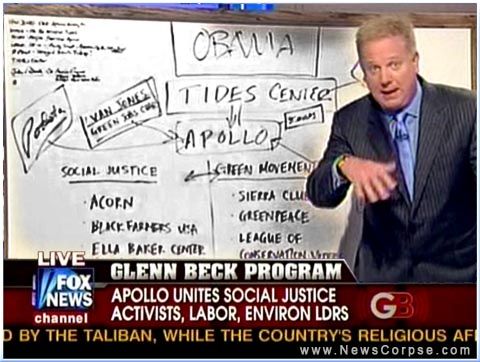
But DecodeDC's use of history in its inaugural episodes, is I think, symptomatic of at least one of the ways in which history is frequently referenced in contemporary American political discourse.  If one's goal is to "decode" or "decipher" American politics, one of the most popular methods of doing so is to reveal some (presumably obscure) fact from the past that will explain (or can be presented as explaining) why things are the way they are today.  In the case of DecodeDC, these reveals are pretty straightforward.  But this use of history comes in more baroque versions, too...such as Glenn Beck's infamous whiteboards.  In each case, one of the purposes of this use of history is simply to denaturalize the present: if something that we take for granted has a (quasi-secret) starting point, perhaps it can change in the future. In the more conspiratorial versions of this move, the genealogical reveal also shows a (quasi-surprising) person or force pulling the strings of the present from behind the scenes.


I've been thinking a lot about the role of history in politics (and vice versa) in light of the recent passing of Eugene Genovese, Eric Hobsbawm, and Henry May.  Though all three have been discussed on this blog, more attention has been given Genovese and May, presumably because, unlike Hobsbawm, they were Americanists.  Elsewhere online, however, Hobsbawm and Genovese seem to dominate the discussion. And what most clearly distinguishes them from May is that both were, more obviously and deeply than May, engagé historians, though the relationship between history and politics in their work was far more complicated than the history-as-code-ring we get from Andrea Seabrook (let alone Glenn Beck).

Both Genovese and Hobsbawm, of course, started their careers (and Hobsbawm ended his, as well) as Marxists.  Marxism provides a particularly rich theoretical connection between politics and history. And in the work of more sophisticated Marxist historians (a category that surely includes both Hobsbawm and the younger Genovese), the understanding of the historical record and of political theory mutually inform and shape each other.  Like its Hegelian predecessor, the Marxist understanding of history sees the possibility of reading the future out of the record of the past.  But for Hegel, unlike Marx, the future foretold by history was, essentially, the Prussian present. Leopold van Ranke, and the other German historians who helped create modern historical practice in the 19th-century, also tended to be politically conservative, essentially seeing history as proving that what is ought to be.

But for all of these thinkers, on the left and the right, history was complicated, though in an ordered way.  This complexity was preserved even when, on occasion, they engaged in a version of the decoding / debunking mode (I'm thinking, in particular, of The Invention of Tradition, which Hobsbawm co-edited).  Though history certainly involved recovering past things now forgotten, for history to be understood, let alone for it to serve a political purpose, it needed to be properly interpreted.   The job of the historian does not end at simply figuring out that Harold Stassen was the first person to say "Democrat Party."*

During my early years of graduate school, my fellow history students and I frequently told each other that much of what was wrong with American political life could be solved if only Americans could have a richer, more complicated understanding of history. I remember one student fantasizing that if historians were regularly invited on Oprah, they could totally transform the discourse on that show for the better. Another student, watching Reagan's farewell address with me during our first year in grad school, was simultaneously enraged and excited by Reagan's discussion of the importance of teaching history:  "we've got to teach history based not on what's in fashion but what's important."  Though he and I knew we didn't agree much with the President about the relationship between the "fashionable" and the important in history, we certainly shared his passion for teaching about the past...and his sense that teaching about the past could help mold the future.

While I continue to believe that doing (and teaching) history is important in many ways, including for our political life, I've long since lost the sense that simply doing good history is a panacea for the problems in our political culture.  To begin with, good history always has to compete with bad history. And though good history occasionally wins, bad history often has the political edge.  And simple history will almost always have an advantage over complicated history.  Invoking "Munich" (or "Vietnam") as codewords in a foreign policy debate is far easier than grappling with the complexity of European politics in 1938 or the American presence in Southeast Asia in the 1950s and 1960s.

However sympathetic one is (or isn't) with Hobsbawm's or Genovese's politics (and I imagine that few are sympathetic with both Genovese's youthful politics and the politics of Genovese's later years...though of course, Genovese managed the trick), it's hard not to conclude that their political understandings enriched their (and, by extension, our) understandings of the past.  Yet I think neither of them -- even Genovese, late in life, allied with a regnant conservatism -- had anywhere near as significant a political impact as an historiographical one.

____________________________________________________
* To be fair to DecodeDC, Seabrook does analyze Stassen's coinage, but in largely ahistorical terms. George Lakoff is the most important analytic voice in the podcast's second episode.

Minggu, 07 Oktober 2012

These Historians' Deaths


By Elisabeth Lasch-Quinn

Over the past few days I have followed, with so many others, the commentary on the lives of not one or two but an entire trio of eminent historians: Eugene Genovese, Eric Hobsbawm, and Henry May. I admire the care that has gone into reflections that have appeared elsewhere as well as on this blog, including those of Leo Ribuffo on Genovese, Andrew Hartman on Hobsbawm, and Ray Haberski on May. For myself, I can only offer something along the lines of a blogger's equivalent to a moment of silence in honor of their memory, and that of the others we have already lost from their remarkable generation.

I knew only one of these three men personally. Eugene Genovese's life was intertwined with my family's at key points, a story some readers here no doubt know much better than I, and for almost as long as I can remember, his name has been a household word. I met him when we moved to Rochester in 1970 and again a few years ago when he invited me to participate in the early planning meetings for the Historical Society, including a memorable one at the New York City apartment of intellectual historian John Patrick Diggins, who died in 2009.  After learning second hand over the intervening decades of Genovese's reputation as firebrand, which in other settings he of course earned, I found his tremendous personal warmth and charm truly disarming. And enlightening.

As Genovese goes from man to a legend to many, albeit one who has erred (is there any other kind, of either?), there is genuine pathos in this moment when a soldier--for he certainly fought passionately for causes he believed in--lays down sword and shield for the final time. His life is complete now, but perhaps it is my long-term awareness of him, directly and indirectly through his best written words, as in his amazing Roll, Jordan, Roll, as someone of such presence that makes it difficult for me to believe he can no longer be living--at least not yet.

Sabtu, 06 Oktober 2012

Thinking Historically about Historians

This blog has posted a few remembrances and considerations regarding the historians who died this past week.  One of our related blogs, HNN, has provided some great coverage of the lives and legacies of Eric Hobsbawm, and Eugene Genovese, but not, somewhat surprisingly, of Henry F. May. Reading across the short essays on Hobsbawm and Genovese it becomes clear that their ability to rally people (including historians) across the ideological spectrum had some influence on the level of coverage they received.  Hobsbawm inspired a vitriolic rebuke from Michael Burleigh and warm embraces from Niall Ferguson and Eric Foner; the latter two I imagine would be loathe to embrace each other.  Genovese elicited extended remarks from Robert George, the conservative Catholic political theorist at Princeton and the libertarian journal Reason.  Apparently, May did not inspire such diverse responses.

In my own training, I encountered these three historians in ways that mirror reactions to their deaths.  In my graduate training, the historian who taught Soviet history would ask us to take on Hobsbawm's analysis of Stalin and the historian of American foreign relations would ask us to defend Hobsbawm's account of the role of the United States in empire building.  The historian of antebellum America used Genovese as THE touchstone for historiographical debate over the world of American slaves and the historian who taught America in 1960s would discuss the personal-political trajectory of Genovese the man.

But Charles Alexander, my advisor and mentor in U.S. intellectual history, made us absorb every molecule of Henry F. May's two major books--both served as major questions on our comprehensive exams.  I have my copies of May's The End of American Innocence and The Enlightenment in America, with margin notes and underlining that reflect, as I show my students, the different ways I used the books as I moved from a first year graduate student to a budding historian writing his first book.  I still get a charge reading the first line of The End of American Innocence: "Everybody knows that at some point in the twentieth centuryAmerica went through a cultural revolution."  All of my work (and much of what we do on this blog) has been a investigation of that contention.  It was pretty much that line that made me want to write a book on how movies changed the idea of art and culture in twentieth century America. You can see May's entire book on line here.

I found professional inspiration for my aspirations in Joan Shelley Rubin's essay on May in Reviews in American History.  Rubin was, of course, another historian who had great influence on many of us in graduate school, and for me, she was a person I read to learn how to realize my aspirations of writing an work of history that was like May's.  In her 1990 essay, she wrote that May's book "retains...both emotional power and analytical significance.  On the most personal level, the book remains appealing because it captures and preserves figures and movements which seem, even now, exciting, creative, imbued with an energy and purpose I admire." Indeed, that sense of the immediacy of the history May related made many us realize that he, in 1959, had provided a way to use culture (as well as political and socio-economic motives) to explain any period.

For Charlie Alexander, though, there was also another reason to follow May very closely--May was an excellent writer.  So I conclude with a passage from the end of May's first chapter that simply gripped me. Even though he wrote it the late 1950s, his charge sounded like something intended for what I was about to begin:


"In the long run, I suppose, one’s attitude toward the beginning of the contemporary period depends on one’s prediction of its outcome.  Since my emotions about the current scene are divided, my interpretation of the past is divided also. It is not hard, retrospectively, to find the standard American culture of 1900 or 1912 seriously inadequate.  Neither intellectual or social orders are likely to be overthrown unless they are inadequate.  Yet revolution, and this kind of revolution in particular, has its cost.  I have tried to understand both conservatives and radicals.  My major purpose has been to show the size and complexity and some of the meanings of the change, and not to draw up a balance sheet of gains and losses.

If this book helps the reader to understand the revolution that got under way by 1917, it may make it easier for him to live through it, or even, in some small area, to influence its outcome.  I take it for granted that this culture revolution is still going on."


Rabu, 03 Oktober 2012

Eugene D. Genovese: Recollections of a Former Student


The death of a favorite teacher in his or her late old age typically evokes strong emotions from former students in their early old age.  In this case the emotions are mine and the teacher is Gene Genovese, one of my professors at Rutgers when I was an undergraduate from 1962 to 1966.  We remained in contact off-and-on over the decades and I saw him last in Atlanta in July 2010.  This piece is not another attempt to offer an instant analysis of the “real” Genovese, an enterprise now well underway in cyberspace.  Rather, I want to add something to the story from the perspective of an undergraduate he taught who subsequently entered what Gene called the “history business.”
I first heard about Gene in the fall of 1963, the first semester of my sophomore year, from my friend Ken O’Brien (who also entered the history business).  Ken was taking Gene’s course in American Negro history.  As a naive 18 year old from a white working class-lower middle class New Jersey family, I was surprised to hear that this subject existed.  I soon learned in detail that it did from Genovese himself.  During the spring semester of 1964, the Intro US history course since the 1870s, taught in lecture by the terrifying Richard P. McCormick, allowed some students to take tutorials in small groups.  Three of us were assigned to Gene.  Our first assignment was to make sense of the currency issue in the late 19th century via debates in the Congressional Record.  No, I’m not making this up.  During the rest of the semester Gene tamped down my enthusiasm for William Jennings Bryan (a racist), delighted in my discovery that Theodore Roosevelt posed no threat to the standing order, and chided me for still liking Woodrow Wilson (the worst racist of the lot).
During my junior and senior years I took three courses from Gene, a two semester sequence on the history of the American South and a seminar on comparative slavery in which I first heard the word hegemony spoken (by him).  I was attracted by Gene the professor rather than by the subject matter.  Nor was I unique in this respect.  The obits, which focus on Gene’s scholarship and shifting but always controversial worldview, ignore his record as a great teacher of undergraduates.  Jocks liked him as much as aspiring scholars did even though he assigned readings on ante bellum agriculture, at least some of which had to be skimmed to get through the courses.

Part of Gene’s appeal to undergrads was that he wasn’t scary like Professor McCormick or their great colleague Warren Susman.  I was not alone in enjoying a glass of wine while visiting his office, an act of hospitality that now might be more likely than an endorsement of Vietnamese Communism to prompt official university censure.
Gene offered such an endorsement at the first Rutgers teach-in on the Vietnam War in April 1965.  Speaking as a “Marxist and a socialist,” he did “not fear or regret the impending Vietcong victory in Vietnam.  I welcome it.”  These two deliberately provocative sentences, quoted in the school paper, the Daily Targum, were picked up by New Jersey news media and soon became notorious.
Initially Warren Susman seemed to be the star of the night for his confrontation with a conservative speaker --yes, there were some on the program-- who called the war a defense of “civilization.”  But Gene’s welcome of a Vietcong victory became the main issue in the 1965 New Jersey gubernatorial campaign.  According to State Senator Wayne Dumont, the Republican nominee, no one expressing this opinion should be allowed to teach at a public university.  Democratic Governor Richard J. Hughes and the Rutgers board of governors grudgingly defended Gene’s right to speak his mind.  Gene’s popularity among students remained undiminished.  
Truth be told, Gene’s rhetorical extravagance outside the classroom was another part of his appeal to students, much as George Fitzhugh’s rhetorical extravagance was part of Fitzhugh’s appeal to Gene as a historical subject.  Gene’s fans included Wayne Valis, the foremost conservative in the Rutgers Class of ‘66 and a future aide to Presidents Nixon, Ford, and Reagan.  The teach-in still elicits fond memories among Rutgers alumni of a certain age and a certain sort.  At a recent reunion of the Targum staff from that era faded copies of the paper reporting on the “Genovese case” stood out among the relics of our youth.
On the whole Gene’s teach-in speech hardly seems extravagant in retrospect. [1] He announced at the outset that he was offering a “frankly political” analysis in a setting that was “not in any sense an enlarged classroom, but a place where professors and students can speak their minds on vital questions in a manner not ordinarily proper in class.” Indeed, his self-identification as a Marxist was intended to “put you on guard against my prejudices as you should be on guard against everyone’s, especially your own.”
Gene placed the war in the context of the Cold War “struggle for the underdeveloped world” in which the United States supported such “thugs” as Chiang Kai-shek, Francisco Franco and the Shah of Iran as well as “whichever general is fronting in Saigon.” Fidel Castro was viewed as a threat not only because he was a Communist but also because of Cuba’s example as a “small country rebuilding a distorted economy on a socialist basis, evicting foreign capital. and suggesting to others that they, too, are entitled to be masters in their own house.”   
American Cold War policy stood “completely naked” in Vietnam.  Having initially  built up the regime of Ngo Dinh Diem instead of seeking elections in keeping with the Geneva Accords of 1954, the United States was now “applying napalm to a people that every honest reporter admits would still overwhelmingly elect Ho Chi Minh.”  In short, the ultimate purpose of the war was “containing a rival social and economic system and punishing those who move toward it.” 
Yet, in an echo of William Appleman Williams’s  The Tragedy of American Diplomacy, Gene said that President Lyndon Johnson, was “not an evil man.” While rightly interpreting the war as part of a purposeful Cold War strategy, Gene mistakenly credited the Johnson administration with more sophistication and forethought than the available evidence warranted even in 1965.  But one aspect of the “predatory” American strategy did seem wrong-headed even in its own terms.   Gene doubted that the People’s Republic of China planned to expand throughout Asia, but if this was Beijing’s intent, then a Communist Vietnam could serve as a bulwark.  These men and women had not bled for decades "in order to make foreigners the masters of their country."  This passage would bring cheer to the hearts of two recent visitors to Hanoi, Secretary of State Hillary Clinton and Secretary of Defense Leon Panetta.  Even Gene’s two deliberately provocative sentences look astute.  If the Johnson administration had allowed the “impending” Vietcong victory to occur in 1965 or 1966, both the United States and Vietnam would have been spared enormous pain. 
Gene’s pointed endorsement of a Vietcong victory does highlight one side of his temperament.  He loved controversy and combat--but sometimes only until he had second thoughts about what he had said or written. 
At the 1969 American Historical Association convention Gene opposed a resolution denouncing the Vietnam War on the grounds that it would divide the organization.  As a graduate student at the time, I agreed; in retrospect this position seems wrong though the issue still does not look clear cut.  As far as I know, Gene never changed his mind.  Nor did I ever hear him regret his inflammatory words urging the AHA business meeting to crush proponents of the anti-war resolution--”put them down hard.”
Perhaps Gene did regret this extravagant rhetoric.  Certainly he came to regret other academic controversies that had needlessly turned personal.  Gene’s clashes with his friends (and comrades) and then enemies Herbert Gutman and Christopher Lasch were especially notable. Throughout the academy the magnification of  intellectual differences is standard operating procedure even during eras less volatile than the 1960s and 1970s.  Nevertheless, the differences between Genovese and Gutman on the question of slave autonomy were slight in comparison to other scholarly disputes about, for example, the existence of an American empire or the effectiveness of federal regulation of big business.  In the final analysis both Genovese and Gutman recognized that the slaves tried to preserve as much of their autonomy and culture as possible and that the masters held ultimate control. 
Although the methodological differences between Lasch and Genovese were more substantial, their friendship lapsed because these two eccentric intellectual giants tried to co-exist in the same history department (Note to readers:  eccentric is a term of respect in my vocabulary).  In these instances the sides of Gene’s temperament that valued intelligence and friendship triumphed over the side that reveled in controversy and combat.  He patched things up with Gutman and resumed a friendship with Lasch.  Yet there is no denying that Genovese could be a very difficult man.
Gene was the second of my Rutgers professors--following Lloyd Gardner--to urge me to enter the history business and he remained supportive over the decades.  Our worldviews and approach to history shared at least one important feature, a willingness to write with understanding about bigots and weirdos.  But in Gene’s view I was a wimpy social democrat who watched polls in Democratic Party primaries for Eugene McCarthy, George McGovern, and other fellow wimps. Sufficiently distant from his strongly held political positions--first on the left and then on the right-- I was never at risk of ideological excommunication. The political never became the personal.
I began seeing Gene and his wife Elizabeth (Betsey) Fox-Genovese regularly when in the early 1990s I started making research trips to Atlanta once or twice a year.  Amid their extraordinary hospitality, we reminisced a lot.  Gene was always happy to hear about Rutgers students from the early 1960s who still told stories about him.  Along with Betsey, and I’m sure many others, I urged him, apparently without success, to write a memoir and to deposit his private papers in an archive instead of destroying them.  Once again I enjoyed Gene’s outrageous comments about his former, present, and future ideological allies.  I also witnessed, on a “same time next year” basis, his move to the right.  As a good Genovese student I tried to understand his rationale.
The personal and psychological aspects of this transition I will leave to others if they must. But the intellectual roots of the change are not hard to find.  I liked to tease Gene that he had always hated liberalism more than he loved socialism; liberalism (in the twentieth century American sense) was intellectually too messy for him as well as insufficiently disciplined in its means and ends.  Sometimes Gene conceded that I might have a point.  A few years ago he half joked that he would tell me the single most important reason for his shift “if you promise not to laugh.”  Gene said that he had concluded that liberals in their optimism were “wrong about human nature.”  I didn’t laugh.  Neither did I offer the futile response that he might have moved a shorter distance on the spectrum to become a Niebuhrian social democrat.  I have no doubt that Gene considered this quip part of a serious explanation of his transition.
Although honored by conservative organizations and claimed especially by traditionalists after his return to the Roman Catholic Church, Gene in his last years is better categorized as a “man of the right” rather than as a conservative  (to recall a distinction Whittaker Chambers made to William F. Buckley, Jr.)   Even this distinction does not fully capture the continuing idiosyncrasies of his worldview.  A fierce defender of Israel, Gene nonetheless voted for Pat Buchanan at least once because he distrusted Republican neocon dreams of creating a worldwide capitalist utopia.  Despite his return to Catholicism, Gene talked often and nostalgically about the Communist party of his youth as well as about the ex-Communists and Popular Fronters who energized New York City Democratic reform politics during the early 1960s.  It is almost as if he considered Communism a necessary stage in both his own life and the life of the country.
In the end two legacies count above all else:  first, Gene’s enormous contribution to the study of American history which, by and large, was enriched rather than marred by his extracurricular ideological combat, and second, for those of us fortunate enough to have been his students, his excellent undergraduate teaching.   


[1] See the abridged version, the only one I could find, of "American Imperialism Confronts a Revolutionary World," in Louis Menashe and Ronald Radosh, ed., Teach-Ins: U. S. A. Reports, Opinions, Documents (New York:  Praeger, 1967), 224-229.  This anthology also contains useful contemporary documents on the Genovese case in New Jersey politics.