Tampilkan postingan dengan label contingency in history. Tampilkan semua postingan

Senin, 08 Oktober 2012

Stray Thoughts on History and Politics

Former NPR reporter Andrea Seabrook recently debuted a new podcast called "DecodeDC" that promises to "decipher Washington's Byzantine language and procedure, sweeping away what doesn't matter so you can focus on what does."  So far, at least, it's a solid piece of work, worth listening to if you're interested in politics and have fifteen minutes or so to spare.  But what struck me about the first two episodes (all that have appeared so far) is that each begins with history.  Episode 1, House of (mis)Representatives, concerns the enormous number of people represented by each Congressperson today, and the political problems that arise as a result.  Why are there so few members of Congress for a nation of our size?  The answer (probably well known to readers of this blog) is that, after frequently increasing its size during its decennial reapportionment process as the nation grew, Congress froze its membership at 435 in 1911 and it's essentially stayed there ever since, while the country has grown from 92 million to 308 million people.  Episode 2, Mind Control, concerns the (non-rational) use of language as a political tool.  It starts with a history of the Republican habit of calling the Democratic Party "the Democrat Party."  Relying on an old William Safire column, Seabrook credits Harold Stassen with coining the term while working for Wendell Willkie's presidential campaign in 1940. After starting with history, each episode quickly moves on to other things. DecodeDC isn't about history, after all.  The second episode, in particular, doesn't make much out of the particular origins of the "Democrat Party."

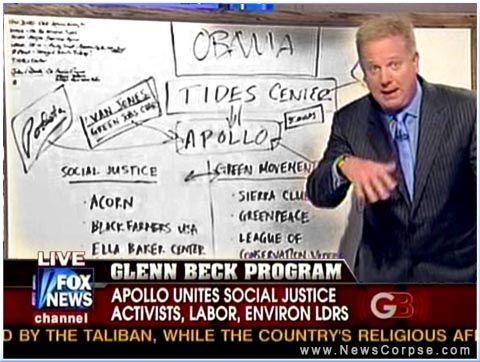
But DecodeDC's use of history in its inaugural episodes, is I think, symptomatic of at least one of the ways in which history is frequently referenced in contemporary American political discourse.  If one's goal is to "decode" or "decipher" American politics, one of the most popular methods of doing so is to reveal some (presumably obscure) fact from the past that will explain (or can be presented as explaining) why things are the way they are today.  In the case of DecodeDC, these reveals are pretty straightforward.  But this use of history comes in more baroque versions, too...such as Glenn Beck's infamous whiteboards.  In each case, one of the purposes of this use of history is simply to denaturalize the present: if something that we take for granted has a (quasi-secret) starting point, perhaps it can change in the future. In the more conspiratorial versions of this move, the genealogical reveal also shows a (quasi-surprising) person or force pulling the strings of the present from behind the scenes.


I've been thinking a lot about the role of history in politics (and vice versa) in light of the recent passing of Eugene Genovese, Eric Hobsbawm, and Henry May.  Though all three have been discussed on this blog, more attention has been given Genovese and May, presumably because, unlike Hobsbawm, they were Americanists.  Elsewhere online, however, Hobsbawm and Genovese seem to dominate the discussion. And what most clearly distinguishes them from May is that both were, more obviously and deeply than May, engagĂ© historians, though the relationship between history and politics in their work was far more complicated than the history-as-code-ring we get from Andrea Seabrook (let alone Glenn Beck).

Both Genovese and Hobsbawm, of course, started their careers (and Hobsbawm ended his, as well) as Marxists.  Marxism provides a particularly rich theoretical connection between politics and history. And in the work of more sophisticated Marxist historians (a category that surely includes both Hobsbawm and the younger Genovese), the understanding of the historical record and of political theory mutually inform and shape each other.  Like its Hegelian predecessor, the Marxist understanding of history sees the possibility of reading the future out of the record of the past.  But for Hegel, unlike Marx, the future foretold by history was, essentially, the Prussian present. Leopold van Ranke, and the other German historians who helped create modern historical practice in the 19th-century, also tended to be politically conservative, essentially seeing history as proving that what is ought to be.

But for all of these thinkers, on the left and the right, history was complicated, though in an ordered way.  This complexity was preserved even when, on occasion, they engaged in a version of the decoding / debunking mode (I'm thinking, in particular, of The Invention of Tradition, which Hobsbawm co-edited).  Though history certainly involved recovering past things now forgotten, for history to be understood, let alone for it to serve a political purpose, it needed to be properly interpreted.   The job of the historian does not end at simply figuring out that Harold Stassen was the first person to say "Democrat Party."*

During my early years of graduate school, my fellow history students and I frequently told each other that much of what was wrong with American political life could be solved if only Americans could have a richer, more complicated understanding of history. I remember one student fantasizing that if historians were regularly invited on Oprah, they could totally transform the discourse on that show for the better. Another student, watching Reagan's farewell address with me during our first year in grad school, was simultaneously enraged and excited by Reagan's discussion of the importance of teaching history:  "we've got to teach history based not on what's in fashion but what's important."  Though he and I knew we didn't agree much with the President about the relationship between the "fashionable" and the important in history, we certainly shared his passion for teaching about the past...and his sense that teaching about the past could help mold the future.

While I continue to believe that doing (and teaching) history is important in many ways, including for our political life, I've long since lost the sense that simply doing good history is a panacea for the problems in our political culture.  To begin with, good history always has to compete with bad history. And though good history occasionally wins, bad history often has the political edge.  And simple history will almost always have an advantage over complicated history.  Invoking "Munich" (or "Vietnam") as codewords in a foreign policy debate is far easier than grappling with the complexity of European politics in 1938 or the American presence in Southeast Asia in the 1950s and 1960s.

However sympathetic one is (or isn't) with Hobsbawm's or Genovese's politics (and I imagine that few are sympathetic with both Genovese's youthful politics and the politics of Genovese's later years...though of course, Genovese managed the trick), it's hard not to conclude that their political understandings enriched their (and, by extension, our) understandings of the past.  Yet I think neither of them -- even Genovese, late in life, allied with a regnant conservatism -- had anywhere near as significant a political impact as an historiographical one.

____________________________________________________
* To be fair to DecodeDC, Seabrook does analyze Stassen's coinage, but in largely ahistorical terms. George Lakoff is the most important analytic voice in the podcast's second episode.

Kamis, 15 Desember 2011

Tim's Light Reading (12-15-2011): The Non-Western Mind, Politics And Intellectuals, The Psychology Of Terrorism, And The 1992 Affect

1. The Mind In The History Of Psychology: Contingency And Psychohistory

Josh Rothman of the Boston Globe's Brainiac blog considers (or rather ponders what two psychologists have considered on) the limitations and possibilities of theories of the mind contingent on whether psychology had developed outside of Western culture. Rothman's piece focuses on the various terms for mind around the world: maum, kokoro, dusa, etc.

This pointer drags up a thought that has been hovering on the edges of my consciousness in relation to USIH historiography. Are intellectual historians afraid of psychology? Except for Lasch and Hofstadter, who among recent intellectual historians has embraced, or embraces, a philosophy of history that deeply engages psychology? Is psychohistory a cultish swamp of historiography, like cliometrics? Or has psychological theory been banished to biography? If so, then I would think that USIH folks, with their penchant for biography, would be embracing psychological theory in trying to capture the essence of their particular persons.

2. The Moral Psychology of Terrorism

Speaking of psychology in recent history, the East Carolina University plans to hold a conference on the "Moral Psychology of Terrorism: Implications for Security" in April 2012. Here are the first few paragraphs from the CFP:

The terrorism of the past decade has been driven by the interface of psychology, morality, faith, religion, and politics. This modern terrorism reflects terrorists’ pursuit of their beliefs and even aggressive promotion of the exclusivity of their world-views at the expense of the lives of those who do not share them. In this sense, the act of terrorism is fueled by arguments of morality and views that are rooted in the psyches and beliefs of terrorists.

Recent terrorism, wherever it spreads, under the banner of major monotheistic religious traditions or Hinduism, Buddhism and Sikhism, brings into the forefront the need to better understand the moral psychology of terrorism. This need is more critical in the areas where youths might be recruited and socialized or ‘brain-washed’ by terrorist leaders. The heinous events committed by terrorists and sympathizers against the citizens of New York, London, Madrid, Bombay, and various cities of Pakistan and Afghanistan further emphasize the need to understand terrorists’ moral psychology.


3. Intellectuals And--Or In---Politics

The NYT's Stone weblog, which covers philosophy, recently featured a post by Gary Cutting, a philosophy professor at the University of Notre Dame, titled "Intellectuals and Politics." Cutting says he's going to discuss "the role of intellectuals in American politics," but I think he's really discussing the politics of real or purported intellectual lives among practicing, active politicians. Historians will typically wish, as I did, that the post had a few more concrete examples from a usable past---of traits, situations, and politicians whose work has gone wrong, or well, due to intellectual associations. Some of us appreciate the nuggets of truth in the maxim uttered by Henry St. John, Lord Viscount Bolingbroke: "History is philosophy teaching by examples." [In his Letters on the Study and Use of History, 1770, p. 14--or 15, depending on your version.]

4. The 1992 Affect

Writing for Vanity Fair, Kurt Andersen argues that the cultural landscape of 2011 is really just a sorry echo of the affections of 1992. We're consuming and recycling the past rather than creating anew (a consequence of hip-hop sampling?*). You might say that we're more Kurt Cobain than Kurt Vile, Kurt Busch, or Kurt Angle. ...Yes, these are my lame attempts at present-day pop culture obscurity. Anyway, here are the first two paragraphs of Andersen's intriguing analysis:

The past is a foreign country. Only 20 years ago the World Wide Web was an obscure academic thingamajig. All personal computers were fancy stand-alone typewriters and calculators that showed only text (but no newspapers or magazines), played no video or music, offered no products to buy. E-mail (a new coinage) and cell phones were still novelties. Personal music players required cassettes or CDs. Nobody had seen a computer-animated feature film or computer-generated scenes with live actors, and DVDs didn’t exist. The human genome hadn’t been decoded, genetically modified food didn’t exist, and functional M.R.I. was a brand-new experimental research technique. Al-Qaeda and Osama bin Laden had never been mentioned in The New York Times. China’s economy was less than one-eighth of its current size. CNN was the only general-interest cable news channel. Moderate Republicans occupied the White House and ran the Senate’s G.O.P. caucus.

Since 1992, as the technological miracles and wonders have propagated and the political economy has transformed, the world has become radically and profoundly new. (And then there’s the miraculous drop in violent crime in the United States, by half.) Here is what’s odd: during these same 20 years, the appearance of the world (computers, TVs, telephones, and music players aside) has changed hardly at all, less than it did during any 20-year period for at least a century. The past is a foreign country, but the recent past—the 00s, the 90s, even a lot of the 80s—looks almost identical to the present. This is the First Great Paradox of Contemporary Cultural History.


And here's Andersen's explanation behind the phenomenon:

Why is this happening? In some large measure, I think, it’s an unconscious collective reaction to all the profound nonstop newness we’re experiencing on the tech and geopolitical and economic fronts. People have a limited capacity to embrace flux and strangeness and dissatisfaction, and right now we’re maxed out. So as the Web and artificially intelligent smartphones and the rise of China and 9/11 and the winners-take-all American economy and the Great Recession disrupt and transform our lives and hopes and dreams, we are clinging as never before to the familiar in matters of style and culture.

Fun. Let me know what you think. - TL

* Andersen covers this: "And in pop music, thanks to sampling, even the last genuinely new form, hip-hop, made an explicit and unapologetic point of recycling earlier songs." ...Yes, indeed, I posted this article for your consumption before having read every word of it---I liked it that much.