A profound commentary, from Glenn Beck:
Via Caroline Glick, "The liberal anti-Semitic projection syndrome."
Tampilkan postingan dengan label Glenn Beck. Tampilkan semua postingan
Tampilkan postingan dengan label Glenn Beck. Tampilkan semua postingan
Kamis, 22 November 2012

Senin, 08 Oktober 2012
Stray Thoughts on History and Politics
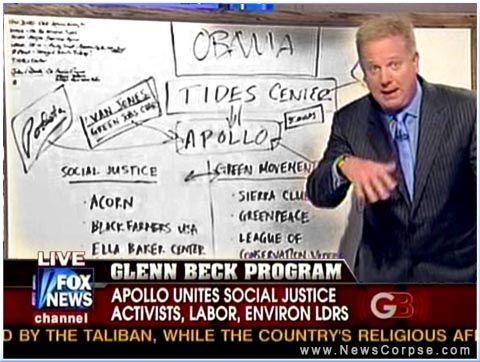
But DecodeDC's use of history in its inaugural episodes, is I think, symptomatic of at least one of the ways in which history is frequently referenced in contemporary American political discourse. If one's goal is to "decode" or "decipher" American politics, one of the most popular methods of doing so is to reveal some (presumably obscure) fact from the past that will explain (or can be presented as explaining) why things are the way they are today. In the case of DecodeDC, these reveals are pretty straightforward. But this use of history comes in more baroque versions, too...such as Glenn Beck's infamous whiteboards. In each case, one of the purposes of this use of history is simply to denaturalize the present: if something that we take for granted has a (quasi-secret) starting point, perhaps it can change in the future. In the more conspiratorial versions of this move, the genealogical reveal also shows a (quasi-surprising) person or force pulling the strings of the present from behind the scenes.
I've been thinking a lot about the role of history in politics (and vice versa) in light of the recent passing of Eugene Genovese, Eric Hobsbawm, and Henry May. Though all three have been discussed on this blog, more attention has been given Genovese and May, presumably because, unlike Hobsbawm, they were Americanists. Elsewhere online, however, Hobsbawm and Genovese seem to dominate the discussion. And what most clearly distinguishes them from May is that both were, more obviously and deeply than May, engagé historians, though the relationship between history and politics in their work was far more complicated than the history-as-code-ring we get from Andrea Seabrook (let alone Glenn Beck).
Both Genovese and Hobsbawm, of course, started their careers (and Hobsbawm ended his, as well) as Marxists. Marxism provides a particularly rich theoretical connection between politics and history. And in the work of more sophisticated Marxist historians (a category that surely includes both Hobsbawm and the younger Genovese), the understanding of the historical record and of political theory mutually inform and shape each other. Like its Hegelian predecessor, the Marxist understanding of history sees the possibility of reading the future out of the record of the past. But for Hegel, unlike Marx, the future foretold by history was, essentially, the Prussian present. Leopold van Ranke, and the other German historians who helped create modern historical practice in the 19th-century, also tended to be politically conservative, essentially seeing history as proving that what is ought to be.
But for all of these thinkers, on the left and the right, history was complicated, though in an ordered way. This complexity was preserved even when, on occasion, they engaged in a version of the decoding / debunking mode (I'm thinking, in particular, of The Invention of Tradition, which Hobsbawm co-edited). Though history certainly involved recovering past things now forgotten, for history to be understood, let alone for it to serve a political purpose, it needed to be properly interpreted. The job of the historian does not end at simply figuring out that Harold Stassen was the first person to say "Democrat Party."*
During my early years of graduate school, my fellow history students and I frequently told each other that much of what was wrong with American political life could be solved if only Americans could have a richer, more complicated understanding of history. I remember one student fantasizing that if historians were regularly invited on Oprah, they could totally transform the discourse on that show for the better. Another student, watching Reagan's farewell address with me during our first year in grad school, was simultaneously enraged and excited by Reagan's discussion of the importance of teaching history: "we've got to teach history based not on what's in fashion but what's important." Though he and I knew we didn't agree much with the President about the relationship between the "fashionable" and the important in history, we certainly shared his passion for teaching about the past...and his sense that teaching about the past could help mold the future.
While I continue to believe that doing (and teaching) history is important in many ways, including for our political life, I've long since lost the sense that simply doing good history is a panacea for the problems in our political culture. To begin with, good history always has to compete with bad history. And though good history occasionally wins, bad history often has the political edge. And simple history will almost always have an advantage over complicated history. Invoking "Munich" (or "Vietnam") as codewords in a foreign policy debate is far easier than grappling with the complexity of European politics in 1938 or the American presence in Southeast Asia in the 1950s and 1960s.
However sympathetic one is (or isn't) with Hobsbawm's or Genovese's politics (and I imagine that few are sympathetic with both Genovese's youthful politics and the politics of Genovese's later years...though of course, Genovese managed the trick), it's hard not to conclude that their political understandings enriched their (and, by extension, our) understandings of the past. Yet I think neither of them -- even Genovese, late in life, allied with a regnant conservatism -- had anywhere near as significant a political impact as an historiographical one.
____________________________________________________
* To be fair to DecodeDC, Seabrook does analyze Stassen's coinage, but in largely ahistorical terms. George Lakoff is the most important analytic voice in the podcast's second episode.
Senin, 27 Februari 2012
On Describing Today's Historical Ecosphere

But more often, works of history that find their way to the best seller list are considerably less scholarly. Take, for example, Hardball host Chris Matthews' Jack Kennedy: Elusive Hero, currently #33 on the New York Times Hardcover Non-Fiction Best Sellers List and the subject of a take-down by the historian David Greenberg in TNR [h/t Erik Loomis at LGM]. Vanity projects by pundits about presidents past seem to have emerged as a genre unto themselves. At least as described by Greenberg, Matthews book seems little more than a projection of his own two-dimensional political personality onto JFK.*
But what I found most interesting about Matthews' book was the list of people who have blurbed it.
As Greenberg notes, Jack Kennedy: Elusive Hero is marketed with praise from Douglas Brinkley, Walter Isaacson, Brian Williams, Peggy Noonan, and Doris Kearns Goodwin. This is an interesting mix of people. Noonan and Williams are fellow media personalities, who don't have any particular historical credentials. But the other three figures inhabit an intermediate zone between scholarly and popular approaches to history: semi-serious historians whose reputations have been built as mainstream public intellectuals. The only academic among the three is Brinkley, though I think his reputation as a scholar is even more slight than Isaacson's or Goodwin's (despite the accusations of plagiarism against the latter). Along with the once ubiquitous Michael Beschloss, Brinkley and Goodwin for years formed a kind of triumvirate of semi-official historical opinion on relatively serious network newscasts. Each is also more closely tied to the political and financial elite than your average historian (popular or scholarly): Goodwin was an assistant to LBJ and married Richard Goodwin, a more senior assistant to both JFK and LBJ. Brinkley is a member of the Century Club and the Council on Foreign Relations. Beschloss is married to a former treasurer and chief investment officer of the World Bank who runs a Washington, DC-based hedge fund. Isaacson emerged out of the media, starting his career as a journalist, rising to be CEO of CNN in 2001 and President and CEO of the Aspen Institute in 2003.
What I find fascinating about these figures is the very complicated role they play in today's historical ecosphere. If you had to place their work on one side or the other of the popular / scholarly divide, they'd certainly be considered popular. Yet their books--especially Goodwin's and Isaacson's--are taken seriously by serious people. They are certainly not in the same category of "historians" as, say, Glenn Beck or Chris Matthews. But they are often called upon to validate the seriousness and even the expertise of people like Matthews (if not Beck). Indeed, Goodwin's blurb for Matthew's JFK book seems to leave David Greenberg somewhat flummoxed; he notes that she "surely cannot regard this as a meritorious book."
What all of this suggests to me is that the old scholarly / popular divide is too crude to describe the ways in which history is produced and consumed in the U.S. today. I'm not going to attempt a more precise taxonomy in this blogpost. But I think establishing one would help us make better sense of things like the Tea Party's use of history, which have been recurring themes on this blog.
___________________________

Kamis, 23 Februari 2012
Tim's Light Reading (2-23-2012): Beck-Inspired Flaming, Documentaries, Instrumental Universities, The Market-Democracy Relationship, and New Works of Interest
[Updated: 8:40 am]
1 (of 6). "The Culture Wars are Real": Beck's Minions Attack John Fea
You may or may not know that Glenn Beck has a "news" website called The Blaze. I didn't---until Messiah College professor John Fea, author of Was America Founded as a Christian Nation?, recently relayed a story about being featured on the Beck site. The Blaze feature, authored by Billy Hallowell, brought attention to Fea for a line in a recent Patheos editorial wherein Fea opined that "Obama may be the most explicitly Christian president in American history." Hallowell's story has garnered 848 comments (as of 3 pm yesterday), and Fea has reported receiving nasty e-mails and voicemails. As an aside, I was somewhat surprised at the attention Fea received because, beyond the title, Hallowell's article isn't particularly incendiary.
I forward this for your consideration because, well, our relatively quiet blog community might garner this kind of attention at some point. It seems logical since we both write about recent political issues (and candidates), and receive some popular attention from moderates and lefty types. Granted, that attention comes from thoughtful corners. But I wouldn't be surprised if a rhetorical bomb-thrower from the right doesn't hit us soon.
2. "We’re Living in a Golden Age of Documentary Filmmaking"
This was the title of a recent Slate article by Eric Hynes. Hynes focuses on the short-shrift this golden age is receiving from the Academy Awards, but I agree fully. I particularly enjoy the work of Errol Morris. His The Fog of War comes up in the article, and I use that documentary religiously in my twentieth-century American survey courses (as well as The Weather Underground, which complements Fog nicely). The point of Hynes's article is that we have lots of screening choices.
3. Perceived Social Rank and Cognitive Ability
Check out this summary of study by a team of Cal Tech researchers. Here are some relevant passages:
Our cognitive abilities and decision-making skills can be dramatically hindered in social settings where we feel that we are being ranked or assigned a status level, such as classrooms and work environments. ...The finding flies in the face of long-held ideas about intelligence and cognition that regard IQ as a stable, predictive measure of mental horsepower.
"This study tells us the idea that IQ is something we can reliably measure in isolation without considering how it interacts with social context is essentially flawed," says Steven Quartz, professor of philosophy at Caltech and one of the authors of the new study. ..."This suggests that the idea of a division between social and cognitive processing in the brain is really pretty artificial. The two deeply interact with each other."
 I'm still sorting all of this out, but I'd say this study might have something profound to say to intellectual historians---particularly those whose work covers class-based societies (i.e. all of us). Cue the study summary:
Throughout the 20th century, IQ was used in different arenas as a way of sorting or classifying people into niches. Because people believed it to be a more abstract notion of cognitive ability, it was thought to have strong predictive validity of mental capabilities even from age six. But IQ was always measured in social isolation. "That reflects a long tradition of intellectual history, of considering rationality and cognition to be this isolated process," Quartz says. "But one of the things that we're learning more and more in social neuroscience is the role of our social contexts and the social adaptation of the brain." Understanding the role social context plays and its differential impact on the brain may ultimately help educators and others to design more effective learning environments.
And last but not least:
The present study found some unexpected trends, including the tendency for female subjects to be more affected than males by the implicit signaling of social status during the test.
4. Economically Instrumental Universities
 USIH friend and public intellectual(!) Ethan Schrum [right] recently penned an op-ed for the Richmond Times-Dispatch that chastises the Obama administration for a having a narrow view of the role of higher education in recent American history. Here's Schrum's conclusion:
Obama, by contrast, told students they were at Michigan to get skills and training for building their personal finances and the American economy. He gave no indication that a student might be at the university to be formed as a person, as a thinker and communicator — and as a global citizen.
Obama's narrow, short-sighted rhetoric for American higher education puts our universities in peril. We must wake up to the possibility that universities might be living on borrowed moral capital and begin framing higher education policy in ways consistent with our universities' noble traditions, before it is too late.
 Sure, this is a long-running problem that pre-dates Obama's recent speech. But the president deserves a tongue-lashing for using the nation's bully pulpit to promote a one-sided, and frankly erroneous, view of higher education. Although I understand the needs of the campaign trail ("It's the economy, stupid!"), Obama could've been more honest.
5. A Forthcoming Work of Possible Interest
(a) Bernard Hodgson (forthcoming), "Democratic Agency and the Market Machine," Journal of Business Ethics.
[From PhilPapers] "The alliance of pure market economies with democratic polities has traditionally been a problematic one. It is argued that orthodox theoretical conceptualizations of market behaviour and the application of such theory to our communal lives have entrenched an incoherent alliance. In particular, the reductive mechanism characteristic of both neo-classical economic theory and its deployment in our socio-economic order has severely undermined the telic agency required for the autonomy or self-rule definitive of an authentic democratic order. Such reduction is observed to function through the disabling of the cognitive capacity of consumers and by disempowering the agency of workers such that coercion is misconceived as freely agreed contract."
6. From My OAH-RSO Feed: New Books and Articles of Interest
This month's RSO is loaded with intellectual history---more than I've sampled below. Be sure to check out entry (i)!
(a) Barry, John M., Roger Williams and the Creation of the American Soul: Church, State, and the Birth of Liberty (New York: Viking, 2012).
(b) Bromell, Nick, "A `Voice from the Enslaved': The Origins of Frederick Douglass's Political Philosophy of Democracy," American Literary History, 23 (Winter 2011), 697-723.
(c)Fischer, David Hackett, Fairness and Freedom: A History of Two Open Societies, New Zealand and the United States (New York: Oxford University Press, 2012).
(d) Goodman, Joyce, "The Gendered Politics of Historical Writing in History of Education," History of Education (London), 41 (Jan. 2012), 9-24.
(e) Laats, Adam, "Monkeys, Bibles, and the Little Red Schoolhouse: Atlanta's School Battles in the Scopes Era," Georgia Historical Quarterly, 95 (Fall 2011), 335-55.
(f) Lee, Maurice S., Uncertain Chances: Science, Skepticism, and Belief in Nineteenth-Century American Literature (New York: Oxford University Press, 2012).
(g) Lee, Michael J., "American Revelations: Biblical Interpretation and Criticism in America, circa 1700-1860" (PhD Diss, University of Notre Dame, 2009).
(h) Matteson, John, The Lives of Margaret Fuller: A Biography (New York: W. W. Norton and Company, 2012).
(i) Murphy, Paul V., The New Era: American Thought and Culture in the 1920s (Lanham: Rowman & Littlefield, 2012).
(j) Powell, Tara, The Intellectual in Twentieth-Century Southern Literature (Baton Rouge: Louisiana State University Press, 2012).
(k) Rose, Anne C., "The Invention of Uncertainty in American Psychology: Intellectual Conflict and Rhetorical Resolution, 1890-1930," History of Psychology, 14 (Nov. 2011), 356-82.
(l) Szalay, Michael, "Ralph Ellison's Unfinished Second Skin," American Literary History, 23 (Winter 2011), 795-827.
1 (of 6). "The Culture Wars are Real": Beck's Minions Attack John Fea
You may or may not know that Glenn Beck has a "news" website called The Blaze. I didn't---until Messiah College professor John Fea, author of Was America Founded as a Christian Nation?, recently relayed a story about being featured on the Beck site.

I forward this for your consideration because, well, our relatively quiet blog community might garner this kind of attention at some point. It seems logical since we both write about recent political issues (and candidates), and receive some popular attention from moderates and lefty types. Granted, that attention comes from thoughtful corners. But I wouldn't be surprised if a rhetorical bomb-thrower from the right doesn't hit us soon.
2. "We’re Living in a Golden Age of Documentary Filmmaking"
This was the title of a recent Slate article by Eric Hynes. Hynes focuses on the short-shrift this golden age is receiving from the Academy Awards, but I agree fully. I particularly enjoy the work of Errol Morris. His The Fog of War comes up in the article, and I use that documentary religiously in my twentieth-century American survey courses (as well as The Weather Underground, which complements Fog nicely). The point of Hynes's article is that we have lots of screening choices.
3. Perceived Social Rank and Cognitive Ability
Check out this summary of study by a team of Cal Tech researchers. Here are some relevant passages:
Our cognitive abilities and decision-making skills can be dramatically hindered in social settings where we feel that we are being ranked or assigned a status level, such as classrooms and work environments. ...The finding flies in the face of long-held ideas about intelligence and cognition that regard IQ as a stable, predictive measure of mental horsepower.
"This study tells us the idea that IQ is something we can reliably measure in isolation without considering how it interacts with social context is essentially flawed," says Steven Quartz, professor of philosophy at Caltech and one of the authors of the new study. ..."This suggests that the idea of a division between social and cognitive processing in the brain is really pretty artificial. The two deeply interact with each other."

Throughout the 20th century, IQ was used in different arenas as a way of sorting or classifying people into niches. Because people believed it to be a more abstract notion of cognitive ability, it was thought to have strong predictive validity of mental capabilities even from age six. But IQ was always measured in social isolation. "That reflects a long tradition of intellectual history, of considering rationality and cognition to be this isolated process," Quartz says. "But one of the things that we're learning more and more in social neuroscience is the role of our social contexts and the social adaptation of the brain." Understanding the role social context plays and its differential impact on the brain may ultimately help educators and others to design more effective learning environments.
And last but not least:
The present study found some unexpected trends, including the tendency for female subjects to be more affected than males by the implicit signaling of social status during the test.
4. Economically Instrumental Universities

Obama, by contrast, told students they were at Michigan to get skills and training for building their personal finances and the American economy. He gave no indication that a student might be at the university to be formed as a person, as a thinker and communicator — and as a global citizen.
Obama's narrow, short-sighted rhetoric for American higher education puts our universities in peril. We must wake up to the possibility that universities might be living on borrowed moral capital and begin framing higher education policy in ways consistent with our universities' noble traditions, before it is too late.

5. A Forthcoming Work of Possible Interest
(a) Bernard Hodgson (forthcoming), "Democratic Agency and the Market Machine," Journal of Business Ethics.
[From PhilPapers] "The alliance of pure market economies with democratic polities has traditionally been a problematic one. It is argued that orthodox theoretical conceptualizations of market behaviour and the application of such theory to our communal lives have entrenched an incoherent alliance. In particular, the reductive mechanism characteristic of both neo-classical economic theory and its deployment in our socio-economic order has severely undermined the telic agency required for the autonomy or self-rule definitive of an authentic democratic order. Such reduction is observed to function through the disabling of the cognitive capacity of consumers and by disempowering the agency of workers such that coercion is misconceived as freely agreed contract."
6. From My OAH-RSO Feed: New Books and Articles of Interest
This month's RSO is loaded with intellectual history---more than I've sampled below. Be sure to check out entry (i)!
(a) Barry, John M., Roger Williams and the Creation of the American Soul: Church, State, and the Birth of Liberty (New York: Viking, 2012).
(b) Bromell, Nick, "A `Voice from the Enslaved': The Origins of Frederick Douglass's Political Philosophy of Democracy," American Literary History, 23 (Winter 2011), 697-723.
(c)Fischer, David Hackett, Fairness and Freedom: A History of Two Open Societies, New Zealand and the United States (New York: Oxford University Press, 2012).
(d) Goodman, Joyce, "The Gendered Politics of Historical Writing in History of Education," History of Education (London), 41 (Jan. 2012), 9-24.
(e) Laats, Adam, "Monkeys, Bibles, and the Little Red Schoolhouse: Atlanta's School Battles in the Scopes Era," Georgia Historical Quarterly, 95 (Fall 2011), 335-55.
(f) Lee, Maurice S., Uncertain Chances: Science, Skepticism, and Belief in Nineteenth-Century American Literature (New York: Oxford University Press, 2012).
(g) Lee, Michael J., "American Revelations: Biblical Interpretation and Criticism in America, circa 1700-1860" (PhD Diss, University of Notre Dame, 2009).
(h) Matteson, John, The Lives of Margaret Fuller: A Biography (New York: W. W. Norton and Company, 2012).
(i) Murphy, Paul V., The New Era: American Thought and Culture in the 1920s (Lanham: Rowman & Littlefield, 2012).
(j) Powell, Tara, The Intellectual in Twentieth-Century Southern Literature (Baton Rouge: Louisiana State University Press, 2012).
(k) Rose, Anne C., "The Invention of Uncertainty in American Psychology: Intellectual Conflict and Rhetorical Resolution, 1890-1930," History of Psychology, 14 (Nov. 2011), 356-82.
(l) Szalay, Michael, "Ralph Ellison's Unfinished Second Skin," American Literary History, 23 (Winter 2011), 795-827.
Senin, 23 Januari 2012
Newt Gingrich's Big Ideas
JOHN KING: Speaker Gingrich, I want to start with you. You're at this for months and you're out there. If there's one thing, just one thing in this campaign you could do over, what would it be?
MR. GINGRICH: I would skip the opening three months, where I hired regular consultants and tried to figure out how to be a normal candidate, and I would just to straight at being a big-ideas, big- solutions, Internet-based campaign from day one, because it just didn't work. I mean, it's not who I am. I'm not capable of being a sort of traditional candidate. I'm a very idea-oriented candidate. And I think the Internet makes it possible to create a momentum of ideas that's very, very exciting.Newt does not have ideas, he has ideas about ideas. He keeps saying what a good idea it is to have ideas. . . . He is the least substantive major political figure I’ve ever seen.He's a stupid man's idea of what a smart man sounds like.

Newt Gingrich has apparently always liked "big ideas." And, just as apparently, critics have felt that his attachment to "big ideas" was largely devoid of content. Gingrich's "interest in long-range and broad-range planning for the future...is clearly more appropriate to the orientation of our Department of Geography" noted his then employer, West George College President Ward Pafford, in a 1975 letter announcing Gingrich's removal from the History Department. "Not only is Mr Gingrich not a problem-solver," quipped The Economist's Democracy in American Blog last year, "he is a problem-aggrandiser."
Following Newt's big win in SC over the weekend, skeptical beltway pundits are having trouble identifying the ideas his campaign is supposedly based on. Via Gary Johnson, Ezra Klein unearthed the justly defeated Drug Importer Death Penalty Act of 1996, which would have put to death anyone bringing more than two ounces of marijuana into the U.S.* Ultimately, Klein concludes, when it comes to Newt's ideas, there's no there there: "Can anyone name some actually big, actually workable, actually new ideas that Gingrich has been associated with during his career? What has he brought to the table that wouldn’t have been there in his absence?"
But although Newt Gingrich's vaunted ideas don't amount to much, I think it would be wrong to dismiss their importance to his political success. Newt is hardly alone on the right in valuing the idea of ideas. Indeed, ideas a key part of what one might call the brand identity of modern American conservatism.

Conservatives have made exceedingly long novels of ideas into best-sellers.
The chief organizing strategy of the John Birch Society, the signature organization of the late 1950s and early 1960s far right, involved exceedingly long, detailed and dry seminars by founder Robert Welch:

Whether or not we join Corey Robin in seeing conservatism as fundamentally an "ideas-driven praxis," there's no question that the idea of ideas has great power on the right.
The question is why?
This is, after all, a movement that has also boldly embraced a rhetoric of populist anti-elitism and has often celebrated anti-intellectualism. In 2005, in the midst of praising George W. Bush in the wake of Katrina, David Frum could conclude that the then President was "sometimes glib, even dogmatic, often uncurious, and as a result ill-informed . . . (but) outweighing the faults are his virtues: decency, honesty, rectitude, courage, and tenacity."
And yet, my guess is the fact that Newt Gingrich has a PhD in history probably does him a lot more electoral good than George McGovern's PhD in history ever did him. As Ezra Klein and others have noted, Newt's ideas don't much distinguish him from most of the other GOP presidential candidates. But the place of ideas in Newt's self-presentation is one of the distinguishing characteristics of his campaign and indeed his entire career. That it confounds and infuriates people like Barney Frank, Paul Krugman, and Ezra Klein is, among Gingrich's base, doubtless a feature not a bug.
Although I happen to agree with Corey Robin that it's worth spending time to understand the actual ideas of conservatives, I also think that historians ought to spend time understanding the imaginative place of ideas among movement conservatives and its relationship to the equally powerful strains of anti-intellectualism on the right. Rather than opposing tendencies, my sense is that they are actually two sides of the same coin.
_______________________________
* This is all the more amazing since Newt himself admits to having smoked pot in grad school.
** And not just scholars on the right. Corey Robin, too, argues that conservatism is a movement of ideas and that leftists and liberals have made a terrible mistake not to take those ideas more seriously.
Jumat, 19 November 2010
“New Class” Thinking and Historiography

I am curious what our readers make of “new class” thinking. Is it a legitimate way of theorizing about the place of intellectuals in our postmodern, postindustrial society? Or is it anti-intellectual nonsense, an updated version of Julian Benda’s La Trahison des Clercs?
In my research on the culture wars, I credit the popularization of “new class” thinking to the neoconservatives. Out of their political repositioning, they developed a critical theory about a so-called “new class” of intellectuals, broadly defined to include all professionals tasked with manipulating language—although more narrowly applied to humanists and social scientists. Most members of this “new class,” so the theory went, had turned their backs on the society to which they owed their high-ranking status. A private memorandum written by Daniel Patrick Moynihan for his boss President Nixon in 1970 exemplified this withering mode of criticism: “No doubt there is a struggle going on in this country of the kind the Germans used to call a Kulturkampf. The adversary culture which dominates almost all channels of information transfer and opinion formation has never been stronger, and as best I can tell it has come near silencing the representatives of traditional America.”
In this sense, “new class” thinking seems more ideological than analytical, consistent with the anti-intellectual histrionics of Rush Limbaugh and Glen Beck, amusingly portrayed by David Bromwich in his recent New York Review of Books piece, “The Rebel Germ.” Bromwich describes how Limbaugh mockingly portrays Democrats as the party of wimpish intellectuals—updating the egghead label applied to early Cold War era Democrats like Adlai Stevenson and his followers—“composed of superannuated aristocrats [and] pretentious arrivistes...” If this is the sole meaning of the “new class,” then there’s nothing much new about it. But plenty of historians and other intellectuals think the concept analytically useful.
Take Christopher Lasch’s biographer Eric Miller, who buys into Alvin Gouldner’s argument about the “new class,” made in his 1982 book, The Future of Intellectuals and the Rise of the New Class. In a passage cited by Miller to explain Lasch’s early theories about society, Gouldner writes that a “new class” intellectual “desacralizes authority-claims and facilitates challenges to definitions of social reality made by traditional authorities...” Miller continues, in his own disapproving words:
The unintended effect of this way of seeing was on the one hand to diminish the individual’s sense of agency while on the other to empower the individual to think of herself as subject to no authority beyond the particular, socially constructed, historically contingent institutions of her own circumstance. In the end, social-science-inspired historiography only buttressed a vision of the world in which humans, while shaped by powerful social structures, were morally on their own and finally responsible to no authority higher than their own. The atomizing, antinomian tendencies latent in this individualistic ideology did not bode well for communitarian political hopes—such as those that were fueling Lasch’s nascent historical work and political vision (72-73).
In other words, paradoxically, the early Lasch, and “new class” thinkers like him, laid the groundwork for postmodernism in their dismissal of traditional structures of intellectual authority. I say paradoxically because the later, communitarian Lasch worked so hard to put the pieces of traditional structures of intellectual authority back together. I also say paradoxically because the later Lasch used “new class” thinking in both its political and analytical senses, especially in The True and Only Heaven (1991) and The Revolt of the Elites (1995).
So which is it? (I ask somewhat rhetorically, knowing one does not preclude the other.)
“New Class” Thinking and Historiography
I am curious what our readers make of “new class” thinking. Is it a legitimate way of theorizing about the place of intellectuals in our postmodern, postindustrial society? Or is it anti-intellectual nonsense, an updated version of Julian Benda’s La Trahison des Clercs?
In my research on the culture wars, I credit the popularization of “new class” thinking to the neoconservatives. Out of their political repositioning, they developed a critical theory about a so-called “new class” of intellectuals, broadly defined to include all professionals tasked with manipulating language—although more narrowly applied to humanists and social scientists. Most members of this “new class,” so the theory went, had turned their backs on the society to which they owed their high-ranking status. A private memorandum written by Daniel Patrick Moynihan for his boss President Nixon in 1970 exemplified this withering mode of criticism: “No doubt there is a struggle going on in this country of the kind the Germans used to call a Kulturkampf. The adversary culture which dominates almost all channels of information transfer and opinion formation has never been stronger, and as best I can tell it has come near silencing the representatives of traditional America.”
In this sense, “new class” thinking seems more ideological than analytical, consistent with the anti-intellectual histrionics of Rush Limbaugh and Glen Beck, amusingly portrayed by David Bromwich in his recent New York Review of Books piece, “The Rebel Germ.” Bromwich describes how Limbaugh mockingly portrays Democrats as the party of wimpish intellectuals—updating the egghead label applied to early Cold War era Democrats like Adlai Stevenson and his followers—“composed of superannuated aristocrats [and] pretentious arrivistes...” If this is the sole meaning of the “new class,” then there’s nothing much new about it. But plenty of historians and other intellectuals think the concept analytically useful.
Take Christopher Lasch’s biographer Eric Miller, who buys into Alvin Gouldner’s argument about the “new class,” made in his 1982 book, The Future of Intellectuals and the Rise of the New Class. In a passage cited by Miller to explain Lasch’s early theories about society, Gouldner writes that a “new class” intellectual “desacralizes authority-claims and facilitates challenges to definitions of social reality made by traditional authorities...” Miller continues, in his own disapproving words:
The unintended effect of this way of seeing was on the one hand to diminish the individual’s sense of agency while on the other to empower the individual to think of herself as subject to no authority beyond the particular, socially constructed, historically contingent institutions of her own circumstance. In the end, social-science-inspired historiography only buttressed a vision of the world in which humans, while shaped by powerful social structures, were morally on their own and finally responsible to no authority higher than their own. The atomizing, antinomian tendencies latent in this individualistic ideology did not bode well for communitarian political hopes—such as those that were fueling Lasch’s nascent historical work and political vision (72-73).
In other words, paradoxically, the early Lasch, and “new class” thinkers like him, laid the groundwork for postmodernism in their dismissal of traditional structures of intellectual authority. I say paradoxically because the later, communitarian Lasch worked so hard to put the pieces of traditional structures of intellectual authority back together. I also say paradoxically because the later Lasch used “new class” thinking in both its political and analytical senses, especially in The True and Only Heaven (1991) and The Revolt of the Elites (1995).
So which is it? (I ask somewhat rhetorically, knowing one does not preclude the other.)
Kamis, 11 Maret 2010
Tim's Light Reading (3/11/2010)
1. Thinking About Public Intellectuals: Harvard is hosting a conference on public intellectuals next month with the theme "Speaking Truth to Power." In the late afternoon on the first day is a symposium that looks to be a future-oriented reprise of our USIH Wingspread panel from last November. Otherwise, the program looks excellent.
2. A Useful Derrida? Or should I say a Derrida that might become useful to historians? Andrew Dunstall, a USIH 2.0 participant last fall, wonders about a new, materialist approach--a retranslation, if you will---to reading Derrida's writing and thinking.
3. The Meaning of the Tea Party: About a week ago David Brooks the amateur political-intellectual historian (again) paralleled the Tea Party to the New Left of the 1960s. (Aside: I agree with his observation about both ~not~ being conservative movements.) Brooks' column came on the heels of a Michael Lind article in Salon the week before where Lind called Glenn Beck the new Abbie Hoffman. A few days after Brooks' piece, Todd Gitlin refuted him in a post at Talking Points Memo. I don't have a dog in this fight because I have no stake in protecting either the Tea Party or the reputation of the sixties New Left. Still, it's an interesting intellectual history discussion because it speaks to how we define both ideology (e.g. paranoia), anti-intellectualism (e.g. paranoia again, radical anti-statism), and atavism as a historiographical causal issue (cyclical-ness).
4. A New Lead-Off Hitter for Grad School Historiography Courses? All intellectual historians love reading about historiography (right?). With that in mind, Adam Arenson makes the case, at Making History Podcast: The Blog, that Allan Megill’s Historical Knowledge, Historical Error (U of C Press, 2007) should replace Peter Novick's That Noble Dream. Discuss. ...In the meantime, it looks like I have yet another book to add to my infinitely expanding reading list.
5. Off-Topic: It looks like expectations for "treatment" by the nursing profession in Amsterdam are on the rise. Boy oh boy. - TL
2. A Useful Derrida? Or should I say a Derrida that might become useful to historians? Andrew Dunstall, a USIH 2.0 participant last fall, wonders about a new, materialist approach--a retranslation, if you will---to reading Derrida's writing and thinking.
3. The Meaning of the Tea Party: About a week ago David Brooks the amateur political-intellectual historian (again) paralleled the Tea Party to the New Left of the 1960s. (Aside: I agree with his observation about both ~not~ being conservative movements.) Brooks' column came on the heels of a Michael Lind article in Salon the week before where Lind called Glenn Beck the new Abbie Hoffman. A few days after Brooks' piece, Todd Gitlin refuted him in a post at Talking Points Memo. I don't have a dog in this fight because I have no stake in protecting either the Tea Party or the reputation of the sixties New Left. Still, it's an interesting intellectual history discussion because it speaks to how we define both ideology (e.g. paranoia), anti-intellectualism (e.g. paranoia again, radical anti-statism), and atavism as a historiographical causal issue (cyclical-ness).
4. A New Lead-Off Hitter for Grad School Historiography Courses? All intellectual historians love reading about historiography (right?). With that in mind, Adam Arenson makes the case, at Making History Podcast: The Blog, that Allan Megill’s Historical Knowledge, Historical Error (U of C Press, 2007) should replace Peter Novick's That Noble Dream. Discuss. ...In the meantime, it looks like I have yet another book to add to my infinitely expanding reading list.
5. Off-Topic: It looks like expectations for "treatment" by the nursing profession in Amsterdam are on the rise. Boy oh boy. - TL
Tim's Light Reading (3/11/2010)
1. Thinking About Public Intellectuals: Harvard is hosting a conference on public intellectuals next month with the theme "Speaking Truth to Power." In the late afternoon on the first day is a symposium that looks to be a future-oriented reprise of our USIH Wingspread panel from last November. Otherwise, the program looks excellent.
2. A Useful Derrida? Or should I say a Derrida that might become useful to historians? Andrew Dunstall, a USIH 2.0 participant last fall, wonders about a new, materialist approach--a retranslation, if you will---to reading Derrida's writing and thinking.
3. The Meaning of the Tea Party: About a week ago David Brooks the amateur political-intellectual historian (again) paralleled the Tea Party to the New Left of the 1960s. (Aside: I agree with his observation about both ~not~ being conservative movements.) Brooks' column came on the heels of a Michael Lind article in Salon the week before where Lind called Glenn Beck the new Abbie Hoffman. A few days after Brooks' piece, Todd Gitlin refuted him in a post at Talking Points Memo. I don't have a dog in this fight because I have no stake in protecting either the Tea Party or the reputation of the sixties New Left. Still, it's an interesting intellectual history discussion because it speaks to how we define both ideology (e.g. paranoia), anti-intellectualism (e.g. paranoia again, radical anti-statism), and atavism as a historiographical causal issue (cyclical-ness).
4. A New Lead-Off Hitter for Grad School Historiography Courses? All intellectual historians love reading about historiography (right?). With that in mind, Adam Arenson makes the case, at Making History Podcast: The Blog, that Allan Megill’s Historical Knowledge, Historical Error (U of C Press, 2007) should replace Peter Novick's That Noble Dream. Discuss. ...In the meantime, it looks like I have yet another book to add to my infinitely expanding reading list.
5. Off-Topic: It looks like expectations for "treatment" by the nursing profession in Amsterdam are on the rise. Boy oh boy. - TL
2. A Useful Derrida? Or should I say a Derrida that might become useful to historians? Andrew Dunstall, a USIH 2.0 participant last fall, wonders about a new, materialist approach--a retranslation, if you will---to reading Derrida's writing and thinking.
3. The Meaning of the Tea Party: About a week ago David Brooks the amateur political-intellectual historian (again) paralleled the Tea Party to the New Left of the 1960s. (Aside: I agree with his observation about both ~not~ being conservative movements.) Brooks' column came on the heels of a Michael Lind article in Salon the week before where Lind called Glenn Beck the new Abbie Hoffman. A few days after Brooks' piece, Todd Gitlin refuted him in a post at Talking Points Memo. I don't have a dog in this fight because I have no stake in protecting either the Tea Party or the reputation of the sixties New Left. Still, it's an interesting intellectual history discussion because it speaks to how we define both ideology (e.g. paranoia), anti-intellectualism (e.g. paranoia again, radical anti-statism), and atavism as a historiographical causal issue (cyclical-ness).
4. A New Lead-Off Hitter for Grad School Historiography Courses? All intellectual historians love reading about historiography (right?). With that in mind, Adam Arenson makes the case, at Making History Podcast: The Blog, that Allan Megill’s Historical Knowledge, Historical Error (U of C Press, 2007) should replace Peter Novick's That Noble Dream. Discuss. ...In the meantime, it looks like I have yet another book to add to my infinitely expanding reading list.
5. Off-Topic: It looks like expectations for "treatment" by the nursing profession in Amsterdam are on the rise. Boy oh boy. - TL
Langganan:
Postingan (Atom)