Tampilkan postingan dengan label Eric Hobsbawm. Tampilkan semua postingan

Selasa, 23 Oktober 2012

A List of Marxist Historians?


Guest post by Kurt Newman.

I am grateful to Andrew Hartman for extending me an invitation to run a query by the readers of the US Intellectual History blog. My name is Kurt Newman. I’m a graduate student in US history at the University of California Santa Barbara.


The query is this. If we were to assemble a list of Marxist historians of the United States, with the provision that we limit such a list to people who are both alive and active, what would the result look like? If we were willing to risk the scorn that might be legitimately inspired by asking an additional stupid question—what would happen if we were to narrow our search to people who could be described as American historians of the United States—would we learn anything interesting about the domestic historical profession?


Under ordinary circumstances, one might have to argue for the relevance of such an inquiry. A list of Marxist historians? From one perspective (let’s say, that of David Horowitz or Lynne Cheney): aren’t all academics in the humanities Marxists? From another (the dominant strain of thinking among the contemporary intelligentsia): didn’t Marxism more or less fade away with the fall of the Soviet Union? (At the margins, there are certainly some Cold War-haunted souls who might feel that discussing such things in public could only serve to invite several varieties of danger. They might even be right!)


The recent passing of Eric Hobsbawm and Eugene Genovese, however, forced many writers otherwise dismissive of the project of historical materialism, to recall that Marxism was for many years an extraordinarily generative force within historiography. Whatever the objections to the interpretive tendencies or personal choices of Hobsbawm and Genovese, no one could deny their authorial skill and influence, nor question their capacity to ask interesting questions. Could the same be said for historians under the influence of any other putatively discredited philosophy?  

As a graduate student who both studies the history of the United States and identifies as a Marxist,  I wonder (although without much angst or anxiety) whether Marxism is currently a tendency with much influence within the contemporary historical profession, particularly in regard to the study of the history of the United States. In light of the manifold failures of neoclassical economics and the crisis in liberal political science, in addition to the escalating popular rejection of balanced-budget conservatism, austerity, and the assault on unions, I think that a Marxist renaissance in US history is both possible and urgently needed. Whether such a revival is likely leads us back to the old Gramsci line about optimism and pessimism and intellects and wills, however that goes. Without a more coherent historicizing of the Marxist legacy in US history, though, it is hard to imagine how such a revival might be initiated.

Without wishing to unduly influence the results, I nevertheless cannot resist the temptation to append a final note. Stemming from my continuing fascination with the work of James Livingston­­—whose engagementwith Marxism strikes me as unusually rigorous, incorporating, for example, Marx’s “two-sector reproduction scheme” from Capital, Volume II in his reading of the paired emergence of corporate capitalism and pragmatic philosophy-- I have been trying to keep track of the specific articulation of Marxist theory in the work of various historians. While I think that any comprehensive list of working Marxist US historians should include all scholars who acknowledge a debt to Marx, including those for whom Marx and the Western Marxist tradition form part, but not all, of their theoretical frameworks (to be honest, it is hard to imagine that anyone who would bother to identify as a Marxist in 2012 would not be open to the influence of a wide variety of perspectives within social and political theory), and those for whom Marxism serves as a general ethical inspiration or source of foundations that propel archival work, rather than a Talmudic enterprise, I am also interested in thinking comparatively about the ways in which historians of the US make use of Marx. In other words, what does it mean, methodologically or polemically, to be a Marxist historian of the US?

I look forward to whatever answers readers and contributors might feel compelled to post. Even in the event of silence and indifference—both perfectly legitimate responses, of course!—I will be able to move forward with my research on this topic with a surer sense of the state of the field. So, thanks in advance for your help.

Kamis, 11 Oktober 2012

Tim's Light Reading (10/11/2012)

1 (of 5). Shocks v. Non-Shocks

At Notes From Ironbound, Werner Herzog's Bear posits that there are two categories among employed academics, "shocks" and "non-shocks." WHB then discusses the implications of their experience (i.e. "the experential divide") in the profession. What do you think? Does this divide exist, as described by WHB? How would you modify the story? What does this mean for intellectual historians?

2. Reading "The Great Books" Of Philosophy

Check out James Garvey's discussion and survey, at Talking Philosophy, of philosophers (and intellectual historians, if he only knew it) on which of "the great books" of philosophy they have actually been read cover-to-cover. For my part, I've read six. Although that seems low in relation to the list, my results match up well with a great many of those surveyed. How many have you read? And does the full reading of these works actually matter, for either philosophers or intellectual historians? Is there a philosophy canon? Should there be one?

3. Husserl in America

The "___X___ in America" meme has the potential to be endless and tiring, but I think this paper on "Husserl's Phenomenology in America," by Richard Lanigan, will be of interest to USIH readers. I've never seen a tracing of Husserl's influence on twentieth-century philosophy and intellectual life in the United States, and Lanigan's piece will perhaps start that line of literature. Which American philosopher or intellectual was most influenced by Husserl? Or are there any?

4. Hobsbawm Obits

In case you missed them, here are three that merit your reflection. And don't forget Andrew Hartman's reflections on Hobsbawm's influence on him (especially Genovese's review of Hobsbawm's Age of Extremes. Since that book introduced me to Hobsbawm, here's a passage on it from the Jacobin Obit:

Hobsbawm’s final addition to his ["Age of..."] series, The Age of Extremes (1994), on the “short twentieth century,” was written in the aftermath of the collapse of the Soviet Union. As Perry Anderson noted, the bourgeoisie as such nearly altogether fell out of the picture in this volume. Instead, the big theme was that of Communism, by chastening bourgeois hegemony, saving Western states from the excesses of divisive capitalism. This, the defeat of Nazism, and the Soviet Union’s ultimate rationality in helping to keep the Cold War mostly cold, was for Hobsbawm the historic justification for Communism. As a positive alternative to capitalism, however, it had proven to be a dead end. Notoriously, however, he told an interviewer that had Stalinism proven to be the fount of a new, higher civilization, its body-count would have been justified.

5. Ratner-Rosenhagen at the Chicago Humanities Festival

Next week I plan to post my review of American Nietzsche. As a preview, or lead-in, you should know that Jennifer Ratner-Rosenhagen will be presenting on her book at the Chicadgo Humanities Festival on Saturday, November 10. Details here. Let me know (timothy.n.lacy-at-gmail.com) if you're thinking about going as I'm working on trying to attend.

Senin, 08 Oktober 2012

Stray Thoughts on History and Politics

Former NPR reporter Andrea Seabrook recently debuted a new podcast called "DecodeDC" that promises to "decipher Washington's Byzantine language and procedure, sweeping away what doesn't matter so you can focus on what does."  So far, at least, it's a solid piece of work, worth listening to if you're interested in politics and have fifteen minutes or so to spare.  But what struck me about the first two episodes (all that have appeared so far) is that each begins with history.  Episode 1, House of (mis)Representatives, concerns the enormous number of people represented by each Congressperson today, and the political problems that arise as a result.  Why are there so few members of Congress for a nation of our size?  The answer (probably well known to readers of this blog) is that, after frequently increasing its size during its decennial reapportionment process as the nation grew, Congress froze its membership at 435 in 1911 and it's essentially stayed there ever since, while the country has grown from 92 million to 308 million people.  Episode 2, Mind Control, concerns the (non-rational) use of language as a political tool.  It starts with a history of the Republican habit of calling the Democratic Party "the Democrat Party."  Relying on an old William Safire column, Seabrook credits Harold Stassen with coining the term while working for Wendell Willkie's presidential campaign in 1940. After starting with history, each episode quickly moves on to other things. DecodeDC isn't about history, after all.  The second episode, in particular, doesn't make much out of the particular origins of the "Democrat Party."

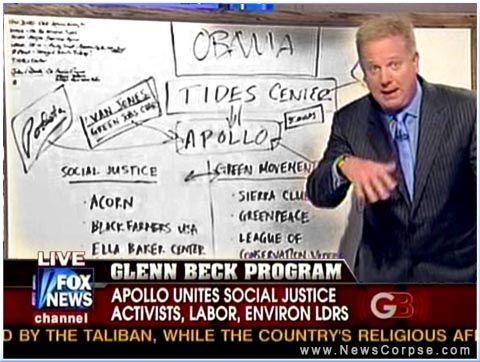
But DecodeDC's use of history in its inaugural episodes, is I think, symptomatic of at least one of the ways in which history is frequently referenced in contemporary American political discourse.  If one's goal is to "decode" or "decipher" American politics, one of the most popular methods of doing so is to reveal some (presumably obscure) fact from the past that will explain (or can be presented as explaining) why things are the way they are today.  In the case of DecodeDC, these reveals are pretty straightforward.  But this use of history comes in more baroque versions, too...such as Glenn Beck's infamous whiteboards.  In each case, one of the purposes of this use of history is simply to denaturalize the present: if something that we take for granted has a (quasi-secret) starting point, perhaps it can change in the future. In the more conspiratorial versions of this move, the genealogical reveal also shows a (quasi-surprising) person or force pulling the strings of the present from behind the scenes.


I've been thinking a lot about the role of history in politics (and vice versa) in light of the recent passing of Eugene Genovese, Eric Hobsbawm, and Henry May.  Though all three have been discussed on this blog, more attention has been given Genovese and May, presumably because, unlike Hobsbawm, they were Americanists.  Elsewhere online, however, Hobsbawm and Genovese seem to dominate the discussion. And what most clearly distinguishes them from May is that both were, more obviously and deeply than May, engagé historians, though the relationship between history and politics in their work was far more complicated than the history-as-code-ring we get from Andrea Seabrook (let alone Glenn Beck).

Both Genovese and Hobsbawm, of course, started their careers (and Hobsbawm ended his, as well) as Marxists.  Marxism provides a particularly rich theoretical connection between politics and history. And in the work of more sophisticated Marxist historians (a category that surely includes both Hobsbawm and the younger Genovese), the understanding of the historical record and of political theory mutually inform and shape each other.  Like its Hegelian predecessor, the Marxist understanding of history sees the possibility of reading the future out of the record of the past.  But for Hegel, unlike Marx, the future foretold by history was, essentially, the Prussian present. Leopold van Ranke, and the other German historians who helped create modern historical practice in the 19th-century, also tended to be politically conservative, essentially seeing history as proving that what is ought to be.

But for all of these thinkers, on the left and the right, history was complicated, though in an ordered way.  This complexity was preserved even when, on occasion, they engaged in a version of the decoding / debunking mode (I'm thinking, in particular, of The Invention of Tradition, which Hobsbawm co-edited).  Though history certainly involved recovering past things now forgotten, for history to be understood, let alone for it to serve a political purpose, it needed to be properly interpreted.   The job of the historian does not end at simply figuring out that Harold Stassen was the first person to say "Democrat Party."*

During my early years of graduate school, my fellow history students and I frequently told each other that much of what was wrong with American political life could be solved if only Americans could have a richer, more complicated understanding of history. I remember one student fantasizing that if historians were regularly invited on Oprah, they could totally transform the discourse on that show for the better. Another student, watching Reagan's farewell address with me during our first year in grad school, was simultaneously enraged and excited by Reagan's discussion of the importance of teaching history:  "we've got to teach history based not on what's in fashion but what's important."  Though he and I knew we didn't agree much with the President about the relationship between the "fashionable" and the important in history, we certainly shared his passion for teaching about the past...and his sense that teaching about the past could help mold the future.

While I continue to believe that doing (and teaching) history is important in many ways, including for our political life, I've long since lost the sense that simply doing good history is a panacea for the problems in our political culture.  To begin with, good history always has to compete with bad history. And though good history occasionally wins, bad history often has the political edge.  And simple history will almost always have an advantage over complicated history.  Invoking "Munich" (or "Vietnam") as codewords in a foreign policy debate is far easier than grappling with the complexity of European politics in 1938 or the American presence in Southeast Asia in the 1950s and 1960s.

However sympathetic one is (or isn't) with Hobsbawm's or Genovese's politics (and I imagine that few are sympathetic with both Genovese's youthful politics and the politics of Genovese's later years...though of course, Genovese managed the trick), it's hard not to conclude that their political understandings enriched their (and, by extension, our) understandings of the past.  Yet I think neither of them -- even Genovese, late in life, allied with a regnant conservatism -- had anywhere near as significant a political impact as an historiographical one.

____________________________________________________
* To be fair to DecodeDC, Seabrook does analyze Stassen's coinage, but in largely ahistorical terms. George Lakoff is the most important analytic voice in the podcast's second episode.

Minggu, 07 Oktober 2012

These Historians' Deaths


By Elisabeth Lasch-Quinn

Over the past few days I have followed, with so many others, the commentary on the lives of not one or two but an entire trio of eminent historians: Eugene Genovese, Eric Hobsbawm, and Henry May. I admire the care that has gone into reflections that have appeared elsewhere as well as on this blog, including those of Leo Ribuffo on Genovese, Andrew Hartman on Hobsbawm, and Ray Haberski on May. For myself, I can only offer something along the lines of a blogger's equivalent to a moment of silence in honor of their memory, and that of the others we have already lost from their remarkable generation.

I knew only one of these three men personally. Eugene Genovese's life was intertwined with my family's at key points, a story some readers here no doubt know much better than I, and for almost as long as I can remember, his name has been a household word. I met him when we moved to Rochester in 1970 and again a few years ago when he invited me to participate in the early planning meetings for the Historical Society, including a memorable one at the New York City apartment of intellectual historian John Patrick Diggins, who died in 2009.  After learning second hand over the intervening decades of Genovese's reputation as firebrand, which in other settings he of course earned, I found his tremendous personal warmth and charm truly disarming. And enlightening.

As Genovese goes from man to a legend to many, albeit one who has erred (is there any other kind, of either?), there is genuine pathos in this moment when a soldier--for he certainly fought passionately for causes he believed in--lays down sword and shield for the final time. His life is complete now, but perhaps it is my long-term awareness of him, directly and indirectly through his best written words, as in his amazing Roll, Jordan, Roll, as someone of such presence that makes it difficult for me to believe he can no longer be living--at least not yet.

Sabtu, 06 Oktober 2012

Thinking Historically about Historians

This blog has posted a few remembrances and considerations regarding the historians who died this past week.  One of our related blogs, HNN, has provided some great coverage of the lives and legacies of Eric Hobsbawm, and Eugene Genovese, but not, somewhat surprisingly, of Henry F. May. Reading across the short essays on Hobsbawm and Genovese it becomes clear that their ability to rally people (including historians) across the ideological spectrum had some influence on the level of coverage they received.  Hobsbawm inspired a vitriolic rebuke from Michael Burleigh and warm embraces from Niall Ferguson and Eric Foner; the latter two I imagine would be loathe to embrace each other.  Genovese elicited extended remarks from Robert George, the conservative Catholic political theorist at Princeton and the libertarian journal Reason.  Apparently, May did not inspire such diverse responses.

In my own training, I encountered these three historians in ways that mirror reactions to their deaths.  In my graduate training, the historian who taught Soviet history would ask us to take on Hobsbawm's analysis of Stalin and the historian of American foreign relations would ask us to defend Hobsbawm's account of the role of the United States in empire building.  The historian of antebellum America used Genovese as THE touchstone for historiographical debate over the world of American slaves and the historian who taught America in 1960s would discuss the personal-political trajectory of Genovese the man.

But Charles Alexander, my advisor and mentor in U.S. intellectual history, made us absorb every molecule of Henry F. May's two major books--both served as major questions on our comprehensive exams.  I have my copies of May's The End of American Innocence and The Enlightenment in America, with margin notes and underlining that reflect, as I show my students, the different ways I used the books as I moved from a first year graduate student to a budding historian writing his first book.  I still get a charge reading the first line of The End of American Innocence: "Everybody knows that at some point in the twentieth centuryAmerica went through a cultural revolution."  All of my work (and much of what we do on this blog) has been a investigation of that contention.  It was pretty much that line that made me want to write a book on how movies changed the idea of art and culture in twentieth century America. You can see May's entire book on line here.

I found professional inspiration for my aspirations in Joan Shelley Rubin's essay on May in Reviews in American History.  Rubin was, of course, another historian who had great influence on many of us in graduate school, and for me, she was a person I read to learn how to realize my aspirations of writing an work of history that was like May's.  In her 1990 essay, she wrote that May's book "retains...both emotional power and analytical significance.  On the most personal level, the book remains appealing because it captures and preserves figures and movements which seem, even now, exciting, creative, imbued with an energy and purpose I admire." Indeed, that sense of the immediacy of the history May related made many us realize that he, in 1959, had provided a way to use culture (as well as political and socio-economic motives) to explain any period.

For Charlie Alexander, though, there was also another reason to follow May very closely--May was an excellent writer.  So I conclude with a passage from the end of May's first chapter that simply gripped me. Even though he wrote it the late 1950s, his charge sounded like something intended for what I was about to begin:


"In the long run, I suppose, one’s attitude toward the beginning of the contemporary period depends on one’s prediction of its outcome.  Since my emotions about the current scene are divided, my interpretation of the past is divided also. It is not hard, retrospectively, to find the standard American culture of 1900 or 1912 seriously inadequate.  Neither intellectual or social orders are likely to be overthrown unless they are inadequate.  Yet revolution, and this kind of revolution in particular, has its cost.  I have tried to understand both conservatives and radicals.  My major purpose has been to show the size and complexity and some of the meanings of the change, and not to draw up a balance sheet of gains and losses.

If this book helps the reader to understand the revolution that got under way by 1917, it may make it easier for him to live through it, or even, in some small area, to influence its outcome.  I take it for granted that this culture revolution is still going on."


Jumat, 21 Oktober 2011

Opinions of Eric Hobsbawm?

Eric Hobsbawm
In Britain, nonagenarian Eric Hobsbawm has enjoyed something of a resurgence in the last few years as a commentator on the current economic climate. He seems to be saying that capitalism had it coming all along and finally everyone is recognizing what he already knew. But is he reliable in this analysis, given his support for Stalin long past most intellectuals dropped their support because of Stalin's ethnic cleansings?

I have had a soft spot for Eric Hobsbawm because his Nations and Nationalism was the first difficult history text in undergrad that I understood. I remember this as a kind of light bulb moment--there was a time when his text was completely inaccessible and then, after a little help from a great professor, I understood it.

I also liked the narrative scope of The Age of Extremes: The Short Twentieth Century, 1914-1991 and have thought about assigning it to undergrads. I sat in on a class in graduate school that read several histories of the twentieth century, and this one stuck in my mind as accessible and thought provoking. 

As I was contemplating putting the text on a syllabus for the job market, I ran across this heated 2009 article by Geoffrey Levy about Hobsbawm, dismissing his many books because of his opinion on Marxism and more particularly on Stalinism. It exposes how insipid my own "ahhhh, Hobsbawm has another book out, how cute" impulse is (I also read his autobiography for a class, which made him seem so much more like a personable character to me). Why does England venerate him as a great historian if he has long held these views on Stalin? Let me quote the beginning:

The Marxist historian who's crowing about the crash of capitalism and says Stalin was right to murder millions is demanding to see his MI5 files. Imagine how the KGB would have treated him!

The voice, though old and crackly, trembled with self-justification. 'Globalisation, which is implicit in capitalism,' it declared, 'not only destroys the heritage and tradition but is incredibly unstable...'

Imagine the pomposity and satisfaction with which Marxist historian Eric Hobsbawm, who lives in a large house in the fashionable North London suburb of Hampstead Heath, regurgitated his old argument to listeners of Radio 4's flagship Today programme.

In the current world crisis, who better for the BBC to exhume for its listeners than the West's greatest 20th-century apologist for Soviet communism and excuser of its totalitarian evils.
Professor Hobsbawm has been all over the airwaves since the credit crunch crisis began, crowing about capitalism's demise. But then, should one expect anything else from an intellectual who has never apologised for expressing his approval of Stalin's mass murders?
On our facebook page, James Livingston explained why he doesn't read or assign Hobsbawm:

I have long thought that Hobsbawm was both doctrinaire and derivative, which pretty much go together, anyway: mostly a bore, telling you what you already knew, with lots of footnotes or hurrumphing erudition. Among those canonical Brits of the 1970s, Christopher Hill and Raymond Williams were the key figures for me, because they were never boring--Hill writing a whole goddamn book on Milton in the English Revolution, Williams writing the most heartbreaking non-fiction book I've ever read, The Country and the City.

I'm always thinking about and with these folks because they were the writers I turned to in trying to understand early modern capitalism, back when I was doing Russian history, ugh. Hobsbawm was always the least interesting of them because he was always trying to prove that Marx was right about something, whatever it was. Everybody else had something else to prove
He has long thought this,
since reading The Age of Revolution in 1971, when I didn't know what it meant to be a Marxist, and thus had no intention of becoming one. 

Do American historians read Hobsbawm? I started out my professional life with a foot in European history, so I have perhaps more exposure to him than others, but I haven't read him in many years. What is your opinion of his work and his legitimacy as a public critic of contemporary capitalism?

Sabtu, 29 Januari 2011

The Neocon Take on the "New Class"


My most recent post on Daniel Bell, and how his form of thinking about the so-called "new class," brought comments, especially from Tim, asking for clarification. Here goes (briefly):

Out of their political repositioning in the late 1960s and 1970s, neoconservatives developed a critical theory (co-opted from anti-Stalinist thinking) about a so-called “new class” of intellectuals, broadly defined to include all professionals tasked with manipulating language—although more narrowly applied to humanists and social scientists. Members of this “new class,” so the theory went, had turned their backs on the society to which they owed their high-ranking status. A private memorandum written by Daniel Patrick Moynihan for his boss President Nixon in 1970 exemplified this withering mode of criticism: “No doubt there is a struggle going on in this country of the kind the Germans used to call a Kulturkampf. The adversary culture which dominates almost all channels of information transfer and opinion formation has never been stronger, and as best I can tell it has come near silencing the representatives of traditional America.”

The central reason the neoconservative “new class” theory was so plausible is because the university credential system had become the principal gateway to the professional world, a sorting mechanism for white-collar hierarchy. The numbers tell the story: in 1960, there were about 3.5 million Americans enrolled in universities; by 1970, this number had more than doubled to around 7.5 million, as the size of faculties grew proportionally. Historian James Livingston nicely relates this demographic explosion on the nation’s college campuses to the culture wars, or to what he generally describes as the “debates about the promise of American life.” “By the 1970s,” Livingston contends, “the principal residence of that promise was widely assumed to be the new ‘meritocracy’ enabled by universal access to higher education.” To this extent, class resentment aimed at intellectuals made sense, in a misplaced sort of way, since intellectuals indeed held the levers to any given individual’s future economic stability.*

----------------------
* See James Livingston, The World Turned Inside Out: American Thought and Culture at the End of the 20th Century (New York: Rowman and Littlefield, 2009). (Or my review of that book, and his response.) Eric Hobsbawm also relates the growing importance of a university education to the redirection of class resentment against “toffs of one kind or another—intellectuals, liberal elites, people who are putting it over on us.” Eric Hobsbawm, “Interview: World Distempers,” New Left Review 61 (Jan/Feb 2010), 135.

The Neocon Take on the "New Class"


My most recent post on Daniel Bell, and how his form of thinking about the so-called "new class," brought comments, especially from Tim, asking for clarification. Here goes (briefly):

Out of their political repositioning in the late 1960s and 1970s, neoconservatives developed a critical theory (co-opted from anti-Stalinist thinking) about a so-called “new class” of intellectuals, broadly defined to include all professionals tasked with manipulating language—although more narrowly applied to humanists and social scientists. Members of this “new class,” so the theory went, had turned their backs on the society to which they owed their high-ranking status. A private memorandum written by Daniel Patrick Moynihan for his boss President Nixon in 1970 exemplified this withering mode of criticism: “No doubt there is a struggle going on in this country of the kind the Germans used to call a Kulturkampf. The adversary culture which dominates almost all channels of information transfer and opinion formation has never been stronger, and as best I can tell it has come near silencing the representatives of traditional America.”

The central reason the neoconservative “new class” theory was so plausible is because the university credential system had become the principal gateway to the professional world, a sorting mechanism for white-collar hierarchy. The numbers tell the story: in 1960, there were about 3.5 million Americans enrolled in universities; by 1970, this number had more than doubled to around 7.5 million, as the size of faculties grew proportionally. Historian James Livingston nicely relates this demographic explosion on the nation’s college campuses to the culture wars, or to what he generally describes as the “debates about the promise of American life.” “By the 1970s,” Livingston contends, “the principal residence of that promise was widely assumed to be the new ‘meritocracy’ enabled by universal access to higher education.” To this extent, class resentment aimed at intellectuals made sense, in a misplaced sort of way, since intellectuals indeed held the levers to any given individual’s future economic stability.*

----------------------
* See James Livingston, The World Turned Inside Out: American Thought and Culture at the End of the 20th Century (New York: Rowman and Littlefield, 2009). (Or my review of that book, and his response.) Eric Hobsbawm also relates the growing importance of a university education to the redirection of class resentment against “toffs of one kind or another—intellectuals, liberal elites, people who are putting it over on us.” Eric Hobsbawm, “Interview: World Distempers,” New Left Review 61 (Jan/Feb 2010), 135.

Selasa, 02 November 2010

Hartman on Livingston


Review of James Livingston, The World Turned Inside Out: American Thought and Culture at the End of the 20th Century (New York: Rowman and Littlefield Publishers, Inc., 2010). ISBN-13: 978-0-7425-3541-1. 179 pages.

Review by Andrew Hartman
Illinois State University
November 2010

“Keep arguing.” James Livingston, 2010

Professor Livingston needn’t worry. His new book will keep people arguing. For The World Turned Inside Out is nothing if not maddeningly counterintuitive. Some of my friends and colleagues who have read it inform me that they agree with nothing in it. Of course, these same friends and colleagues also tell me they have never agreed with a single word Livingston has written. And yet, they keep reading. And they keep arguing.

In his first major contribution to intellectual history, Pragmatism and the Political Economy of Cultural Revolution, 1850-1940 (1994), Livingston argued against historians who made the Populists out to be history’s tragic, if fallen heroes, celebrated for their resistance to the corporate order. In contrast, Livingston marveled at the material surpluses offered by the new corporate order and, furthermore, contended that the emergence of corporations merited intellectual innovation in the eyes of pragmatists, especially John Dewey. “In the narrative form of pragmatism,” Livingston wrote, “the decline of proprietary capitalism loses its pathos, and the triumph of corporate capitalism appears as the first act of an unfinished comedy, not the residue of tragedy” (1994; xvi). Livingston thus inverted the historical trajectory posited by Christopher Lasch in his 1991 The True and Only Heaven: whereas Lasch understood “progress” to be mere ideological cover for the bureaucratic and technocratic constraints of the corporate order, Livingston pointed to the newfound freedoms made possible by that order. Unfortunately for us all, Lasch died in 1994, unable to respond to Livingston’s provocations.

In his next significant book, Pragmatism and Feminism: Rethinking the Politics of American History (2001), Livingston contended that the intellectual revolutions otherwise known as pragmatism and feminism were very similar in structure, largely because both were made possible by consumer capitalism’s obliteration of older bourgeois restraints. In opposition to most feminist theorists, especially those who framed their ideas in the Marxist tradition, Livingston theorized that feminism not only worked well alongside consumer capitalism, but that the latter created a context that allowed for the former. He wrote: “So if the cause (in both senses) of modern feminism is the extrication of women from an exclusive preoccupation with domestic roles—a process that both presupposes paid employment and permits the detachment of female sexuality from familial objects or reproductive functions—and if modern feminism is by definition a cross-class social movement because it claims to speak for all women, it would seem to follow that the necessary condition of modern feminism is the rise of corporate capitalism” (2001; 176). Somewhat ironically, Marxist theorist Nancy Fraser recently came around to this view, not to celebrate consumer capitalism, as Livingston, but rather, to critique second-wave feminism.

And now, in The World Turned Inside Out (2010), Livingston makes a whole series of counterintuitive claims that serve as an intellectual defense of consumer capitalism and the corporate order. Here are a few of his central points that should keep us arguing:

1. The left won the culture wars, and in fact, most political struggles since the 1960s.

2. Postmodernism and poststructuralism are American inventions, prefigured by pragmatism and other American intellectual revolutions.

3. Mass consumer culture (television, film, music) anticipated even the most radical forms of postmodern thinking, such as deconstruction.

4. All of these developments were good, and happened despite Livingston’s recognition that a spike in economic inequality caused the financial crisis of 2008.

This review will focus on Livingston’s first point, that the left has been largely victorious, since, more than the others, it will likely engender the most cognitive dissonance in those who lived through the past thirty years, when even the eight-year interruption to conservative rule, in the form of the Clinton administration, needs to be qualified by such pesky facts as Ross Perot, NAFTA, and Welfare Reform.

“The cultural and intellectual revolution that changed North America and the world after 1975,” Livingston writes, “was so successful—it was so formative, causative, and measurable—that we can take it for granted, and then look past it, to the point where some of us even argue that conservatism took over American thought and culture after 1980” (2010; xiii). At first glance, it seems Livingston is making an argument similar to that made by historian David Courtwright in his new book, No Right Turn: Conservative Politics in a Liberal America. Courtwright shows that where the cultural right failed, the economic right succeeded; where the Moral Majority and the Christian Coalition fell short in turning back the tides of secularism, the American Enterprise Institute and the U.S. Chamber of Commerce achieved lower taxes and fewer regulations. Courtwright’s thesis is that contemporary American life is dominated by both cultural and economic libertarianism, the twin legacies of the boomer generation. Like Courtwright, Livingston accentuates the cultural effects of “the fabled 1960s,” arguing “that the tendencies and sensibilities we associate with that moment decisively shaped intellectual agendas and cultural practices… in the 1980s and 1990s” (2010; xv).

But unlike Courtwright, Livingston thinks conservatives failed in the economic arena as well. In other words, the Reagan Revolution was not very revolutionary, at least, not in the sense we are accustomed to thinking about it. Livingston offers up as evidence the ineluctable growth of government, even its redistributive arm, which for him includes the military, a redistributive agency for the poor. Livingston says that an “unspoken socialism” became an entrenched national consensus, as transfer payments—“income received by households and individuals for which no contribution to current output of goods or services has been required”—“were the fastest-growing component of income in the late twentieth century, amounting, by 1999, to 20 percent of all labor income” (19). This is compelling stuff, though it requires a mild suspension of disbelief, since, in this instance, Livingston ignores that transfer payments likely increased in response to the loss of millions of well-paying unionized jobs. To this extent, deindustrialization better describes recent U.S. political economy than does socialism, and the growth of transfer payments should be understood as necessary to political stability in the face of growing inequality. At a more basic level, the fact of growing inequality calls into question the premise that the left is winning the national political battle. By what political spectrum does a society with a victorious left equate to an increasingly unequal one?

Livingston is on firmer ground when he limits the scope of his analysis to the culture wars. On this battleground, the left did much better, even if, again, Livingston overplays his hand. It is beyond doubt that the United States is now more tolerant than it was sixty years ago, when many more forms of discrimination were still legal, and that this tolerance led to conservative frustration in the culture wars. “Whatever the issue—whether sexuality, gay rights, reproduction, education, women’s rights, racial equity, equal opportunity, affirmative action, or freedom of expression—the domestic debate was… always lost by the so-called cultural conservatives who kept citing ‘family values.’” The key to Livingston’s point here lies in the recent history of the university, for, as he writes, “the New Left of the 1960s grew up and got jobs in all the right places, especially, but not only, in higher education” (20). In accentuating the importance of higher education, and in claiming that the left controls the “commanding heights” of the university, Livingston is rehashing conservative culture war contentions, most famously argued by Lynne Cheney, Dinesh D’Souza, Roger Kimball, and Allan Bloom. But whereas these right-wingers lamented left-wing academic hegemony, Livingston brags about it.

Livingston is certainly correct in asserting the centrality of the university to American society: the university credential system has become the principal gateway to the professional world, a sorting mechanism for white-collar hierarchy. The numbers tell the story: in 1960, there were about 3.5 million Americans enrolled in universities; by 1970, this number had more than doubled to around 7.5 million, as the size of faculties grew proportionally. Livingston nicely relates this demographic explosion on the nation’s college campuses to the culture wars, or to what he generally describes as the “debates about the promise of American life.” “By the 1970s,” Livingston writes, “the principal residence of that promise was widely assumed to be the new ‘meritocracy’ enabled by universal access to higher education” (21). To this extent, class resentment aimed at intellectuals—and tropes about “political correctness”—made sense, in a misplaced sort of way, since intellectuals indeed held the levers to any given individual’s future economic stability. Similarly, Eric Hobsbawm recently related the growing importance of a university education to the redirection of class animosity against “toffs of one kind or another—intellectuals, liberal elites, people who are putting it over on us.” But whereas Hobsbawm detects false consciousness in this rhetorical arrangement, Livingston, rather, implies there is truth in such charges since, by his estimation, the left did indeed control the university, the culture, and thus, the postindustrial, postmodern political system.

If Livingston is correct to place the university at the center of American cultural politics, he is mistaken to assert that the left controls the university. Of course cultural leftists gained positions of power in departments of English, American Studies, and to a lesser degree, history, sociology, and political science. But so what? This fact needs to be weighed against the ever-decreasing percentage of students who major in the disciplines of the humanities and the social sciences. What does it mean that leftists occupy English departments when the largest and fastest growing major is business? Furthermore, I am genuinely curious as to how Livingston would respond to the research conducted by Marc Bousquet and others that details how universities are increasingly organized as profit-making institutions that slash labor costs by replacing tenured faculty with adjuncts and graduate students. Reorganizing the university along the lines of a corporation that offers a product to consumers—to students and their tuition-paying parents—has lessened the impact of the university as a creator of culture, at least, of the type of culture I would call leftist.

Another less noticeable yet no less significant problem with Livingston’s postulation that the left won the culture wars is that he unintentionally repeats the vital centrist theory of American history: those who disagreed with the American consensus— whether it be the Cold War liberal consensus of the 1950s, or the postmodern cultural consensus of the 1990s—stand in the way of progress and, as such, deserve scorn and condescension. Just as Arthur Schlesinger, Jr. labeled both communists and right-wing isolationists dangerous reactionaries in 1949, Livingston implies that both modernist Marxists like Fredric Jameson and traditionalist conservatives like Robert Bork were atavistic remnants of a culture that had passed them by. While silly Marxists like Jameson persisted in anachronistically prioritizing material conditions over language, crazy conservatives like Bork made wild arguments about how the 1960s enshrined the radical individualism of the Declaration of Independence. Livingston ignores that both responses to the postmodern condition were no less innovative than, say, deconstruction. Take Bork, for instance. While his argument was undoubtedly strange coming from a notorious conservative figure, especially given its anti-American implications, it was also, paradoxically, straight out of the book of Nietzsche (though Nietzsche looked nihilism much more squarely in the face, and dated its modern beginnings to Christ not Jefferson).

One of Livingston’s problems is that he does not take conservatism very seriously. Following Roger Kimball, he claims that the culture wars were largely an “intramural sport on the left” (53). From my view, it goes without saying that conservatives were also deeply engaged in the culture wars. Think about Mississippi evangelical Donald Wildmon and his organization, the American Family Association, which coordinated protests against Andres Serrano’s Piss Christ and Martin Scorsese’s The Last Temptation of Christ. Also remember that it was the American Legion and other conservative veteran’s groups that derailed the Smithsonian’s proposed Enola Gay exhibit. The list goes on. Even in academia, where the “intramural sport on the left” characterization is most accurate, conservative culture warriors had their say, made evident by the critical and commercial success of such conservative missives as Allan Bloom’s The Closing of the American Mind, Dinesh D’Souza’s Illiberal Education, and Lynne Cheney’s non-ironically titled, Telling the Truth. Livingston mentions these thinkers only to brush them aside, and to conflate their worldview with anti-postmodernist thinkers such as Alan Sokol, the physicist who wrote a hoax article in 1996 for the journal Social Text to prove the bankruptcy of the entire postmodern project. Livingston writes of Sokol: “Like Mrs. Cheney, he believed in a fixed external reality governed by scientifically proven laws of motion and… he believed the academic Left had lost its way when it made the linguistic turn and decided, following Charles Peirce’s semiotic lead, that ‘matter is effete mind’” (51).

Livingston lumps Fredric Jameson together with the Sokols and Cheneys of the world, as equally conservative, even reactionary. But Livingston does not analyze Jameson’s work in any depth. This is unfortunate, because had he done so, he might have found a way to reconcile the contradictory claim that the left was winning the political struggle in spite of increasing inequality. Or not, which is perhaps the point. Livingston is correct that Jameson eschewed postmodern trends and continued to categorize reality and perception differently, particularly in his famous 1984 New Left Review essay, “Postmodernism, or, the Cultural Logic of Late Capitalism.” On the one hand, Jameson scoffed at the idea that social classes had disappeared in real terms, made evident by the “ever greater quantities of structurally unemployable subjects.” On the other, he understood why the perception that class no longer mattered resonated in a postmodern context, inasmuch as the new forms of capitalist organization had “flung workers in archaic factories out of work, displaced new kinds of industry to unexpected parts of the world, and recruited work forces different from the traditional ones in a variety of features, from gender to skill and nationality…” In this way, by bracketing off reality from perception, Jameson was pretty convincing, to me at least, in explaining the link between postmodern epistemologies and what he considered “pure” capitalist economic policies.

Livingston is absolutely right that there is no return from pragmatism, which he argues anticipated deconstruction at every level. Pragmatism (and deconstruction) endowed human beings with a history. In other words, pragmatism (and deconstruction) was a theoretical move that explained how humans could not have preceded the first attempt to understand humans, through the social use of language or signs. Livingston writes: “These propositions become downright threatening when you realize that they drive nails into the coffin of the modern individual… For it suggests that individuals are not somehow prior to any social contract or political community or linguistic convention… and that language is not the transparent medium of the truth-seeking capacity we call reason” (43). This is intoxicating stuff. But it still does not explain inequality, nor help us overcome it. For Jameson, such postmodern epistemologies made Sartre’s existentialist version of Marxism a tempting if flawed resolution. In the fanciful world of the postmodern, where political identities, like gender, were as fluid as performance, Jameson seemed to suggest that inventing a new leftist political subject, a necessary precondition of liberation from capital, would have been no less fanciful. Such a suggestion, however, did not create a way out of the postmodern condition so much as represent the hopelessness of the left. To me, Livingston’s book also represents such hopelessness in that, even in the so-called left-wing victory, inequality reigns supreme (not to mention war!)

This review only touches the surface of The World Turned Upside Down. The book includes several chapters on popular culture, one on American empire, and an appendix dedicated to analyzing the recent financial collapse. All of it is grist for the mill. Readers will find Livingston’s takes on mainstream films like Blade Runner and Robocop, “perhaps the two best movies of the 1980s” (61), alongside B-movies like the disgusting I Spit on Your Grave (recently remade!), equal parts fascinating and frustrating. Readers will either love or hate Livingston’s scatological exploration of South Park. Either way, if you pick up this book, you will not be bored. And you certainly will not stop arguing.