Tampilkan postingan dengan label Marxism. Tampilkan semua postingan

Sabtu, 22 Desember 2012

Is Obama Really Socialist?

Yes, he is.

From Peter Ferrara, at Forbers, "Is President Obama Really A Socialist? Let's Analyze Obamanomics":

President Obama says that income taxes must be raised on the rich because they don’t pay their fair share. The indisputable facts from official government sources say otherwise.

The CBO reports based on official IRS data that in 2009 the top 1% of income earners paid 39% of all federal income taxes, three times their share of income at 13%. Yet, the middle 20% of income earners, the true middle class, paid just 2.7% of total federal income taxes on net that year, while earning 15% of income. That means the top 1% paid almost 15 times as much in federal income taxes as the entire middle 20%, even though the middle 20% earned more income.

Moreover, the official data, as reported by CBO and the IRS, show that the bottom 40% of income earners, instead of paying some income taxes to support the federal government, were paid cash by the IRS equal to 10% of federal income taxes as a group on net.

Any normal person would say that such an income tax system is more than fair, or maybe that “the rich” pay more than their fair share. So why does President Obama keep saying that the rich do not pay their fair share? Is he ignorant? Wouldn’t somebody in his Administration whisper to him that he is peddling nonsense?

The answer is that to President Obama this is still not fair because he is a Marxist. To a Marxist, the fact that the top 1% earn more income than the bottom 99% is not fair, no matter how they earn it, fairly or not. So it is not fair unless more is taken from the top 1% until they are left only with what they “need,” as in any true communist system. Paying anything less is not their “fair” share. That is the only logical explanation of President Obama’s rhetoric, and it is 100% consistent with his own published background.

Notice that Obama keeps saying that “the rich,” a crass term implying low class social envy, don’t “need” the Bush tax cuts. That is reminiscent of the fundamental Marxist principle, “From each according to his ability, to each according to his need.”

Good tax policy is not guided by “need.” It is guided by what is needed to establish the incentives to maximize economic growth. The middle class, working people and the poor are benefited far more by economic growth than by redistribution. That is shown by the entire 20th century, where the standard of living of American workers increased by more than 7 times, through sustained, rapid economic growth.

But President Obama’s tax policy of increasing all tax rates on savings and investment will work exactly contrary to such economic growth. It is savings and investment which creates jobs and increases productivity and wages. Under capitalism, capital and labor are complementary, not adversarial, exactly contrary to the misunderstanding of Marxists. More capital investment increases the demand for labor, bidding up wages to the level of worker productivity, which is enhanced by the capital investment.
Continue reading.

FLASHBACK: See Jonah Goldberg, at Commentary in 2010, "What Kind of Socialist Is Barack Obama?" There are a lot of different terms at stake here. Ferrara explicitly places Obama's consistent redistributionism within the Marxian class-struggle paradigm. Goldberg sees Obama more in terms of the stagnant European variety of democratic socialism. Personally my sense is that the only thing holding Obama back from a truly Marxist public-ownership-of-the means-of-production model are the enormous liberty restraints in the American constitutional system and political order. Obama knows this, of course. He knows that the left must chip away at these liberty restraints piecemeal to bring about the socialist utopia. You bore through the institutions over the long haul, and it's working. The monstrous ObamaCare health collectivization is the tip of the iceberg. The November reelection provides the chance for Democrats to consolidate their gains and push FORWARD toward the communist future! More than ever before, it's all about class warfare and raising taxes, and the president barely hides his disdain for the free market anymore. It's really a lot.

PREVIOUSLY: "Ushangi Davitashvili Kisses Bust of Soviet Dictator Josef Stalin."

Kamis, 13 Desember 2012

First Rule of Defeating Leftists: Don't Call Them 'Liberals'

I'm 41 posted an excellent entry the other day, "The Blogger’s Rules For Defeating Liberals."

However, I cringed with all the references to "liberals." These goons are not "liberal." They're progressive collectivists (as the most hardened of them self-identify) or, frankly, simply radical leftists.

Zilla has more:
I can’t stand to see them called “liberals” because there is nothing “liberal” about them. Words matter, as they say. Call ‘em what they really are: LEFTISTS. The edit to the [blog] title is from me, because I don’t want to see the freaks called by their preferred misnomer at any place that I have editorial control over.
When referring to "liberals," the proper meaning makes reference to those early thinkers evoking the ideology of individual liberty and limited government, most importantly John Locke, Thomas Jefferson, and Adam Smith. The Democrat Party until roughly John F. Kennedy espoused a form of "modern liberalism" that by default drew on America's constitutional foundations in liberty but increasingly sought an expanded role for the state in promoting economic equality and social welfare. Yet, the left today is almost completely unrecognizable from the Cold War liberalism of Kennedy and Harry Truman. Today's left is a quasi-Marxist, state-collectivist ideological apparatus, intent to delegitimize private property and wealth accumulation and to elevate extreme ethnic tribalism as the blunt cudgel of radical redistributionist class warfare. President Obama is the chief class warrior and national divider in this mode, the perfect vessel of the vengeful fever swamp ghouls of the Democrat Party.

Zilla might not even be this charitable, although that's the pretty well-understood ideological bastardization of "liberalism" over the last couple of generations. Today's leftists are the Orwellian zombies who spout tolerance but practice extreme racism, anti-Semitism and viewpoint intolerance. These ghouls preach "peace" and "respect" as the highest principles but instead practice union thuggery and anti-speech bullying and lawfare as standard operating procedures. And more than ever, the left phantasmagorically operates under a false consciousness of objective lies as progressive truth. The "tent trutherism" coming out of Lansing is just the latest manifestation, but President Obama's 2012 campaign will perhaps be remembered by traditional historians as the most dishonest (and morally reprobate) in post-modern history, marked especially by a media empire in service to state power, with journalists effectively functioning as party apparatchiks for the endlessly voracious tax-and-spend regime of the soul-crushing collectivist machine.

That's why people should simply refuse to call these people "liberals." They are precisely the opposite of the great classical liberals, and are indeed the very kinds of tyrants for which the latter developed theories to frustrate, prevent, and destroy.

Minggu, 09 Desember 2012

Nelson Mandela Outed as Communist Party Member After Decades of Denial

Of course he was a Communist. They always lie about their true affiliations. Progressives always lie about their ultimate aims. Their entire ideological program is predicated on deception and propaganda. That's just how these people work.

At Telegraph UK, "Nelson Mandela 'proven' to be a member of the Communist Party after decades of denial":
A new book claims that, 50 years after he was first accused of being a Communist, Nelson Mandela was a Communist party member after all.
Frederik de Klerk with Nelson Mandela

For decades, it was one of the enduring disputes of South Africa's anti-apartheid struggle. Was Nelson Mandela, the leader of the African National Congress, really a secret Communist, as the white-only government of the time alleged? Or, as he claimed during the infamous 1963 trial that saw him jailed for life, was it simply a smear to discredit him in a world riven by Cold War tensions?

Now, nearly half a century after the court case that made him the world's best-known prisoner of conscience, a new book claims that whatever the wider injustice perpetrated, the apartheid-era prosecutors were indeed right on one question: Mr Mandela was a Communist party member after all.

The former South African president, who won the Nobel Peace Prize in 1993, has always denied being a member of the South African branch of the movement, which mounted an armed campaign of guerrilla resistance along with the ANC.

But research by a British historian, Professor Stephen Ellis, has unearthed fresh evidence that during his early years as an activist, Mr Mandela did hold senior rank in the South African Communist Party, or SACP. He says Mr Mandela joined the SACP to enlist the help of the Communist superpowers for the ANC's campaign of armed resistance to white rule.

His book also provides fresh detail on how the ANC's military wing had bomb-making lessons from the IRA, and intelligence training from the East German Stasi, which it used to carry out brutal interrogations of suspected "spies" at secret prison camps.
There's lots more at that top link.

Photo Credit: Wikimedia Commons.

Sabtu, 08 Desember 2012

Supreme Court Sets Stage for Historic Ruling on Homosexual Marriage

David Savage's analysis, at the Los Angeles Times, "Supreme Court to rule on Prop. 8 ban on gay marriage":
WASHINGTON — The Supreme Court set the stage Friday for a historic decision on gay rights, announcing it would hear appeals of rulings striking down California's Proposition 8 and the federal law denying benefits for legally married same-sex couples.

The court could decide in the Proposition 8 case whether the Constitution's promise of equal treatment gives gays and lesbians a right to marry. But the justices also left themselves the option to rule narrowly or even to duck a decision.

In 2008, California voters approved the measure limiting marriage to a man and a woman. Last year, the U.S. 9th Circuit Court of Appeals said the proposition had illegally taken away a right to marry that gays had won in the state courts.

This 9th Circuit decision, though limited to California, was the first by federal judges to reject a state's marriage law.

Ted Olson and David Boies, two nationally prominent attorneys who launched the legal attack on Proposition 8, served notice they would seek a broad ruling national in scope at a time when public opinion has turned in favor of gay marriage rights.

"We are going to address all the issues, focused on the fundamental constitutional right to marry of all citizens," Olson said Friday.

"We ought to have marriage equality as a constitutional right everywhere," Boies added.

They maintained they were not concerned that the decision to hear the case puts in jeopardy their court victory for California gays who wish to marry. If the justices had simply turned down the appeal, gay marriage would have once again been legal in the state.

John Eastman, a California law professor and chairman of the National Organization for Marriage, which supports traditional marriage, saw the court's announcement as a sign that Proposition 8 would be upheld. If so, gay marriage would remain illegal in California, barring another voter initiative.

"It's a strong signal that the justices are concerned with the rogue rulings that have come out of San Francisco. We believe the U.S. Supreme Court will overturn this exercise in judicial activism," said Eastman, a former clerk to Justice Clarence Thomas.
I don't know. I'm skeptical about that, as I noted earlier.

But continue reading in any case.

Sabtu, 01 Desember 2012

We're All Abortionists Now!

An awesome piece, from Ellis Washington at WND, "UNDER OBAMACARE, WE'RE ALL ABORTIONISTS NOW!":
Regarding the approval of the Obamacare individual mandate by the Supreme Court June 28, in a Volokh Conspiracy blog entry by Nick Rosenkranz, “Constitutional Law after Obamacare,” there was an insightful comment by a reader named “Wolfwalker” who wrote: “[M]ost of the legal community is a bunch of fascists who have lost all respect for the Constitution much like the federal government itself. Mr. Rosenkranz, I can write your speech in two sentences: The decision upholding Obamacare is the worst decision issued by any Supreme Court since Dred Scott v. Sanford. It renders all constitutional limits on federal powers completely meaningless.”

Wolfwalker’s comment on Mr. Rosenkranz’s blog is the most astute and succinct synopsis I’ve yet read on Obamacare, both from a constitutional and historical perspective.

Indeed, Obamacare renders all constitutional limits on federal powers completely meaningless. “And there’s the rub,” as Shakespeare would say. Obamacare demonstrates to all America the tyrannical, fascist power President Obama and the Democratic Socialist Party is willing to wield like a cudgel to smash the God-given, unalienable rights of the people. By the Supreme Court unconstitutionally acquiescing to Obamacare, all Americans are shackled “under the despotism of an oligarchy,” as Jefferson wrote in an 1820 letter to William Jarvis.

For example, religious rebellion to the Obama administration’s abortion/contraception mandate have achieved new life after the U.S. Supreme Court ordered a federal appeals judge to review a challenge to the health-care law by Liberty, a Christian university.

The 4th U.S. Circuit Court of Appeals previously dismissed Liberty University’s challenge to the law’s individual and employer insurance mandates, including the tyrannous mandate by the Department of Health and Human Services that employee health insurance cover contraceptives, abortion-inducing drugs, sterilization drugs and abortions. This prompted Liberty University’s appeal to the Supreme Court; however, the Court dismissed the appeal when it issued its controversial decision upholding Obamacare in June.

Liberty University’s case against Obamacare was given renewed vigor by the high court Monday (Nov. 26) when it granted the school a new hearing, ordering the 4th Circuit to reassess the case Liberty University v. Geithner in reply to a new appeal. Liberty filed after the June decision. Liberty Counsel, a nonprofit legal services organization representing the Virginia university, believes that these latest legal developments renews the religious challenge to Obamacare, probably sending the question to the Supreme Court for hearing during its 2013 term.

Mat Staver, Liberty Counsel founder, chairman and dean of Liberty University’s law school, said, “Today’s ruling breathes new life into our challenge to Obamacare. Our fight against Obamacare is far from over.

“Congress exceeded its power by forcing every employer to provide federally mandated insurance,” Staver continued. “But even more shocking is the abortion mandate, which collides with religious freedom and the rights of conscience.”

At least 35 Christian universities and businesses have filed suits challenging the health-care mandates, including Louisiana College, Houston Baptist University and East Texas Baptist University. The Southern Baptist Ethics & Religious Liberty Commission joined the legal fight in October, signing a friend-of-the-court (amicus curiae) brief in support of a joint challenge by evangelical Wheaton College in suburban Chicago and the Roman Catholic Belmont Abbey College in North Carolina. The ERLC was among 11 evangelical groups signing the brief filed by the Christian Legal Society in support of the Wheaton and Belmont Abbey appeal. Others suing the federal government over Obamacare include Christian publisher Tyndale House, Priests for Life, Hobby Lobby and the EWTN Catholic television and radio network....

If Obamacare and its unconstitutional individual mandate becomes the law of the land, then President Obama and the Democratic Socialist Party would have succeeded in achieving his 100-plus-year progressive dream of perverting and deconstructing America’s republic; to in essence make all Americans slaves to a Marxist, socialist government. This atheistic, Leviathan state will then have de jure and de facto control over every birth, life and death decision for over 320 million people. However, most galling of all to me is that Obamacare has effectively made all Americans (including Jews, Christians and all religious people of faith) co-conspirators of the abortion industry’s machinery of death. Under Obamacare, we are all abortionists now!

Jumat, 30 November 2012

Campaign for America's Future, Top Democrat Activist Group, Launches Class-Warfare Website

In a stunning embrace of political terminology normally associated with political polarization and vile anti-Americanism, top Democrat Party activists, led by long time progressive leader Robert Borosage, have launched an initiative to push economic warfare against conservatives and Republicans. Aaron Klein reports, at WND, "Democrat Operatives Launch Class-Warfare Website":

Robert Borosage
A George Soros-funded radical think tank with close ties to the Democratic Party has launched a new website urging politicians and activists to wage class warfare while hailing what it calls a new era in politics – the use of class warfare to win elections.

WageClassWar.org was launched last week by the Campaign for America’s Future, or CAF.

CAF’s co-director, Robert Borosage, explained the need for such a website.

“America’s growing diversity and its increasingly socially liberal attitudes played a big role in this election. But looking back, we are likely to see this as the first of the class warfare elections of our new Gilded Age of extreme inequality,” he wrote in a statement.

“More and more of our elections going forward will feature class warfare – only this time with the middle class fighting back. And candidates are going to have to be clear about which side they are on,” he wrote.

Continued Borosage: “In 2012, candidates who supported the economic interests of the many over the few won their elections. Populism was the voice, but economic opportunity was the message. The pundits may wring their hands, but in the future it won’t be values voters, angry white men or soccer moms that win elections. It will be class war.”

The website does not feature a mission statement and is unclear about exactly how the group will go about attempting to wage class warfare.

The site explains how Obama’s 2012 campaign utilized class warfare and set the stage for the deployment of such tactics in future elections.
Continue reading Klein's report here.

But readers can go right to the website, which features Borosage's introductory exhortation for the progressive class-warfare agenda, "Waging Class War":
Needless to say, Obama is neither by temperament nor predilection a populist class warrior. But faced with potential defeat, he turned to what works. The depths of the Obama presidency came in the summer of 2011 after the debt ceiling debacle, in which the president was roughed up by Tea Party zealots, and emerged looking weak and ineffective.

Obama came back by deciding to stop seeking back-room compromises with people intent on destroying him and to start making his case. In the fall, he put out the American Jobs Act and stumped across the country demanding that Republicans vote on it. His standing in the polls began to rise. Then Occupy Wall Street exploded, driving America’s extreme inequality and rigged system into the debate. In December, the president embraced the frame: He traveled to Osawatomie, Kansas, revisiting a campaign stop Teddy Roosevelt had made in the first Gilded Age. He indicted the “you’re on your own” economics of Republicans while arguing that “this is a make-or-break moment for the middle class, and for all those who are fighting to get into the middle class.”

In the run-up to the election, the president’s campaign employed two basic strategies. First, the president consolidated his own coalition. He defended contraception and pay equity while his campaign attacked the Republican “war on women.” He reached out to Hispanics by ending the threat of deportation for the Dream kids. He not only ended “don’t ask, don’t tell,” but also moved to embrace gay marriage. Widely described as socially liberal measures, these were also profoundly bread-and-butter concerns. Could women choose when to have children? Could Hispanic children be free to pursue the American dream? Could gay people gain the economic benefits of marriage?

At the same time, the president’s campaign made a risky but remarkably successful decision. Their opinion research showed that painting Romney as a flip-flopper had little traction, but the attacks on vulture capitalism hit home. They decided to spend big money early in such key states as Ohio on a negative ad barrage defining Romney as the heartless vulture capitalist from Bain. Both campaigns believe that Romney never recovered.
And the conclusion to Borosage's declaration of war:
More and more of our elections going forward will feature class warfare — only this time with the middle class fighting back. And candidates are going to have to be clear about which side they are on. Politicians in both parties are now hearing CEOs telling them that it is time for a deal that cuts Medicare and Social Security benefits in exchange for tax reform that lowers rates and closes loopholes. Before they take that advice, they might just want to look over their shoulders at what will be coming at them.
This is very useful, for it puts the lie to the left's own words that this president was going to heal the country's divisions and govern as a post-partisan leader amid the emergence of transcendent progressive benevolence. There have been so many lies over the last few years, but this is one of the biggest, now actually embraced by top Democrats as a badge of honor and a program to destroy the enemy.

This is also useful as a reminder of just how far left the mainstream of the Democrat Party has moved. Here's the Borosage entry at Discover the Networks:
A former New Left radical and onetime Director of the Institute for Policy Studies (IPS), Robert Borosage co-founded (with Roger Hickey) both the Campaign for America’s Future and the Institute for America’s Future. He also founded and currently chairs the Progressive Majority Political Action Committee, the activist arm of a political networking organization whose aim is to help elect as many leftist political leaders as possible. In addition, he is a contributing editor at The Nation magazine and a regular contributor to The American Prospect.

Borosage attended Yale Law School and earned a graduate degree in International Affairs from George Washington University. In 1974 he established the Center for National Security Studies, a civil rights / civil liberties organization that regularly accuses the CIA and the FBI of rampant abuses.

From 1979 to 1988 Borosage was Director of the Institute for Policy Studies. In 1988 he left IPS to work on Jesse Jackson’s presidential campaign, for which he served as a speechwriter and an assistant in framing responses to policy issues.

Borosage also has worked for such political figures as Senators Paul Wellstone, Barbara Boxer, and Carol Moseley-Braun.

In 1989 Borosage founded the Campaign for New Priorities, which called for decreased federal spending on the military and greater allocations for social welfare programs.

In 1996 Borosage and Roger Hickey co-founded the Campaign for America's Future (CAF), and three years later they established a sister organization, the Institute for America's Future (IAF).

Each year, CAF holds a “Take Back America” conference which the organization describes as “a catalyst for building the infrastructure to ensure that the voice of the progressive majority is heard.” Speaking at one such event in Los Angeles in June 2001, Borosage characterized President George W. Bush’s policies as a mélange of “tax cuts for the wealthy,” “arsenic in the water,” and “salmonella in the food”....

In a November 2002 L.A. Weekly article, The Nation editor David Corn quoted what Borosage had said backstage during a recent anti-war rally sponsored by International A.N.S.W.E.R. According to Corn, Borosage stated: "This [rally] is easy to dismiss as the radical fringe, but it holds the potential for a larger movement down the road…. History shows that protests are organized first by militant, radical fringe parties and then get taken over by more centrist voices as the movement grows. They provide a vessel for people who want to protest."
Backstage at an A.N.S.W.E.R. rally? International ANSWER is the residual protest arm of the Stalinist World Workers Party. It's been on the leading edge of the most radical left wing agitation since the early George W. Bush administration. There are all kinds of interlocking ties between groups like this and the mainstream of the Democrat Party, although President Obama and institutional Democrats have long attempted to mainstream their activities and distance themselves from the revolutionary shock troops.

Here's more background, on the founding contingents of the Campaign for America's Future:
Approximately 130 people played a role in co-founding the Campaign for America's Future (CAF) in 1996. Among these individuals were: Mary Frances Berry, Julian Bond, Heather Booth, Robert Borosage (co-founder), John Cavanagh, Richard Cloward, Jeff Cohen, Ken Cook, Peter Dreier, Barbara Ehrenreich, Betty Friedan, Todd Gitlin, Heidi Hartmann, Tom Hayden, Denis Hayes, Roger Hickey (co-founder), Patricia Ireland, Jesse Jackson, Joseph Lowery, Steve Max, Gerald McEntee, Harold Meyerson, Frances Fox Piven, Robert Reich, Mark Ritchie, Arlie Schardt, Susan Shaer, Andrew Stern, John Sweeney, and Richard Trumka. To view the full list of co-founders, click here.
It's also useful to troll around over at the CAF website, where one finds Borosage agitating on the current fiscal cliff negotiations, "The Grand Betrayal":
The battle lines are being drawn. The AFL-CIO, SEIU and AFSCME have announced labor’s opposition to cuts in entitlement programs and to continued tax cuts for the rich. Groups representing the base of the Democratic Party—from African-Americans to Latinos, women and the young—are lining up around a four-point program calling for jobs first; protecting Medicare, Medicaid and Social Security; letting the top-end Bush tax cuts expire; and protecting programs for the vulnerable.

Reaching no deal is preferable to a bad one that cuts entitlements. Going over the so-called fiscal cliff is perilous, but probably preferable to a bargain under the terms currently in play. With no agreement, the Bush tax cuts would expire. In January the Senate would immediately push to revive the lower rates for everyone but the top 2 percent. Republicans could vote for tax cuts, but rates at the top would rise. The automatic spending cuts would not kick in immediately (although the stock market might feel the hit quickly). But the thing to remember about failure to reach a deal before January is that Medicare, Social Security and many programs for the most vulnerable are shielded from the cuts. And the new Congress would likely act rapidly to reverse the cuts to military and domestic spending. The already faltering recovery would surely weaken, threatening the loss of more jobs. But that might force Congress to address the real crisis—jobs and growth—rather than court a ruinous austerity.

Whatever the outcome, the battle is likely to be only the first skirmish of a defining struggle over the future of the Democratic Party and the progressive movement. We’ve just had what might be called the first of a new era of class-warfare elections. The plutocracy ran one of their own, on their agenda and with their money. The American people’s rejection of Mitt Romney, despite the lousy economy, demonstrated the declining appeal of the conservative, trickle-down agenda. The budget debate will draw battle lines within the Democratic Party, between the Wall Street–dominated New Democratic wing and the progressive wing fighting for the change this country desperately needs.

We are headed into a new era of upheaval. Our money-soaked politics may suffocate growing demands for change. But if Democratic legislators join the president in a grand betrayal, they may witness a powerful Tea Party movement from the left, as Republican legislators have from the right.
Well, the battle lines are being drawn alright.

But remember, as Rush Limbaugh warned, the politics of the fiscal cliff aren't really about fiscal policy. They're about destroying the Republican Party. This Wage Class War initiative just comes right out in the open with it, which is good. Let's not pretend that Americans are one country with a few minor differences on the margins. We're indeed in a political war for the survival of the America that we grew up with, one, in my lifetime, marked by decency in overcoming oppression, and in expanding political and economic opportunity to growing numbers. But progressives don't care about any of that. They have been taken over by the most radical elements of the '60s counter-culture and New Left revolutionary cadres. These are Marxist-Leninists in suits. Their man is now in office for a second term after having bludgeoned the so-called political embodiment of corporate power, GOP nominee Mitt Romney --- a man who was wholly unprepared for the onslaught of progressive blood libel and demonization that was thrown down throughout the campaign.

So conservatives can just suck it up and man the ramparts for the battles that are coming. The left's isn't even pretending to hide its program of fundamental transformation of the country, enunciated so well and violently by top Democrat Party hack Robert Borosage and his fellow subversives of the progressive movement.

Sabtu, 24 November 2012

Ideological Discrimination at University of Iowa Law School

At The TaxProf, "Jurors Agree: University of Iowa Law School Discriminated Against Faculty Applicant Due to Her Conservative Views" (via Memeorandum):
Following up on my previous posts (links below) about Teresa Wagner's federal lawsuit: Des Monies Register, Jurors Say They Saw Hiring Bias at University of Iowa; But University, Not Former Law Dean, Wronged Conservative Job Applicant:
A federal jury believed the University of Iowa’s law school illegally denied a promotion to a conservative Republican because of her politics, former jurors told The Des Moines Register.

However, jurors said they felt conflicted about holding a former dean personally responsible for the bias. They wanted to hold the school itself accountable, but federal law does not recognize political discrimination by institutions. “I will say that everyone in that jury room believed that she had been discriminated against,” said Davenport resident Carol Tracy, the jury forewoman.

Meanwhile, attorneys for Teresa Wagner on Tuesday filed a motion for a new trial in the case that scholars agree could have national implications in what some argue is the liberally slanted world of academia.
Des Moines Register editorial: U of I Needs to Respect Diversity of Thought, Too: The Claim of Political Bias in Hiring at the Law School Should Not End with the Deadlocked Jury...
Continue reading.

Hey, when you go after bias at the universities, you're hammering away at the enemy's beachhead of Marxist cultural power and ideological indoctrination.

More at Volokh, "Jurors in Bias Case Believe University of Iowa Engaged in Ideological Discrimination."

Kamis, 25 Oktober 2012

Why Did Obama Run Left?

From Stanley Kurtz, at National Review:
Let the pre-criminations begin! Clive Crook asks why on earth Obama ceded the center to Mitt Romney by running a class-warfare-based campaign. Crook sees Obama as a centrist mysteriously cowed by his party’s leftist base. I think we can clear this mystery up. Obama ran a leftist class-warfare campaign because…well, he’s a leftist class-warrior.
QED.

But read the whole thing.

Selasa, 23 Oktober 2012

A List of Marxist Historians?


Guest post by Kurt Newman.

I am grateful to Andrew Hartman for extending me an invitation to run a query by the readers of the US Intellectual History blog. My name is Kurt Newman. I’m a graduate student in US history at the University of California Santa Barbara.


The query is this. If we were to assemble a list of Marxist historians of the United States, with the provision that we limit such a list to people who are both alive and active, what would the result look like? If we were willing to risk the scorn that might be legitimately inspired by asking an additional stupid question—what would happen if we were to narrow our search to people who could be described as American historians of the United States—would we learn anything interesting about the domestic historical profession?


Under ordinary circumstances, one might have to argue for the relevance of such an inquiry. A list of Marxist historians? From one perspective (let’s say, that of David Horowitz or Lynne Cheney): aren’t all academics in the humanities Marxists? From another (the dominant strain of thinking among the contemporary intelligentsia): didn’t Marxism more or less fade away with the fall of the Soviet Union? (At the margins, there are certainly some Cold War-haunted souls who might feel that discussing such things in public could only serve to invite several varieties of danger. They might even be right!)


The recent passing of Eric Hobsbawm and Eugene Genovese, however, forced many writers otherwise dismissive of the project of historical materialism, to recall that Marxism was for many years an extraordinarily generative force within historiography. Whatever the objections to the interpretive tendencies or personal choices of Hobsbawm and Genovese, no one could deny their authorial skill and influence, nor question their capacity to ask interesting questions. Could the same be said for historians under the influence of any other putatively discredited philosophy?  

As a graduate student who both studies the history of the United States and identifies as a Marxist,  I wonder (although without much angst or anxiety) whether Marxism is currently a tendency with much influence within the contemporary historical profession, particularly in regard to the study of the history of the United States. In light of the manifold failures of neoclassical economics and the crisis in liberal political science, in addition to the escalating popular rejection of balanced-budget conservatism, austerity, and the assault on unions, I think that a Marxist renaissance in US history is both possible and urgently needed. Whether such a revival is likely leads us back to the old Gramsci line about optimism and pessimism and intellects and wills, however that goes. Without a more coherent historicizing of the Marxist legacy in US history, though, it is hard to imagine how such a revival might be initiated.

Without wishing to unduly influence the results, I nevertheless cannot resist the temptation to append a final note. Stemming from my continuing fascination with the work of James Livingston­­—whose engagementwith Marxism strikes me as unusually rigorous, incorporating, for example, Marx’s “two-sector reproduction scheme” from Capital, Volume II in his reading of the paired emergence of corporate capitalism and pragmatic philosophy-- I have been trying to keep track of the specific articulation of Marxist theory in the work of various historians. While I think that any comprehensive list of working Marxist US historians should include all scholars who acknowledge a debt to Marx, including those for whom Marx and the Western Marxist tradition form part, but not all, of their theoretical frameworks (to be honest, it is hard to imagine that anyone who would bother to identify as a Marxist in 2012 would not be open to the influence of a wide variety of perspectives within social and political theory), and those for whom Marxism serves as a general ethical inspiration or source of foundations that propel archival work, rather than a Talmudic enterprise, I am also interested in thinking comparatively about the ways in which historians of the US make use of Marx. In other words, what does it mean, methodologically or polemically, to be a Marxist historian of the US?

I look forward to whatever answers readers and contributors might feel compelled to post. Even in the event of silence and indifference—both perfectly legitimate responses, of course!—I will be able to move forward with my research on this topic with a surer sense of the state of the field. So, thanks in advance for your help.

Senin, 08 Oktober 2012

Stray Thoughts on History and Politics

Former NPR reporter Andrea Seabrook recently debuted a new podcast called "DecodeDC" that promises to "decipher Washington's Byzantine language and procedure, sweeping away what doesn't matter so you can focus on what does."  So far, at least, it's a solid piece of work, worth listening to if you're interested in politics and have fifteen minutes or so to spare.  But what struck me about the first two episodes (all that have appeared so far) is that each begins with history.  Episode 1, House of (mis)Representatives, concerns the enormous number of people represented by each Congressperson today, and the political problems that arise as a result.  Why are there so few members of Congress for a nation of our size?  The answer (probably well known to readers of this blog) is that, after frequently increasing its size during its decennial reapportionment process as the nation grew, Congress froze its membership at 435 in 1911 and it's essentially stayed there ever since, while the country has grown from 92 million to 308 million people.  Episode 2, Mind Control, concerns the (non-rational) use of language as a political tool.  It starts with a history of the Republican habit of calling the Democratic Party "the Democrat Party."  Relying on an old William Safire column, Seabrook credits Harold Stassen with coining the term while working for Wendell Willkie's presidential campaign in 1940. After starting with history, each episode quickly moves on to other things. DecodeDC isn't about history, after all.  The second episode, in particular, doesn't make much out of the particular origins of the "Democrat Party."

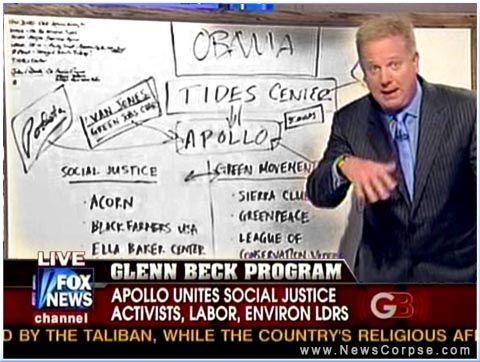
But DecodeDC's use of history in its inaugural episodes, is I think, symptomatic of at least one of the ways in which history is frequently referenced in contemporary American political discourse.  If one's goal is to "decode" or "decipher" American politics, one of the most popular methods of doing so is to reveal some (presumably obscure) fact from the past that will explain (or can be presented as explaining) why things are the way they are today.  In the case of DecodeDC, these reveals are pretty straightforward.  But this use of history comes in more baroque versions, too...such as Glenn Beck's infamous whiteboards.  In each case, one of the purposes of this use of history is simply to denaturalize the present: if something that we take for granted has a (quasi-secret) starting point, perhaps it can change in the future. In the more conspiratorial versions of this move, the genealogical reveal also shows a (quasi-surprising) person or force pulling the strings of the present from behind the scenes.


I've been thinking a lot about the role of history in politics (and vice versa) in light of the recent passing of Eugene Genovese, Eric Hobsbawm, and Henry May.  Though all three have been discussed on this blog, more attention has been given Genovese and May, presumably because, unlike Hobsbawm, they were Americanists.  Elsewhere online, however, Hobsbawm and Genovese seem to dominate the discussion. And what most clearly distinguishes them from May is that both were, more obviously and deeply than May, engagé historians, though the relationship between history and politics in their work was far more complicated than the history-as-code-ring we get from Andrea Seabrook (let alone Glenn Beck).

Both Genovese and Hobsbawm, of course, started their careers (and Hobsbawm ended his, as well) as Marxists.  Marxism provides a particularly rich theoretical connection between politics and history. And in the work of more sophisticated Marxist historians (a category that surely includes both Hobsbawm and the younger Genovese), the understanding of the historical record and of political theory mutually inform and shape each other.  Like its Hegelian predecessor, the Marxist understanding of history sees the possibility of reading the future out of the record of the past.  But for Hegel, unlike Marx, the future foretold by history was, essentially, the Prussian present. Leopold van Ranke, and the other German historians who helped create modern historical practice in the 19th-century, also tended to be politically conservative, essentially seeing history as proving that what is ought to be.

But for all of these thinkers, on the left and the right, history was complicated, though in an ordered way.  This complexity was preserved even when, on occasion, they engaged in a version of the decoding / debunking mode (I'm thinking, in particular, of The Invention of Tradition, which Hobsbawm co-edited).  Though history certainly involved recovering past things now forgotten, for history to be understood, let alone for it to serve a political purpose, it needed to be properly interpreted.   The job of the historian does not end at simply figuring out that Harold Stassen was the first person to say "Democrat Party."*

During my early years of graduate school, my fellow history students and I frequently told each other that much of what was wrong with American political life could be solved if only Americans could have a richer, more complicated understanding of history. I remember one student fantasizing that if historians were regularly invited on Oprah, they could totally transform the discourse on that show for the better. Another student, watching Reagan's farewell address with me during our first year in grad school, was simultaneously enraged and excited by Reagan's discussion of the importance of teaching history:  "we've got to teach history based not on what's in fashion but what's important."  Though he and I knew we didn't agree much with the President about the relationship between the "fashionable" and the important in history, we certainly shared his passion for teaching about the past...and his sense that teaching about the past could help mold the future.

While I continue to believe that doing (and teaching) history is important in many ways, including for our political life, I've long since lost the sense that simply doing good history is a panacea for the problems in our political culture.  To begin with, good history always has to compete with bad history. And though good history occasionally wins, bad history often has the political edge.  And simple history will almost always have an advantage over complicated history.  Invoking "Munich" (or "Vietnam") as codewords in a foreign policy debate is far easier than grappling with the complexity of European politics in 1938 or the American presence in Southeast Asia in the 1950s and 1960s.

However sympathetic one is (or isn't) with Hobsbawm's or Genovese's politics (and I imagine that few are sympathetic with both Genovese's youthful politics and the politics of Genovese's later years...though of course, Genovese managed the trick), it's hard not to conclude that their political understandings enriched their (and, by extension, our) understandings of the past.  Yet I think neither of them -- even Genovese, late in life, allied with a regnant conservatism -- had anywhere near as significant a political impact as an historiographical one.

____________________________________________________
* To be fair to DecodeDC, Seabrook does analyze Stassen's coinage, but in largely ahistorical terms. George Lakoff is the most important analytic voice in the podcast's second episode.

Minggu, 07 Oktober 2012

Crooked Timber's Chris Bertram is 'Very Sad' That Communist Historian Eric Hobsbawm Has Died

Chris Bertram is professor of philosophy at University of Bristol, in Southwest England. He's an expert on Rousseau, apparently, and, from what I gather, a fan of Karl Marx as well, or some variation of Marxism. Most interestingly, he's a defender of Joseph Stalin, or at least the Stalinist model of Soviet Communism, from what appears in the comments at his post at Crooked Timber, "Eric Hobsbawm is dead."

Perhaps he's just being playful, but Bertram's sense of humor is rather Stalinist as well:
Jonathan, ajay …

Annoying as our commenters often are, I’m not persuaded that it would less bad to murder them if there were more people around.
But especially interesting is Bertram's response to A.N. Wilson indictment of Hobsbawm at London's Daily Mail, "He hated Britain and excused Stalin's genocide. But was hero of the BBC and the Guardian, Eric Hobsbawm a TRAITOR too?"

Read that, and then Bertram's comment here:
That Daily Mail piece is truly marvellous. One of the upsides of the death of someone like Hobsbawm is that all the real arseholes are given an opportunity to remind us all what arseholes they are, and A.N. Wilson is no exception. The DM, of course, was rather partial to the Third Reich.
He doesn't dispute the facts in evidence regarding the Communist Hobsbawm. He simply, rather childishly, calls Wilson an asshole and the Daily Mail a Nazi organ.

Of course, this is Crooked Timber, an extreme left-wing academic blog, with contributors such as the socialist crank political scientist Henry Farrell, who I've blogged about many times. (Farrell got all butt-hurt when Glenn Beck singled out violent socialist Frances Fox Piven in his broadcasts a couple of years back.)

In any case, recall the comments from Bret Stephens' essay previously, "Eric Hobsbawm and the Details of History."

Contemporary leftists embrace their extremists and totalitarians, from the Occupy Movement to dictators like Fidel Castro. And for some, even Joseph Stalin wasn't too extreme. You simply cannot find comparable affinity to far-right extremism among today's conservatives in American politics. And it says something that it's the right that the mainstream press has attacked remorselessly this last few years as essentially white supremacists and Klansmen, while we have a president who was trained by Communist Party members and who palled around with Weather Underground terrorists in the radical leftist marination of Chicago's community organizing thug politics. All of these points are facts. The left has no problem with socialism and Communist Party politics --- for progressives and Democrat Party hacks, there are no enemies on the left, as I've long argued at this blog. Indeed, one of the lasting implications of the Obama interregnum will be the degree to which the extreme left ideological fringe has been mainstreamed in current political life.

Sabtu, 10 Desember 2011

Why We Need Intellectual History (An Ongoing Series)

From the "forum" section of today's Peoria Journal Star:
----------------------------------------------------------------
Many years ago the Marxists in Russia rioted against the czars. They killed them and their children, replacing them with Lenin, then Stalin and his terrible regime, slaughtering and imprisoning many.

Years later, Hitler wanted to take over Germany. He made the Jews his villains. Germans rioted and killed and distracted while he took over Germany.

Now the Marxists of our country, with the help of the president, are using the same tactics. Rioting against businesses, investors and the wealth that makes our country the best in the world.

They want all of us to be poor. Those in power become rich as they gradually tax away the wealth of the country.

G______ M_____

Lacon, IL

----------------------------------------------------------------

Is it still a violation of Godwin's Law if occurs in the forum section of a newspaper? - TL

Selasa, 13 September 2011

Crises of Capitalism


In this lecture put to animation by RSA Animate (one of several such brilliantly animated lectures done by RSA), David Harvey explains the economic crisis of 2008 in Marxist terms. This lecture is a synthesis of Harvey's 2010 book, The Enigma of Capital and the Crises of Capitalism, where he contends, among other things, that surplus capital generates problems that will turn into crises if not solved by innovations in capital accumulation. What is the basis of the current crisis? He writes:

Labour availability is no problem now for capital, and it has not been so for the last twenty-five years. But disempowered labour means low wages, and impoverished workers do not constitute a vibrant market. Persistent wage repression therefore poses the problem of lack of demand for the expanding output of capitalist corporations. One barrier to capital accumulation--the labor question--is overcome at the expense of creating another--lack of a market. So how could this second barrier be circumvented? The gap between what labour was earning and what it could spend was covered by the rise of the credit card industry and increasing indebtedness.

It hardly takes analytical imagination to understand how we got from there to the bursting of the housing bubble and the ensuing collapse of the banking system that financed it. My point here is not to say that Harvey's analysis (in this specific example) is necessarily unique. That good Keynesian Jim Livingston made a similar argument about how inequality (Harvey's "wage repression") created systemic problems (still) in need of correction. Rather, I wanted to draw attention to Harvey's work more generally, and gauge the level of familiarity or interest. I think he's one of the more lucid Marxists around (which I realize is not a large sampling).

I first read Harvey in graduate school when I was assigned The Condition of Postmodernity, which I found a brilliant combination of history, analysis, and critique. Harvey gave a total reading to an age in which total readings had supposedly been obliterated. I then quickly read some of his other books, which were more geographic or spatial explorations of capital, and also his A Brief History of Neoliberalism, which has done more to form my thinking on that topic than anything else.

I am currently reading The Enigma of Capital with my graduate students. It's a required "philosophy of history and historiography" course, and Harvey falls in the week after Marx on the syllabus. I wanted to show the students how a Marxian analysis might still apply to their world. The combination of Marx then Harvey works really well--at least, I hope it does, I'll find out more when I meet with students tomorrow night--because nobody is more familiar with Marx's Capital than Harvey. He's been teaching that text for decades. You can take the course on-line now!

Harvey integrates actual analysis from Capital into his contemporary analysis of capitalism's crises in ways that I find very convincing, or at the very least, thought provoking. Check out how Harvey quotes Marx extensively to convince his reader that the current crisis is an intensification of past processes inherent to capitalism. Here he talks about what happens when faith in credit, which is necessary to maintaining the smooth flow of capital, breaks down (Marx called credit a Protestant thing, because of the need for faith):

From time to time, however, the expectations become so excessive and the financing so profligate as to give rise to a distinctive financial crisis within the financial system itself. Marx provides a brief description in Capital: 'The bourgeois [read Wall Street], drunk with prosperity and arrogantly certain of himself, has just declared that money is a purely imaginary creation. Commodities [read as safe as houses] alone are money,' he said. 'But now the opposite cry resounds over the markets of the world: only money [read liquidity] is a commodity. As the hart pants over fresh water, so pants his soul after money, the only wealth. In a crisis the antithesis between commodities and their value form, money, is raised to the level of an absolute contradiction.' In the depth of that contradiction, expectations become riddled with fear (neither houses nor the Bank of England appear as safe as they were once presumed to be) and the financing becomes far too meagre to to support further accumulation.

I think this nicely sums up what happened in 2008, when the value of houses crumbled alongside the exotic financial products tied to them. The Marx quote is poetic, too, but that's not surprising coming from the first great poet of capitalism.