Tampilkan postingan dengan label popular history. Tampilkan semua postingan

Senin, 03 Desember 2012

Notes on the State of Thomas Jefferson

On the heels of a vigorous discussion of how best to tell the story of emancipation prompted by the November release of Steven Spielberg's Lincoln, an interesting debate on the legacy of Thomas Jefferson erupted online late last week.* While the Spielberg movie had clearly prompted the earlier discussion, the occasion for the Jefferson discussion was a bit more obscure, though all involved knew that Henry Wiencek's Master of the Mountain was somehow the cause of the dispute.

The foundation of this recent discussion about Jefferson seems to have been not Wiencek's book itself (which appeared back in October), nor even the controversies about the book, but rather a November 26 New York Times piece by Jennifer Schuessler about these controversies.

The Schuessler article does a somewhat better job conveying the heat of this dispute than casting light on what exactly is at stake.  Wiencek, an independent scholar, indicts Jefferson for his involvement with the institution of slavery and for his treatment of his slaves. While the book received some positive reviews, most academics have been very critical of it.  Wiencek, at least as portrayed by Schuessler, suggests that these scholars "inside the Jefferson bubble" are reflexively protecting the third president from criticism.  Meanwhile, Schuessler presents academic scholars as dismissive of Wiencek in part because he is not an academic.  What gets a bit buried in the article is that the criticism of Wiencek is largely that little in his book is new, and what is new isn't very convicing. Wiencek apparently argues that, in the middle of his life, Jefferson suddenly realized how profitable slavery was and promptly abandoned his previous objections to the institution (“It was all about the money,” Schuessler quotes Wiencek as saying. “By the 1790s, he saw [slaves] as capital assets and was literally counting the babies.”).  Historians seem to be particularly irked at Wiencek's attempts to cast all of his opponents as reflexive Jefferson defenders. I don't have a view of Master of the Mountain, which I haven't read. But Wiencek's suggestion that Annette Gordon-Reed is "inside the Jefferson bubble" is ridiculous. Gordon-Reed came to Jefferson studies as a complete outsider.  Her pathbreaking first book, Thomas Jefferson and Sally Hemings: An American Controversy, was a broadside directed against Jefferson's actual reflexive defenders.  
The nature of the controversy over Wiencek's book and of its coverage in the New York Times is worth noting in part because this week's online discussion of Jefferson, while centering on Wiencek's subject--Jefferson and slavery--has said relatively little about Wiencek and his book. The opening salvo seems to have been fired by Paul Finkelman, an academic legal historian and author of Slavery and the Founders: Race and Liberty in the Age of Jefferson.  Finkelman was quoted by Schuessler as a critic of Wiencek's claims of great originality.  As if to emphasize that his disagreements with Wiencek did not concern the negativity of Master of the Mountain's evaluation of Jefferson (nor, for that matter, the desirability of alliterative titles evoking the third president's home), last Saturday, December 1, Finkelman published an op-ed in the New York Times entitled "The Monster of Monticello," which argued that Jefferson was a "creepy, brutal hypocrite."  The main source of Finkelman's disagreement with Wiencek involves the latter's claim that Jefferson's devotion to slavery dated from the 1790s.  In fact, argues Finkelman, "Jefferson was always deeply committed to slavery, and even more deeply hostile to the welfare of blacks, slave or free."

David Post, a blogger at the conservative academic blog The Volokh Conspiracy and a Professor of Law at Temple and adjunct scholar at the Cato Institute, responded with hostility to Finkelman, accusing him of purveying "truly outrageous and pernicious and a-historical nonsense."

Much of the rest of the academic blogosphere followed with a series of posts agreeing wholeheartedly with Finkelman's indictment of Jefferson. For example, Corey Robin wrote a long post arguing that Jefferson's thought was a tributary of fascism (though he later emphasized that the connection between Jefferson and fascism was more related to his views on race than on slavery per se).  Scott Lemieux blogged for Finkelman and against Post on Lawyers, Guns and Money.  Yesterday, Kathleen Geier of the Washington Monthly's Political Animal blog noted the controversy.

Geier pointed out that negative views of Jefferson and his relationship to slavery have become much more mainstream than they were even in the very recent past.  I'd agree with this assessment and think that, in general, it reflects progress in scholars' coming to terms with Thomas Jefferson's life, thought, and legacy.

However, to me what stands out about this entire debate is how it violates a lot of our expectations when it comes to academic historians' forays into the public sphere.

Compare it, for example, to what I think is a much more stereotypical example of the form: the debate earlier this year over David Barton's The Jefferson Lies. As most readers of this blog know Barton, an evangelical Christian minister, popular historian, GOP activist, and favorite of the far right, enjoyed his national fifteen minutes of fame last year.  The publication of his Jefferson book, however, was greeted with lots of very effective scholarly pushback, eventually leading his publisher to pull all copies from distribution.

The controversy over Barton's The Jefferson Lies thus fulfilled a lot of what one might expect from a conflict between academic and non-academic history in the public sphere: a popular, ideologically-driven author attempted to pass fabrications off as history in order to defend a peculiar, hagiographical portrait of a Founding Father.  Academic historians effectively fact-checked him and manage to win the war...or at least the battle.

What's interesting about the more recent Jefferson scuffle is that the main divisions between the non-academic historian, Henry Wiencek, and his academic opponents are considerably more subtle.  Though some have tried to defend an idealized vision of Jefferson, the main conflict is between two negative portraits of him.  And the main areas of disagreement involve issues of interpretation (e.g. did Jefferson's attitudes toward slavery change in the 1790s?) and tone, rather than relatively simple issues of fact and honesty.  The result is an opportunity for a more complicated, but still largely negative, portrait of Jefferson-on-race to reach a broader public.  This is a good thing. But my guess is that the underlying debate over Wiencek's book is still rather mysterious for non-historians playing along at home.
________________________________
* I posted on the debates about Lincoln last Monday, which prompted a fascinating discussion in comments that I did not adequately respond to.  Ray then added a fascinating post on Hollywood history later in the week.  I plan to return to the questions raised in that conversation and in Ray's post, though I may not get to it until next Monday.

Senin, 08 Oktober 2012

Stray Thoughts on History and Politics

Former NPR reporter Andrea Seabrook recently debuted a new podcast called "DecodeDC" that promises to "decipher Washington's Byzantine language and procedure, sweeping away what doesn't matter so you can focus on what does."  So far, at least, it's a solid piece of work, worth listening to if you're interested in politics and have fifteen minutes or so to spare.  But what struck me about the first two episodes (all that have appeared so far) is that each begins with history.  Episode 1, House of (mis)Representatives, concerns the enormous number of people represented by each Congressperson today, and the political problems that arise as a result.  Why are there so few members of Congress for a nation of our size?  The answer (probably well known to readers of this blog) is that, after frequently increasing its size during its decennial reapportionment process as the nation grew, Congress froze its membership at 435 in 1911 and it's essentially stayed there ever since, while the country has grown from 92 million to 308 million people.  Episode 2, Mind Control, concerns the (non-rational) use of language as a political tool.  It starts with a history of the Republican habit of calling the Democratic Party "the Democrat Party."  Relying on an old William Safire column, Seabrook credits Harold Stassen with coining the term while working for Wendell Willkie's presidential campaign in 1940. After starting with history, each episode quickly moves on to other things. DecodeDC isn't about history, after all.  The second episode, in particular, doesn't make much out of the particular origins of the "Democrat Party."

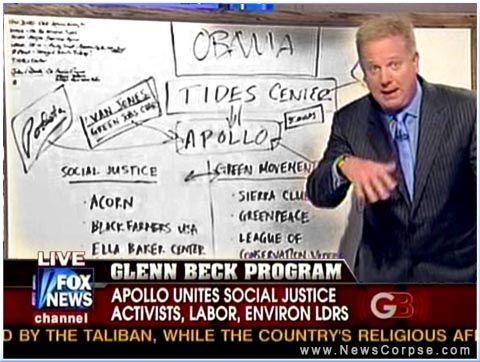
But DecodeDC's use of history in its inaugural episodes, is I think, symptomatic of at least one of the ways in which history is frequently referenced in contemporary American political discourse.  If one's goal is to "decode" or "decipher" American politics, one of the most popular methods of doing so is to reveal some (presumably obscure) fact from the past that will explain (or can be presented as explaining) why things are the way they are today.  In the case of DecodeDC, these reveals are pretty straightforward.  But this use of history comes in more baroque versions, too...such as Glenn Beck's infamous whiteboards.  In each case, one of the purposes of this use of history is simply to denaturalize the present: if something that we take for granted has a (quasi-secret) starting point, perhaps it can change in the future. In the more conspiratorial versions of this move, the genealogical reveal also shows a (quasi-surprising) person or force pulling the strings of the present from behind the scenes.


I've been thinking a lot about the role of history in politics (and vice versa) in light of the recent passing of Eugene Genovese, Eric Hobsbawm, and Henry May.  Though all three have been discussed on this blog, more attention has been given Genovese and May, presumably because, unlike Hobsbawm, they were Americanists.  Elsewhere online, however, Hobsbawm and Genovese seem to dominate the discussion. And what most clearly distinguishes them from May is that both were, more obviously and deeply than May, engagĂ© historians, though the relationship between history and politics in their work was far more complicated than the history-as-code-ring we get from Andrea Seabrook (let alone Glenn Beck).

Both Genovese and Hobsbawm, of course, started their careers (and Hobsbawm ended his, as well) as Marxists.  Marxism provides a particularly rich theoretical connection between politics and history. And in the work of more sophisticated Marxist historians (a category that surely includes both Hobsbawm and the younger Genovese), the understanding of the historical record and of political theory mutually inform and shape each other.  Like its Hegelian predecessor, the Marxist understanding of history sees the possibility of reading the future out of the record of the past.  But for Hegel, unlike Marx, the future foretold by history was, essentially, the Prussian present. Leopold van Ranke, and the other German historians who helped create modern historical practice in the 19th-century, also tended to be politically conservative, essentially seeing history as proving that what is ought to be.

But for all of these thinkers, on the left and the right, history was complicated, though in an ordered way.  This complexity was preserved even when, on occasion, they engaged in a version of the decoding / debunking mode (I'm thinking, in particular, of The Invention of Tradition, which Hobsbawm co-edited).  Though history certainly involved recovering past things now forgotten, for history to be understood, let alone for it to serve a political purpose, it needed to be properly interpreted.   The job of the historian does not end at simply figuring out that Harold Stassen was the first person to say "Democrat Party."*

During my early years of graduate school, my fellow history students and I frequently told each other that much of what was wrong with American political life could be solved if only Americans could have a richer, more complicated understanding of history. I remember one student fantasizing that if historians were regularly invited on Oprah, they could totally transform the discourse on that show for the better. Another student, watching Reagan's farewell address with me during our first year in grad school, was simultaneously enraged and excited by Reagan's discussion of the importance of teaching history:  "we've got to teach history based not on what's in fashion but what's important."  Though he and I knew we didn't agree much with the President about the relationship between the "fashionable" and the important in history, we certainly shared his passion for teaching about the past...and his sense that teaching about the past could help mold the future.

While I continue to believe that doing (and teaching) history is important in many ways, including for our political life, I've long since lost the sense that simply doing good history is a panacea for the problems in our political culture.  To begin with, good history always has to compete with bad history. And though good history occasionally wins, bad history often has the political edge.  And simple history will almost always have an advantage over complicated history.  Invoking "Munich" (or "Vietnam") as codewords in a foreign policy debate is far easier than grappling with the complexity of European politics in 1938 or the American presence in Southeast Asia in the 1950s and 1960s.

However sympathetic one is (or isn't) with Hobsbawm's or Genovese's politics (and I imagine that few are sympathetic with both Genovese's youthful politics and the politics of Genovese's later years...though of course, Genovese managed the trick), it's hard not to conclude that their political understandings enriched their (and, by extension, our) understandings of the past.  Yet I think neither of them -- even Genovese, late in life, allied with a regnant conservatism -- had anywhere near as significant a political impact as an historiographical one.

____________________________________________________
* To be fair to DecodeDC, Seabrook does analyze Stassen's coinage, but in largely ahistorical terms. George Lakoff is the most important analytic voice in the podcast's second episode.

Senin, 02 Juli 2012

Popular Analytic Philosophy?

Gavagai?
Jim Holt begins the latest post to the New York Times philosophy blog, The Stone, with the following questions:  "Is philosophy literature? Do people read philosophy for pleasure?"  His immediate answer is, I think, more or less correct, "Of course it is, and of course they do." What makes Holt's post (and the edited version of it that appeared in yesterday's print edition of the Times) more controversial and potentially interesting is his second set of questions: "Does anybody read analytic philosophy for pleasure? Is this kind of philosophy literature?"

But the rest of Holt's post confines itself to the second of these two questions, taking a definition from Evelyn Waugh of literature as "the right use of language irrespective of the subject or reason of utterance,” which Waugh further defined as involving "lucidity, elegance, and individuality."  Holt makes a perfectly fair case that at least some analytic philosophy is lucid, elegant, and individual, and thus (at least according to Waugh), literature.  Fair enough.

But does anyone, other than analytic philosophers, in fact read analytic philosophy for pleasure?  Holt's utter silence on this question is telling.


A few months ago, I blogged about the myth of the accessibility of academic history.  I don't think most academic history commands -- or need command -- a sizable non-academic audience.  To the extent that we expect or demand that it should, we do our field a disservice. Nevertheless, if the accessibility of academic history is a myth, it is a valuable one.  As I wrote then, "the notion that one should write as if one were addressing a literate, general audience helps historians counteract the tendency of academic discourses to get ever more abstruse and hermetic."

But if the popular market for academic history is frequently exaggerated, the popular market for analytic philosophy is entirely imaginary...which may account for the fact that Holt doesn't even attempt to answer his question about its existence.

Indeed, the reach of analytic philosophy within the academic world beyond the philosophy department is slight.  To take an example close to home: the failure of U.S. intellectual historians to grapple sufficiently with analytic philosophy, both as an object of historical study and as a potential font of theoretical insight, has been a fairly frequent topic of discussion at the U.S. Intellectual History Conference and on this blog.

It is telling that Holt follows his first set of questions (about philosophy in general) with a paragraph about actual, human behavior:

People savor the aphorisms of Nietzsche, the essays of Schopenhauer, the philosophical novels of Sartre. They read the dialogues of Plato (and they would doubtless read the dialogues of Aristotle too, had Western civilization not been so careless as to mislay them). Some even claim to enjoy the more daunting treatises in the philosophical canon. “When I have a leisure moment, you will generally find me curled up with Spinoza’s latest,” Bertie Wooster swankily announces in one of P.G. Wodehouse’s “Jeeves” novels.

But Holt gives analytic philosophy only a rather theoretical defense of its literary virtues.  It's hard not to see Jim Holt as simply changing the subject from the question of whether an audience exists for analytic philosophy to whether, at some abstract level, an audience ought to exist.

When it comes to literary qualities, Willard Quine is not Plato or Friedrich Nietzsche, but I don't think Holt has to prove that he is.  Those who've read, say, Word and Object, know that Quine could certainly turn a phrase and could write very clearly about complicated and potentially abstruse issues.  I have no problem whatsoever seeing Word and Object as a literary work (in Waugh's sense).

Yet, it is also true that very, very few people read Word and Object (which is one of the great classics of analytic epistemology, for what it's worth) outside philosophy classes.  And Quine is hardly even a household name.

Compare and contrast Quine to John Dewey.  Nobody, I think, has ever tried to make a case for Dewey as a prose stylist. Indeed, his turgid writing famously prompted Oliver Wendell Holmes to declare that Dewey wrote "as God would have spoken had He been inarticulate but keenly desirous to tell you how it was.”  And yet Dewey was a household name, with enormous intellectual purchase beyond philosophy and beyond the academy.  Indeed, plenty of philosophers who've enjoyed enormous influence and popularity have been difficult or even poor writers. Hegel and Heidegger are two examples that spring to mind.

Yes, people savor the literary qualities of well-written philosophy. But people read philosophy because they think they are going to learn something about "big questions": how the world is, how we understand the world, how to live a good life, how to identify (or bring about) a good society, and so forth.  I think people beyond philosophy departments remain interested in these questions. But, for decades, they generally haven't much been interested in the kind of answers that Anglo-American philosophy departments have given to them.  Why they haven't is an interesting question. But I suspect the problem has little to do with whether or not Saul Kripke, David Lewis, or John Searle are good prose stylists.

Senin, 09 April 2012

How -- And For Whom -- We Write

March 17. 1947: The Second-to-Last Time an Historian
Appeared on the Cover of Time**
Claire Potter of the blog Tenured Radical recently put up a very thoughtful post responding to AHA President Bill Cronon's column in last month's Perspectives on History.*  Both are worth reading.

Among other issues, Potter and Cronon both address what makes good historical writing good.  And both Cronon and Potter put a very heavy emphasis on the need to keep historical writing accessible to non-historians and even non-academics.  Here's Potter:

Sometimes scholars are not even accessible to each other, much less colleagues in related fields.  Conceptual categories that we take for granted but are obscure to non-professionals; overly-specialized or theoretical language, and “failing to notice the absence of those who don’t feel welcome” in an intellectually exclusive coterie are all weaknesses of practice that can emerge from qualities that are otherwise praiseworthy.
The result can be that despite popular enthusiasm for history, and the genuine desire of other historians to connect with our work, we run the risk of turning people off instead of tuning them in.
Without in any way diminishing the importance of this sentiment, I want to note how commonplace it is. Although in practice we might often honor it in the breach, the idea that historical writing ought to be broadly accessible is, I think, a core professional value held by most academic historians in the U.S. today.

Academic historians believe in broadly accessible historical writing for many of the reasons that Cronon lays out in his essay, which is entitled "Professional Boredom."  Citing, among other things, the History Channel, he notes that "no other academic discipline has done a better job of retaining a large public audience."   Moreover, Cronon adds that there are "essential contributions history can make to public understanding of all manner of problems in the present."  If we become too specialized or too boring, or even if we define professional history too narrowly, "the risks," writes Cronon, "could not be more clear."

I'm as much as a believer in broadly accessible history as Cronon or Potter.  And, lord knows, I'm not in favor of boring history (though I think we can all think of great works of history that are boring).  But the story we tell ourselves about academic history appealing to a mass audience is to a very great extent a myth.


Public interest in academic history is limited to a very small number of historians, generally writing on a small number of topics.  And most popular works of history are written by authors who are not academic historians. The current New York Times Combined Print and E-Book Nonfiction Best Seller List contains four works of history (broadly understood) among the top fifteen books, none of them written by an academic historian: Steve Jobs by Walter Isaacson at #7, Killing Lincoln by Bill O'Reilly and Martin Dougard at #8, Unbroken by Laura Hillenbrand at #10, and The Immortal Life of Henrietta Lacks by Rebecca Skloot at #13. No works by academic historians appear further down the list, either.

And most of us know from experience that, even if our books get noticed outside academic circles, most sell relatively few copies and find relatively small audiences.  If you've ever tried pitching an idea for a historical monograph to a non-academic press or a literary agent, you get an even stronger sense of how different the popular market for history is from the academic one.

Anyone who watches the History Channel with any regularity knows that the kind of content they specialize in is very different from the work that academic historians do.

In this regard, it's interesting to compare the academic discipline of history to such disciplines as English and philosophy.  There's actually huge popular interest in cultural criticism and philosophy, as the existence of E! (the cable network and website) and the voluminous "philosophy" section in any bookstore attest.  But academic English scholars and academic philosophers understand themselves as doing something fundamentally different from, respectively, E! and the Deepak Chopra-heavy "philosophy" section of most bookstores.  Academic historians, on the other hand, tend to see a variation of our own craft when we look at the History Channel or the New York Times Best Seller List.

And yet, this myth of the accessibility of academic history is, in many ways, a very productive one.  As I've already said, I value readability. And though few academic historians are writing books for audiences much beyond our subdisciplines, let alone beyond the academy, the notion that one should write as if one were addressing a literate, general audience helps historians counteract the tendency of academic discourses to get ever more abstruse and hermetic.  At least when I was in graduate school, many other disciplines seemed on occasion to put a positive value on their own abstruseness, presenting it as a sign of technical sophistication (e.g. philosophy and economics) or even their explicit opposition to negative values that they associated with readable texts (e.g. the literary disciplines).

But while I certainly want academic history to continue valuing clear, non-technical prose, I also think we should try to have a more realistic sense of who we reach and how we reach them. The myth of accessible academic history has its costs as well as its benefits.

To begin with, the myth of accessibility can devalue some of what academic historians do uniquely well.  We produce knowledge about the past regardless of whether there is a mass market for the knowledge we produce.  And since I don't believe that the mass market does a good job of determining what's worth knowing, I think we ought to moderate our polemics against specialization.  Many good ideas--even ideas that eventually have a profound impact on broad, public conversations--start in abstruse corners of academic work. Think, for example, of Kuhn and the idea of a "paradigm shift."

Secondly, if we are going to take seriously our role as interlocutors in larger, public debates, we shouldn't count on traditional academic publications to do so.  Academic historians frequently bemoan the fact that our nation's public conversations about history often leave much to be desired.  Clearer writing in our academic monographs, however valuable it is in and of itself, is not going to change this situation.

_________________________________________________

* I almost called Potter's post "very smart"; those who've read it will understand why I didn't!

** This conclusion based on a cursory online search of Time magazine covers; do not reproduce this thought in an academic work.

Senin, 27 Februari 2012

On Describing Today's Historical Ecosphere

We historians conventionally distinguish scholarly historical writing from popular historical writing.  The former is what those of us who write for this blog do professionally; the latter is what tends to appear on bestseller lists.  The very existence of popular historical writing distinguishes our field from many others in the humanities. These days, at least, there's precious little popular literary criticism for example (though popular cultural criticism certainly exists). And though bookstores are brimming with popular philosophy books, they bear virtually no resemblance to the work of academic philosophers.  In contrast, not only are there innumerable works of popular history, most academic historians (or, at least, the Americanists among us) like to think that our work is potentially of interest to a broader, non-academic audience.  Occasionally a handful of scholarly works, usually in the areas of military or political history, find a large (or at least largish) audience outside the Ivory Tower.  I'm thinking, for example, of Jim McPherson's Battle Cry of Freedom or Rick Perlstein's Before the Storm. Pulitzer Prizes in History often go to such works.

But more often, works of history that find their way to the best seller list are considerably less scholarly.  Take, for example, Hardball host Chris Matthews' Jack Kennedy: Elusive Hero, currently #33 on the New York Times Hardcover Non-Fiction Best Sellers List and the subject of a take-down by the historian David Greenberg in TNR [h/t Erik Loomis at LGM].  Vanity projects by pundits about presidents past seem to have emerged as a genre unto themselves.  At least as described by Greenberg, Matthews book seems little more than a projection of his own two-dimensional political personality onto JFK.*  

But what I found most interesting about Matthews' book was the list of people who have blurbed it.

As Greenberg notes, Jack Kennedy: Elusive Hero is marketed with praise from Douglas Brinkley, Walter Isaacson, Brian Williams, Peggy Noonan, and Doris Kearns Goodwin.  This is an interesting mix of people.  Noonan and Williams are fellow media personalities, who don't have any particular historical credentials. But the other three figures inhabit an intermediate zone between scholarly and popular approaches to history: semi-serious historians whose reputations have been built as mainstream public intellectuals.  The only academic among the three is Brinkley, though I think his reputation as a scholar is even more slight than Isaacson's or Goodwin's (despite the accusations of plagiarism against the latter).  Along with the once ubiquitous Michael Beschloss, Brinkley and Goodwin for years formed a kind of triumvirate of semi-official historical opinion on relatively serious network newscasts.  Each is also more closely tied to the political and financial elite than your average historian (popular or scholarly):  Goodwin was an assistant to LBJ and married Richard Goodwin, a more senior assistant to both JFK and LBJ.  Brinkley is a member of the Century Club and the Council on Foreign Relations.  Beschloss is married to a former treasurer and chief investment officer of the World Bank who runs a Washington, DC-based hedge fund.  Isaacson emerged out of the media, starting his career as a journalist, rising to be CEO of CNN in 2001 and President and CEO of the Aspen Institute in 2003.

What I find fascinating about these figures is the very complicated role they play in today's historical ecosphere. If you had to place their work on one side or the other of the popular / scholarly divide, they'd certainly be considered popular.  Yet their books--especially Goodwin's and Isaacson's--are taken seriously by serious people. They are certainly not in the same category of "historians" as, say, Glenn Beck or Chris Matthews. But they are often called upon to validate the seriousness and even the expertise of people like Matthews (if not Beck).  Indeed, Goodwin's blurb for Matthew's JFK book seems to leave David Greenberg somewhat flummoxed; he notes that she "surely cannot regard this as a meritorious book."

What all of this suggests to me is that the old scholarly / popular divide is too crude to describe the ways in which history is produced and consumed in the U.S. today.  I'm not going to attempt a more precise taxonomy in this blogpost. But I think establishing one would help us make better sense of things like the Tea Party's use of history, which have been recurring themes on this blog.

___________________________
* I needed to add somewhere the cover of Glenn Beck's book on George Washington, since it so nicely captures the actual focus of many of these sorts of projects:

Senin, 13 Juni 2011

Podcasting and (Intellectual) History

I'm a big fan of podcasts.  I listen to them while I cook, when I walk the dog, and sometimes as I'm falling asleep.  Over the years, the podcasts I've listened to regularly have changed, as I discover new ones and get bored with some former favorites.  The current roster of podcasts to which I subscribe includes some traditional radio shows, like This American Life (which my local NPR station plays) and To the Best of Our Knowledge (which it doesn't).  Many of the podcasts to which I listen reflect avocational interests of mine, from the Oklahoma City Thunder (Thunder Ground Radio and OKC Thundercast) to music (Sound Opinions) to comedy (WTF with Mark Maron and Jordan, Jesse GO!).  A few touch on topics of professional concern...though in not very professional ways (Filmspotting and The Partially Examined Life).

But one thing is notably missing from the embarrassingly extensive list of podcasts to which I subscribe (which includes many more than those already mentioned): history.  I've listened a few times to My History Can Beat Up Your Politics, a perfectly respectable podcast that explores current political issues through the lens of history, but I've never been moved to listen to it regularly   And I've yet to find a really compelling podcast focused on history, let alone on intellectual history. 

So this brief post is really a bleg:  what am I missing?  Are there any history podcasts out there that are essential listening? Especially given how well-developed the historical blogosphere has become, I'd be shocked if there aren't some really first-rate history podcasts.  But for some reason I've never run into any of them.

Podcasting and (Intellectual) History

I'm a big fan of podcasts.  I listen to them while I cook, when I walk the dog, and sometimes as I'm falling asleep.  Over the years, the podcasts I've listened to regularly have changed, as I discover new ones and get bored with some former favorites.  The current roster of podcasts to which I subscribe includes some traditional radio shows, like This American Life (which my local NPR station plays) and To the Best of Our Knowledge (which it doesn't).  Many of the podcasts to which I listen reflect avocational interests of mine, from the Oklahoma City Thunder (Thunder Ground Radio and OKC Thundercast) to music (Sound Opinions) to comedy (WTF with Mark Maron and Jordan, Jesse GO!).  A few touch on topics of professional concern...though in not very professional ways (Filmspotting and The Partially Examined Life).

But one thing is notably missing from the embarrassingly extensive list of podcasts to which I subscribe (which includes many more than those already mentioned): history.  I've listened a few times to My History Can Beat Up Your Politics, a perfectly respectable podcast that explores current political issues through the lens of history, but I've never been moved to listen to it regularly   And I've yet to find a really compelling podcast focused on history, let alone on intellectual history. 

So this brief post is really a bleg:  what am I missing?  Are there any history podcasts out there that are essential listening? Especially given how well-developed the historical blogosphere has become, I'd be shocked if there aren't some really first-rate history podcasts.  But for some reason I've never run into any of them.

Sabtu, 02 Januari 2010

The Metaphysical Club: Popular History?


I really should have read Louis Menand’s The Metaphysical Club: A Story of Ideas in America a long time ago. It's probably the most talked about work in U.S. intellectual history in decades. But it was published while I was in grad school, none of my professors assigned it, and then I moved onto a dissertation, which turned into my first book, and then after that a second book project. Both my published book and my book-in-progress are on different eras than that covered by Menand. (The Metaphysical Club covers the Civil War through WWI—my books cover the early cold war and post-1960s America, respectively). But over this winter break, I've had a little extra time, including jury duty, which allowed me many hours of reading. So I finally got around to reading it.

To be honest, another reason it took me so long to open Menand's book is because I was skeptical of it, due solely to its popularity and celebrity. I tend to instinctively avoid popular history books. I suppose I'm pessimistic that popular history books, or popular non-fiction books more generally, have much to offer other than appeals to the lowest common denominator, which, lets face it, is pretty low. I don't think I'm elitist. I enjoy all kinds of lowbrow movies (The Hangover being a recent example). I just don't like to waste my time reading crappy books, which I think tends to define most bestsellers. Most are closer to Sarah Palin's ghostwritten book Going Rogue, currently atop the New York Times bestseller list, than anything serious or smart. (Reviews of such books, on the other hand, can be quite enjoyable to read—check out Jonathan Raban's excellent one of Going Rogue in the recent New York Review of Books.)

The Metaphysical Club reached the bestseller lists. And it won the Pulitzer. It thus easily qualifies as popular history. And yet, most scholars have had nice things to say about it. For good reason. It's fantastic! Some critics have pointed out that Menard probably puts too much stock in the power of biography. He implies that Oliver Wendell Holmes, Jr., William James, and John Dewey—the central characters of a large and compelling cast of intellectuals—were uniquely capable of adjusting the nation's social thought to the post-Civil War, modernizing world. But Menard is convincing, even in making the case for the driving force of personality, because he is such a subtle chronicler of changing intellectual contexts. The way he connects the tissue of pragmatism to modernism, Darwinism, and most importantly, to the post-Civil War need to conceptualize authority without force, is skillfully done.

Other critics have argued that Menard's book is derivative. But even if it's true that the book is synthetic, this is hardly a serious complaint and smacks of professional jealousy. Just because Historians A and B first made original, disparate arguments doesn't mean that Historian C can't bring the two arguments together. Sometimes it's the synthesis that is the breakthrough. At the very least, Menard's beautifully lucid prose makes old analysis seem fresh, or it makes concrete the post-Cold War return to thinking about pragmatism.

I suppose my enjoyment of Menard should compel me to rethink my anti-popular history stance. It's not like I haven't enjoyed bestsellers or award winners in the past. Howard Zinn's A People's History of the United States, often criticized by academic historians for simplifying complex processes, or by judging history solely through a moralistic lens, convinced me that I wanted to be a historian (or teacher or activist) when I first read it 15 years ago. And it has sold over two million copies. And I absolutely love Martin Sherwin and Kai Bird's biography, American Prometheus: The Truth and Tragedy of J. Robert Oppenheimer, which has sold many copies and won the Pulitzer and various other awards. Plus, if one of my books ever becomes a bestseller, I certainly won’t complain.

I have another thought with regards to popular history. Is Menand's book as widely read as it is sold? Is it really popular history? I suspect that, rather, it is one of those intellectually fashionable books that people who want to be seen as intellectually fashionable buy but don't read, at least not cover-to-cover. Why do I suspect this? Mostly because, although Menand's writing is superb and clear, the material is complex, and the subject matter is not likely as riveting to the multitudes as it is to those of us who practice intellectual history. As an example, when Menand describes how statistics-driven thinking on probability helped shape the instrumentalist, process approach of pragmatism, the narrative does not exactly excite most, I imagine, to the same degree as a Stephen Ambrose description of storming Normandy, or some other heroic feat of war. To this extent, I place The Metaphysical Club alongside Allan Bloom's The Closing of the American Mind, which millions purchased, yet which millions can't have read cover-to-cover. The masses might have been drawn to Bloom's motif about how moral relativism is destroying knowledge—especially conservatives who enjoyed having their preconceptions confirmed by a famous University of Chicago philosopher—but I seriously doubt many Bloom fans actually delved into his close readings of Nietzsche, which even my most impressive students find obtuse.

In sum, has The Metaphysical Club joined The Closing of the American Mind in its propensity to collect dust on bookshelves across America? Am I crazy? My friend Varad Mehta, a European intellectual historian, pointed out to me that there is a difference between popular history as such, and rigorous, scholarly history that becomes popular. This is a good point, and if this distinction holds, Menand clearly falls into the latter category. Varad also historicized the problem by arguing that what we now consider serious intellectual work was once popular history—Gibbon and Hume, for example. Thus, in his eyes, it is us, professional historians, who have changed, and as such, it is we who are to blame for the gulf between popular and professional history. I agree with Varad’s historical point, but would argue that changed contexts mean different paradigms. Prior to the carving out of institutional space for the study of history, there was no distinction between popular and professional historical writing. There was just plain history. And Hume and Gibbon hardly wrote for the masses to the degree that Sarah Palin’s ghostwriter does.

I’m mostly interested in reader responses: Is The Metaphysical Club popular history? And if so, what does this mean?

The Metaphysical Club: Popular History?


I really should have read Louis Menand’s The Metaphysical Club: A Story of Ideas in America a long time ago. It's probably the most talked about work in U.S. intellectual history in decades. But it was published while I was in grad school, none of my professors assigned it, and then I moved onto a dissertation, which turned into my first book, and then after that a second book project. Both my published book and my book-in-progress are on different eras than that covered by Menand. (The Metaphysical Club covers the Civil War through WWI—my books cover the early cold war and post-1960s America, respectively). But over this winter break, I've had a little extra time, including jury duty, which allowed me many hours of reading. So I finally got around to reading it.

To be honest, another reason it took me so long to open Menand's book is because I was skeptical of it, due solely to its popularity and celebrity. I tend to instinctively avoid popular history books. I suppose I'm pessimistic that popular history books, or popular non-fiction books more generally, have much to offer other than appeals to the lowest common denominator, which, lets face it, is pretty low. I don't think I'm elitist. I enjoy all kinds of lowbrow movies (The Hangover being a recent example). I just don't like to waste my time reading crappy books, which I think tends to define most bestsellers. Most are closer to Sarah Palin's ghostwritten book Going Rogue, currently atop the New York Times bestseller list, than anything serious or smart. (Reviews of such books, on the other hand, can be quite enjoyable to read—check out Jonathan Raban's excellent one of Going Rogue in the recent New York Review of Books.)

The Metaphysical Club reached the bestseller lists. And it won the Pulitzer. It thus easily qualifies as popular history. And yet, most scholars have had nice things to say about it. For good reason. It's fantastic! Some critics have pointed out that Menard probably puts too much stock in the power of biography. He implies that Oliver Wendell Holmes, Jr., William James, and John Dewey—the central characters of a large and compelling cast of intellectuals—were uniquely capable of adjusting the nation's social thought to the post-Civil War, modernizing world. But Menard is convincing, even in making the case for the driving force of personality, because he is such a subtle chronicler of changing intellectual contexts. The way he connects the tissue of pragmatism to modernism, Darwinism, and most importantly, to the post-Civil War need to conceptualize authority without force, is skillfully done.

Other critics have argued that Menard's book is derivative. But even if it's true that the book is synthetic, this is hardly a serious complaint and smacks of professional jealousy. Just because Historians A and B first made original, disparate arguments doesn't mean that Historian C can't bring the two arguments together. Sometimes it's the synthesis that is the breakthrough. At the very least, Menard's beautifully lucid prose makes old analysis seem fresh, or it makes concrete the post-Cold War return to thinking about pragmatism.

I suppose my enjoyment of Menard should compel me to rethink my anti-popular history stance. It's not like I haven't enjoyed bestsellers or award winners in the past. Howard Zinn's A People's History of the United States, often criticized by academic historians for simplifying complex processes, or by judging history solely through a moralistic lens, convinced me that I wanted to be a historian (or teacher or activist) when I first read it 15 years ago. And it has sold over two million copies. And I absolutely love Martin Sherwin and Kai Bird's biography, American Prometheus: The Truth and Tragedy of J. Robert Oppenheimer, which has sold many copies and won the Pulitzer and various other awards. Plus, if one of my books ever becomes a bestseller, I certainly won’t complain.

I have another thought with regards to popular history. Is Menand's book as widely read as it is sold? Is it really popular history? I suspect that, rather, it is one of those intellectually fashionable books that people who want to be seen as intellectually fashionable buy but don't read, at least not cover-to-cover. Why do I suspect this? Mostly because, although Menand's writing is superb and clear, the material is complex, and the subject matter is not likely as riveting to the multitudes as it is to those of us who practice intellectual history. As an example, when Menand describes how statistics-driven thinking on probability helped shape the instrumentalist, process approach of pragmatism, the narrative does not exactly excite most, I imagine, to the same degree as a Stephen Ambrose description of storming Normandy, or some other heroic feat of war. To this extent, I place The Metaphysical Club alongside Allan Bloom's The Closing of the American Mind, which millions purchased, yet which millions can't have read cover-to-cover. The masses might have been drawn to Bloom's motif about how moral relativism is destroying knowledge—especially conservatives who enjoyed having their preconceptions confirmed by a famous University of Chicago philosopher—but I seriously doubt many Bloom fans actually delved into his close readings of Nietzsche, which even my most impressive students find obtuse.

In sum, has The Metaphysical Club joined The Closing of the American Mind in its propensity to collect dust on bookshelves across America? Am I crazy? My friend Varad Mehta, a European intellectual historian, pointed out to me that there is a difference between popular history as such, and rigorous, scholarly history that becomes popular. This is a good point, and if this distinction holds, Menand clearly falls into the latter category. Varad also historicized the problem by arguing that what we now consider serious intellectual work was once popular history—Gibbon and Hume, for example. Thus, in his eyes, it is us, professional historians, who have changed, and as such, it is we who are to blame for the gulf between popular and professional history. I agree with Varad’s historical point, but would argue that changed contexts mean different paradigms. Prior to the carving out of institutional space for the study of history, there was no distinction between popular and professional historical writing. There was just plain history. And Hume and Gibbon hardly wrote for the masses to the degree that Sarah Palin’s ghostwriter does.

I’m mostly interested in reader responses: Is The Metaphysical Club popular history? And if so, what does this mean?